Category
page 1History of the Manhattan Project

Atomic bombings of Hiroshima and Nagasaki
On 6 and 9 August 1945, the United States detonated two atomic bombs over the Japanese cities of Hiroshima and Nagasaki, respectively, during the final days of World War II. The aerial bombings killed 150,000 to 246,000 people, most of whom were civilians, and remain the first and only uses of nuclear weapons in an armed conflict.
In the final year of World War II, the Allies prepared for a costly invasion of the Japanese mainland. This undertaking was preceded by a conventional bombing and firebombing campaign that devastated 64 Japanese cities, including an operation on Tokyo. The war in Europe concluded when Germany surrendered on 8 May 1945, and the Allies turned their full attention to the Pacific War. By July 1945, the Allies' Manhattan Project had produced two types of atomic bombs: "Little Boy", an enriched uranium gun-type fission weapon, and "Fat Man", a plutonium implosion-type nuclear weapon. The 509th Composite Group of the U.S. Army Air Forces was trained and equipped with the specialized Silverplate version of the Boeing B-29 Superfortress, and deployed to Tinian in the Mariana Islands. The Allies called for the unconditional surrender of the Imperial Japanese Armed Forces in the Potsdam Declaration on 26 July 1945, the alternative being "prompt and utter destruction". The Japanese government ignored the ultimatum. Japan announced its surrender to the Allies on 15 August, six days after the bombing of Nagasaki and the Soviet Union's declaration of war against Japan and invasion of Manchuria. The Japanese government signed an instrument of surrender on 2 September, ending the war.

Manhattan Project
World War II American R&D program that produced the first nuclear weapons

Little Boy
US nuclear bomb

Fat Man
American nuclear bomb
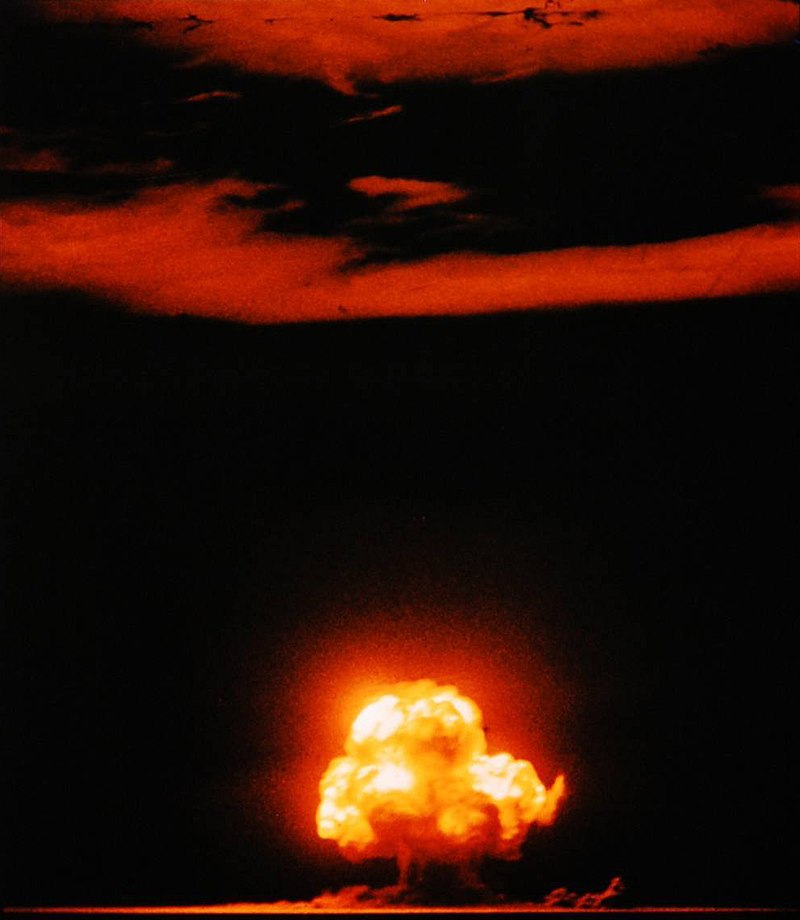
Trinity
1945 first detonation of a nuclear weapon
Einstein–Szilárd letter
letter by Leó Szilárd and Albert Einstein to US President Roosevelt in August 1939
Operation Crossroads
pair of nuclear weapon tests conducted by the United States at Bikini Atoll in mid-1946
USS Indianapolis
1931 Portland-class cruiser
Chicago Pile-1
world's first nuclear reactor to achieve criticality, part of the Manhattan Project, the Allied effort to create atomic bombs during World War II
Hanford Site
decommissioned nuclear production complex in Washington, United States
demon core
historical subcritical mass of plutonium
Alsos Mission
United States military operation of 1943-1945 to discover enemy scientific developments during World War II

calutron
thumb|alt=A man stands in front of a C-shaped object twice his size.|An Alpha calutron tank removed from the magnet for recovery of uranium-235
thumb|alt=A large oval-shaped structure|Alpha I magnet, called the "Racetrack". The calutrons are located around the ring.
Thin Man
type of nuclear weapon
Metallurgical Laboratory
former laboratory at the University of Chicago, part of the Manhattan Project
U-234
1943 Type X submarine
Pumpkin bomb
type of conventional high-explosive bomb ballistic simulator
Quebec Agreement
joint agreement between the United Kingdom and United States primarily for nuclear energy
X-10 Graphite Reactor
world's second artificial nuclear reactor and the first reactor designed and built for continuous operation
Project Y
secret laboratory established by the Manhattan Project
Smyth Report
First official account of the Manhattan Project and the Allied effort to develop atomic bombs during World War II written by physicist Henry DeWolf Smyth

Silverplate
thumb|upright=1.6|Bockscar, a Silverplate [[B-29 Superfortress of the 509th Composite Group, dropped an atomic bomb on Nagasaki ]]

Interim Committee
secret advisory group on nuclear energy
Clinton Engineer Works
Manhattan Project uranium enrichment facility
timeline of the Manhattan Project
US-fundraising research and development project
.jpg)
K-25
thumb|upright=1.3|The K-25 building of the Oak Ridge Gaseous Diffusion Plant aerial view, looking southeast. The mile-long building, in the shape of a "U", was completely demolished in 2013.

Project Alberta
section of the Manhattan Project, active 1945
S-1 Uranium Committee
Group that helped initiate the Manhattan Project
S-50
Manhattan Project uranium enrichment facility
Dayton Project

Atomic Energy Act of 1946
The Atomic Energy Act of 1946 (McMahon Act) determined how the United States would control and manage the nuclear technology it had jointly developed with its World War II allies, the United Kingdom and Canada
Montreal Laboratory
Physics laboratory
British contribution to the Manhattan Project
British contribution to the WWII atomic bomb project
Operation Peppermint
1944 US preparations to counter possible threats from Germany