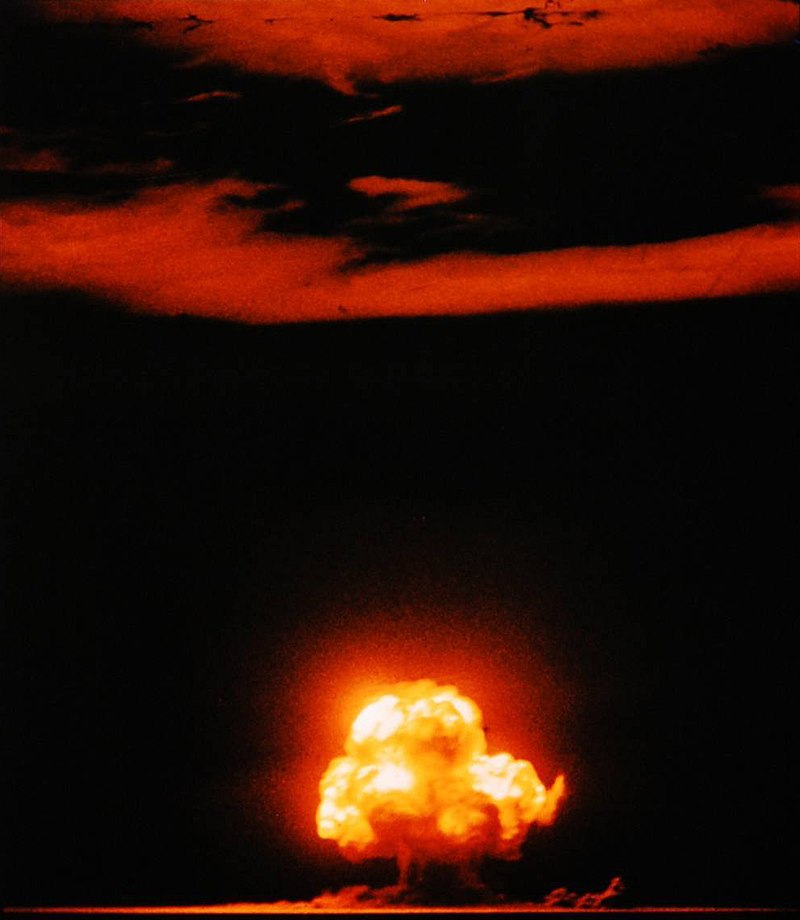
File:Trinity_shot_color.jpg · Wikimedia Commons · See Wikimedia Commons
Trinity
Sign in to saveAlso known as Trinity Test, The Trinity Test, Trinity test, Trinity nuclear test, Trinity Explosion
1945 first detonation of a nuclear weapon
Trinity was the code name for the first nuclear weapon ever detonated, which took place in 1945. It matters because it marked the beginning of the nuclear age and demonstrated the destructive power of atomic technology, fundamentally changing warfare and global politics.
AI-generated from the Wikipedia summary — may contain errors.
Wikidata facts
- Instance of
- nuclear weapons testing
- Part of
- Manhattan Project
- Country
- United States
- Located in
- New Mexico
- Operator
- United States
- Country of origin
- United States
- Followed by
- Operation Crossroads
- Designed by
- Manhattan Project
- Image
- Trinity Test Fireball 16ms.jpg
Show 9 more facts
- Commons category
- Trinity test
- Commons gallery
- Trinity test
- point in time
- 1945-07-16
- uses
- The Gadget
- product or material produced
- Trinitite
- explosive energy equivalent
- 18.6
- series ordinal
- 1
- different from
- Trinity
- code name
- Trinity
Sources (3)
via Wikidata · CC0
~40 min read
Encyclopedic overview
Trinity was the first detonation of a nuclear weapon, conducted by the United States Army at 5:29 a.m. Mountain War Time (11:29:21 GMT) on July 16, 1945, as part of the Manhattan Project. The test was of an implosion-design plutonium bomb, or "gadget" – the same design as the Fat Man bomb later detonated over Nagasaki, Japan, on August 9, 1945. Concerns about whether the complex Fat Man design would work led to a decision to conduct the first nuclear test. The code name "Trinity" was assigned by J. Robert Oppenheimer, the director of the Los Alamos Laboratory. The name was possibly inspired by the poetry of John Donne.
Planned and directed by Kenneth Bainbridge, the test was conducted in the Jornada del Muerto desert about 35 miles (56 km) southeast of Socorro, New Mexico, on what was the Alamogordo Bombing and Gunnery Range, but was renamed the White Sands Proving Ground just before the test. The only structures originally in the immediate vicinity were the McDonald Ranch House and its ancillary buildings, which scientists used as a laboratory for testing bomb components.
Excerpted from Wikipedia’s “Trinity” article, available under the CC BY-SA 4.0 licence.
Gallery (12)
On the map
2 mapped locations