Category
page 1Military vehicles introduced from 1940 to 1944

T-34
The T-34 is a Soviet medium tank from World War II. When introduced, its 76.2 mm (3 in) tank gun was more powerful than many of its contemporaries, and its 60-degree sloped armour provided good protection against anti-tank weapons. The T-34 had a profound effect on the conflict on the Eastern Front, and had a long-lasting impact on tank design. The tank was praised by German generals when encountered during Operation Barbarossa, although its armour and armament were surpassed later in the war. Its main strength was its cost and production time, meaning that German panzer forces would

Tiger I
1942 heavy tank family
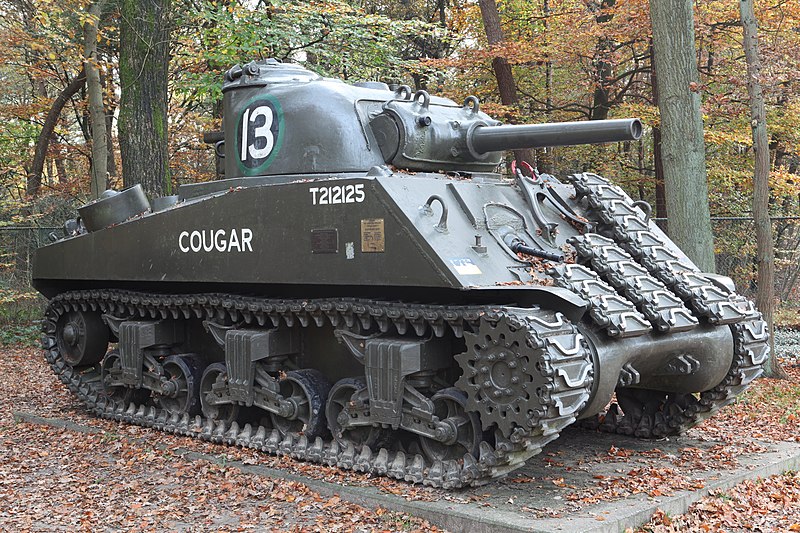
M4 Sherman
1942 medium tank family

Katyusha
Soviet/Russian multiple launch rocket system

Panther
German medium tank

Tiger II
1944 German heavy tank

M3 Lee
1941 American medium tank

M26 Pershing
American heavy battle tank at the end of World War Two

Sturmgeschütz III
1940 German self-propelled gun family

Churchill
1941 heavy infantry tank

M3 Stuart
1941 light tank family

M24 Chaffee
1944 light tank family

T-44
The T-44 was a medium tank developed and produced near the end of World War II by the Soviet Union. It was the successor to the T-34, offering an improved ride and cross-country performance, along with much greater armor. Designed to be equipped with an 85 mm main gun, by the time it was fully tested the T-34 had also moved to this weapon. Both tanks offered similar performance, so introducing the T-44 was not considered as important as increasing T-34 production. Fewer than 2,000 T-44s were built, compared to about 84,000 T-34s. Although the T-44 was available by the end of the war, it w
.jpg)
T-70
The T-70 is a light tank used by the Red Army during World War II, replacing both the T-60 scout tank for reconnaissance and the T-50 light infantry tank for infantry support. The T-80 light tank was a more advanced version of the T-70 with a two-man turret—it was produced only in very small numbers when light tank production was abandoned. The T-90 self-propelled anti-aircraft gun was a prototype vehicle with twin machine guns, based on the T-70 chassis.
.svg)
Elefant
Elefant (German for "elephant") was a heavy tank destroyer (self-propelled anti-tank gun) used by German Panzerjäger (anti-tank) units during World War II. Ninety-one units were built in 1943 under the name Ferdinand (after its designer Ferdinand Porsche) using VK 45.01 (P) tank hulls which had been produced for the Tiger I tank before the competing Henschel design had been selected.
T-60
Soviet light tank

Hetzer
The 38 (Sd.Kfz. 138/2), originally the 38(t), known mostly post-war as '''''', was a German light tank destroyer of the Second World War based on a modified Czechoslovak Panzer 38(t) chassis.

Jagdpanther
The ' (German: "hunting Panther"), Sd.Kfz. 173', was a tank destroyer (, a self-propelled anti-tank gun) built by Germany during World War II.
The combined the 8.8 cm Pak 43 anti-tank gun, similar to the main gun of the Tiger II, with the armor and suspension of the Panther chassis.

SU-100
The SU-100 (Russian: самоходная установка-100, СУ-100 romanized: Samokhodnaya Ustanovka-100) is a Soviet tank destroyer armed with the D-10S 100 mm anti-tank gun in a casemate superstructure. It was used extensively during the last year of World War II and saw service for many years afterwards with the armies of Soviet allies around the world.
Cromwell
British WWII cruiser tank

Wespe
The 'Sd.Kfz. 124 Wespe''' (German for "wasp"), also known as Leichte Feldhaubitze 18/2 auf Fahrgestell Panzerkampfwagen II (Sf.)'' ("Light field howitzer 18 on Panzer II chassis (self-propelled)"), is a German self-propelled gun developed and used during the Second World War. It was based on a modified Panzer II chassis.

Sturmtiger
was a World War II German assault gun built on the Tiger I chassis and armed with a 380mm rocket-propelled mortar. The official German designation was ''''''. Its primary task was to provide heavy fire support for infantry units fighting in urban areas. The few vehicles produced fought in the Warsaw Uprising, the Battle of the Bulge and the Battle of the Reichswald. The fighting vehicle was known by various informal names, among which the became the most popular.
Sturmgeschütz / STuG IV
1943 German assault gun
Hummel
1943 German self-propelled howitzer
Marder I
tank destroyer
Jagdpanzer IV
1943 German tank destroyer series

Jagdtiger
T-50
Soviet light tank
Marder II
1942 German self-propelled antitank gun
Panzerjäger I
1940 German self-propelled antitank gun

Nashorn
' (, German for "rhinoceros"), initially known as ' (German "hornet"), was a German ("tank hunter") of World War II. It was developed as an interim solution in 1942 by equipping a light turretless chassis based on the Panzer III and Panzer IV tanks with the 8.8 cm Pak 43 anti-tank gun. Though only lightly armoured and displaying a high profile, it could penetrate the front armour of any Allied tank at long range, and its relatively low cost and superior mobility to heavier vehicles ensured it remained in production until the war's end.
M22 Locust
airborne forces
Crusader
1941 cruiser tank

SU-85
The SU-85 (Samokhodnaya ustanovka 85) was a Soviet self-propelled gun used during World War II, based on the chassis of the T-34 medium tank. Earlier Soviet self-propelled guns were meant to serve as either assault guns, such as the SU-122, or as tank destroyers; the SU-85 fell into the latter category. As with the other AFVs in the SU series, the designation "85" refers to the vehicle's main armament, the 85 mm D-5T gun.
Marder III
1942 German tank destroyer
M18 Hellcat
1943 tank destroyer
T-40
Soviet amphibious tank
Comet
medium (cruiser) tank

Brummbär
The '''' (also known as or Sd.Kfz. 166) is a German armoured infantry support gun based on the Panzer IV chassis used in the Second World War. It was used at the Battles of Kursk, Anzio, Normandy, and was deployed in the Warsaw Uprising. It was known by the nickname '''' (German: "Grouch") by Allied intelligence, a name which was not used by the Germans. German soldiers nicknamed it the "", a contraction of the term . Just over 300 vehicles were built and they were assigned to four independent battalions.

SU-76
The SU-76 (Samokhodnaya Ustanovka 76) was a Soviet light self-propelled gun used during and after World War II. The SU-76 was based on a lengthened version of the T-70 light tank chassis and armed with the ZIS-3 mod. 1942 76-mm divisional field gun. Developed under the leadership of chief designer S.A. Ginzburg (1900–1943). Its quite simple construction and multipurpose combat role made it the second most produced Soviet armored fighting vehicle of World War II, after the T-34 medium tank.

IS-2
The IS-2 (, sometimes romanized as JS-2) is a Soviet heavy tank, the second of the IS tank series named after Soviet leader Joseph Stalin. It was developed and saw combat during World War II and saw service in other Soviet allied countries after the war.
Kübelwagen
car model

ISU-152
The ISU-152 (, meaning "IS tank based self-propelled installation with 152mm caliber gun") is a Soviet self-propelled gun developed and used during World War II. It was unofficially nicknamed Zveroboy (; "beast killer") in response to several large German tanks and guns coming into service, including Tigers and Panthers. Since the ISU-152's gun was mounted in a casemate, aiming it was awkward, and had to be done by repositioning the entire vehicle using the tracks. Therefore, it was used as mobile artillery to support more mobile infantry and armor attacks. It continued service into the 1970s
Willys MB
American off-road light military utility vehicle
Valentine
1940 infantry tank
Universal Carrier
armored personnel carrier
M10 Gun Motor Carriage
1942 tank destroyer

SU-152
The SU-152 () is a Soviet self-propelled heavy howitzer used during World War II.

Panzerwerfer
The German Panzerwerfer refers to either of two different types of half-tracked multiple rocket launchers employed by Nazi Germany during the Second World War. The two self-propelled artillery vehicles are the 15 cm Panzerwerfer 42 auf Selbstfahrlafette Sd.Kfz.4/1 (based on the Opel '‘Maultier’’, or "mule", half-track) and 15 cm Panzerwerfer 42 auf Schwerer Wehrmachtsschlepper (or Panzerwerfer auf SWS).
thumb|right|220px|Two soldiers operating a Panzerwerfer in Lapland (Finland)|Lapland on the Eastern Front, 1944
L6/40
1939 light tank
Goliath tracked mine
German demolition vehicle
Schwimmwagen
German amphibious car
M36 Gun Motor Carriage
1944 tank destroyer
M13/40
1940 medium tank
IS tank family
series of Soviet heavy tanks, made 1943 to 1966 (in service to 1990)
Grille
self-propelled howitzer

Wirbelwind
The '''Flakpanzer IV "Wirbelwind" (Whirlwind' in English) was a German self-propelled anti-aircraft gun based on the Panzer IV tank. It was developed in 1944 as a successor to the earlier Möbelwagen'' self-propelled anti-aircraft gun.
M7 Priest
1940s self-propelled 105 mm howitzer
Cruiser Mk II
type of cruiser tank
Ostwind
The Flakpanzer IV "Ostwind" (East Wind in English) was a German self-propelled anti-aircraft gun based on the Panzer IV tank. It was developed in 1944 as a successor to the earlier Flakpanzer IV/2 cm Vierling Wirbelwind and produced at the Ostbau Works plant.