Category
page 1Museums of ancient Rome in Germany
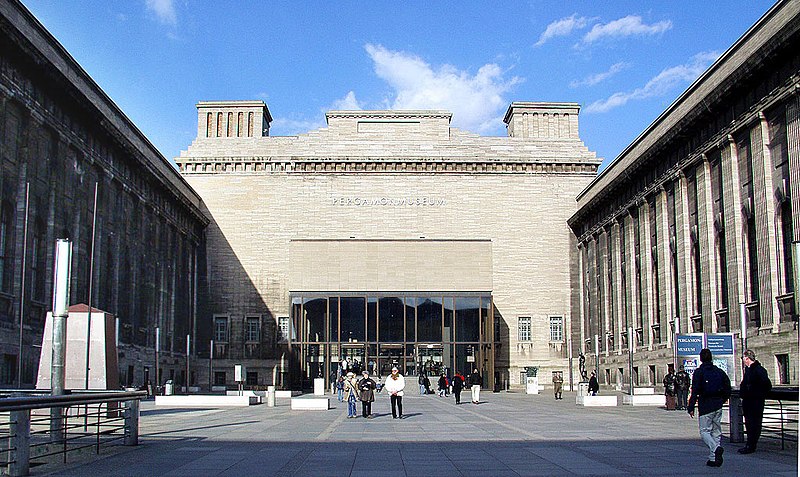
Pergamon Museum
museum building in Berlin, part of the Museumsinsel, presents the Vorderasiatisches Museum, the Museum für Islamische Kunst and parts of the Antikensammlung

Neues Museum
Name of one of the museum buildings on the Museum Island in Berlin, Germany

Glyptothek
The Glyptothek () is a museum in Munich, Germany, which was commissioned by the Bavarian King Ludwig I to house his collection of Greek and Roman sculptures (hence γλυπτο- glypto- "sculpture", from the Greek verb γλύφειν glyphein "to carve" and the noun θήκη "container"). It was designed by Leo von Klenze in the neoclassical style, and built from 1816 to 1830. Today the museum is a part of the Kunstareal.
Karlsruhe Palace
Palace built by count Karl Wilhelm von Baden-Durlach
Romano-Germanic Museum
archaeological museum of ancient roman and germanic cultures in Cologne, Germany
Staatliche Antikensammlungen
collection of graeco-roman antiquities in Munich
Museum of Art and Crafts Hamburg
museum of fine, applied and decorative arts in Hamburg, Germany

Saalburg Roman Fort
The Saalburg is a Roman fort located on the main ridge of the Taunus, northwest of Bad Homburg, Hessen, Germany. It is a cohort fort, part of the Limes Germanicus, the Roman linear border fortification of the German provinces. The Saalburg, located just off the main road roughly halfway between Bad Homburg and Wehrheim is the most completely reconstructed Roman fort in Germany. Since 2005, as part of the Upper Limes, it forms part of a UNESCO World Heritage site. In the modern numbering system for the limes, it is ORL 11.
Rheinisches Landesmuseum Trier
German archaeological museum
Roman Villa Borg
Archaeological museum in Germany
Akademisches Kunstmuseum
art museum in Bonn