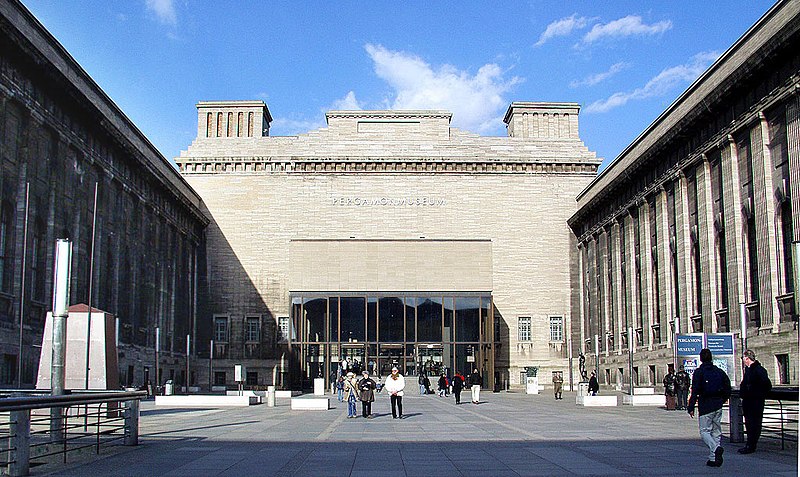
File:Pergamonmuseum_Front.jpg · Wikimedia Commons · See Wikimedia Commons
Pergamon Museum
Sign in to saveAlso known as Pergamonmuseum
museum building in Berlin, part of the Museumsinsel, presents the Vorderasiatisches Museum, the Museum für Islamische Kunst and parts of the Antikensammlung
The Pergamon Museum in Berlin houses three major collections: the Museum of the Ancient Near East, the Museum of Islamic Art, and part of the Antiquities Collection. It is significant as one of the world's leading museums for displaying ancient artifacts from the Middle East, Islamic world, and classical antiquity.
AI-generated from the Wikipedia summary — may contain errors.
Official website

Home | Pergamonmuseum
Das Pergamonmuseum beherbergt die Antikensammlung, das Vorderasiatische Museum und das Museum für Islamische Kunst.
smb.museum →Link to the official site · 5,432 chars · not written by Vinony
Wikidata facts
- Instance of
- museum
- Part of
- Staatliche Museen zu Berlin
- Named after
- Pergamon
- Country
- Germany
- Located in
- Bezirk Mitte
- Location
- Berlin-Mitte
- Official website
- www.smb.museum/museen-einrichtungen/pergamonmuseum
- Image
- Pergamonmuseum Front.jpg
Show 15 more facts
- occupant
- Antikensammlung Berlin
- Commons category
- Pergamonmuseum
- inception
- 1910-01-01
- visitors per year
- 751000
- Commons Institution page
- Pergamon Museum
- topic's main category
- Category:Pergamonmuseum
- heritage designation
- architectural heritage monument
- Commons gallery
- Pergamonmuseum
- date of official opening
- 1910-00-00
- architect
- Alfred Messel
- located in/on physical feature
- Museum Island
- email address
- mailto:[email protected]
- architectural style
- Neoclassical architecture
- ground level 360 degree view URL
- artsandculture.google.com/streetview/pergamonmuseum-staatliche-museen-zu-berlin/0QEALap3qf0s1g?sv_lng=13.397029&sv_lat=52.5210599&sv_h=20.063867949356037&sv_p=3.602589024736247&sv_pid=oeGLHzibhfSR3atEXHgoDQ&sv_z=1.0000000000000002
- fee
- 6.00
Sources (11)
via Wikidata · CC0
~8 min read
Encyclopedic overview
The Pergamon Museum (German: Pergamonmuseum; pronounced [ˈpɛʁ.ɡa.mɔn.muˌzeː.ʊm] ) is a listed building on the Museum Island in the historic centre of Berlin, Germany. It was built from 1910 to 1930 by order of Emperor Wilhelm II and according to plans by Alfred Messel and Ludwig Hoffmann in Stripped Classicism style. As part of the Museum Island complex, the Pergamon Museum was added to the UNESCO World Heritage List in 1999 because of its architecture and testimony to the evolution of museums as architectural and social phenomena.
Prior to its closing in 2023, the Pergamon Museum was home to the Antikensammlung, including the famous Pergamon Altar, the Vorderasiatisches Museum and the Museum für Islamische Kunst.
Excerpted from Wikipedia’s “Pergamon Museum” article, available under the CC BY-SA 4.0 licence.
Gallery (7)
On the map
Available in 59 languages
- Español
- Français
- Deutsch
- 中文
- 日本語
- Русский
- Português
- Italiano
- العربية
- Afrikaans
- Armenian
- Azerbaijani
- Bahasa Indonesia
- Bangla
- Basque
- be_x_old
- Belarusian
- Breton
Show 40 more
- Bulgarian
- Catalan
- Central Kurdish
- Croatian
- Czech
- Danish
- Egyptian Arabic
- Esperanto
- Estonian
- Filipino
- Finnish
- Georgian
- Greek
- Hausa
- Hebrew
- Hungarian
- Icelandic
- Latin
- Lithuanian
- Macedonian
- Malayalam
- Mazanderani
- Nederlands
- Norwegian
- Polski
- Romanian
- Serbian
- Serbian (Latin)
- simple
- Slovak
- Slovenian
- Svenska
- Tamil
- Tiếng Việt
- Türkçe
- Ukrainian
- Western Panjabi
- فارسی
- ไทย
- 한국어
via Wikidata sitelinks · CC0