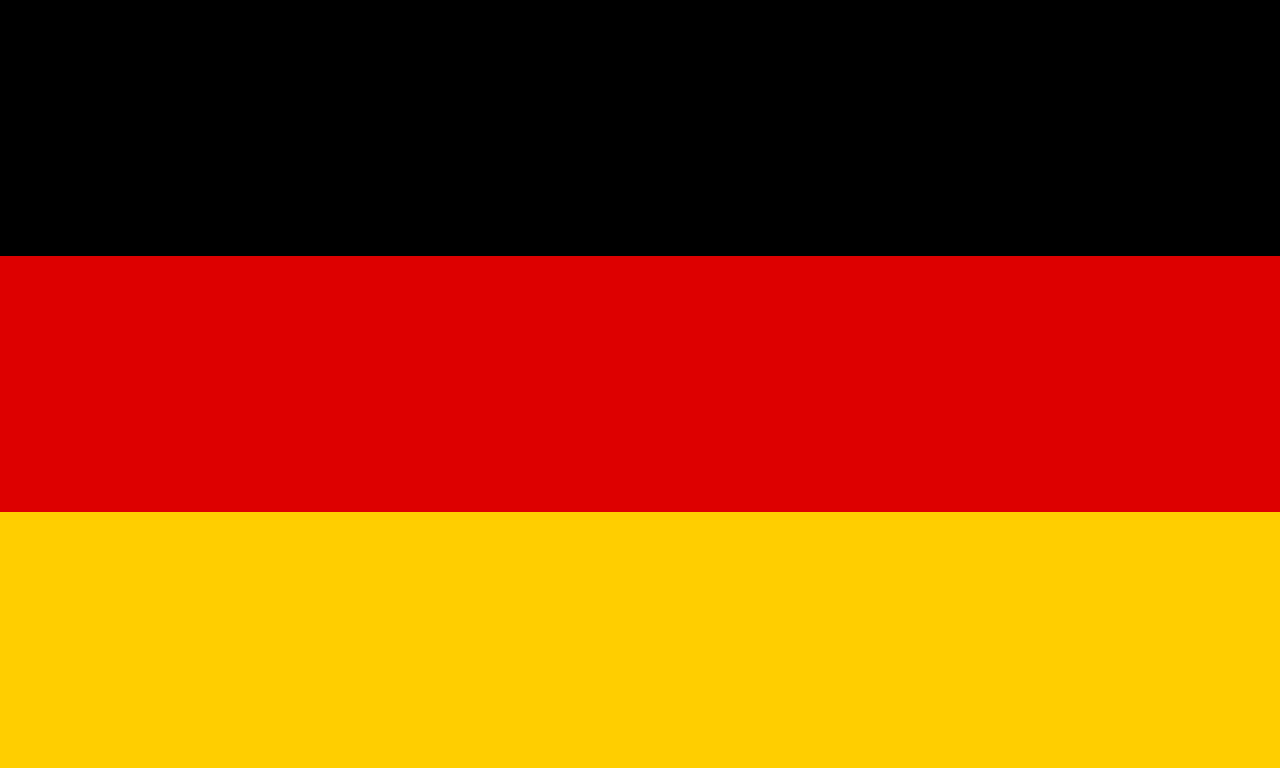
Germany
Sign in to saveAlso known as Federal Republic of Germany
Germany, officially the Federal Republic of Germany, is a country in Western and Central Europe. It lies between the Baltic Sea and the North Sea to the north with the Alps to the south. Its sixteen constituent states have a total population of over 82 million, making it the most populous member state of the European Union (EU). Germany borders Denmark to the north; Poland and the Czech Republic to the east; Austria and Switzerland to the south; and France, Luxembourg, Belgium, and the Netherlands to the west. The nation's capital and most populous city is Berlin and its main financial centre
Germany is a large country in Western and Central Europe with over 82 million people, making it the most populous member state of the European Union. It matters globally due to its size, central location between the Baltic and North Seas, and its role as a major economic and political power in Europe.
AI-generated from the Wikipedia summary — may contain errors.
In the Vinony graph
Germany appears in Vinony's Countries collection — one of 215 entries.
Vinony's link graph records 214,103 inbound references to Germany, and connects out to Francia, Baden-Württemberg and Saxony.
The entry is geolocated on the map, across 2 mapped points.
It is catalogued under topics including 1990 establishments in Europe, Countries and territories where German is an official language and Countries in Europe.
Weather now
7-day forecast
via Open-Meteo
Country


- Capital
- Berlin
- Population
- 83,491,249
- Region
- Europe · Western Europe
- Demonym
- German
- Currencies
- EUR (€)
- Languages
- German
- Calling code
- +49
- Drives on
- Right
- Gini
- 31.9 (2016)
- FIFA code
- GER
- TLD
- .de
- Timezones
- UTC+01:00
- Borders
- AUT, BEL, CZE, DNK, FRA, LUX, NLD, POL, CHE
via REST Countries
Indicators · World Bank
- GDP
- $4.7T(2024)
- Population
- 83,516,593(2024)
- Life expectancy
- 80.8 yrs(2024)
- Unemployment
- 3.7 %(2025)
- Urban population
- 82 %(2024)
- Internet users
- 93.5 %(2024)
- Forest area
- 32.7 %(2023)
- Renewable energy
- 17.6 %(2021)
via World Bank Open Data · CC BY 4.0
Macro indicators · FRED
- GDP
- $769,467.4B(2026-01)
- Unemployment
- 4 %(2026-03)
- CPI
- 127.78(2025-03)
Place details
- Locality
- Haina (Kloster)
- Region
- Hessen
- Country
- Deutschland
- Population
- 82,927,922
- Timezone
- Europe/Berlin
via OpenStreetMap · GeoNames
Wikipedia views (30d)
398,364 totalvia Wikimedia Pageviews API
Key facts
- Country.GDP_nominal_rank
- 3rd
- Country.conventional_long_name
- Federal Republic of Germany
- Country.common_name
- Germany
- Country.image_flag
- Flag of Germany.svg
- Country.image_coat
- Coat of arms of Germany.svg
- Country.coa_size
- 70
- Country.national_anthem
- The Song of the Germans
- Country.map_width
- 250px
- Country.capital
- Berlin
- Country.largest_city
- capital
- Country.official_languages
- German
- Country.demonym
- German
- Country.government_type
- Federal parliamentary republic
- Country.leader_title1
- President
- Country.leader_name1
- Frank-Walter Steinmeier
- Country.leader_title2
- Chancellor
- Country.leader_name2
- Friedrich Merz
- Country.area_km2
- 357,022
via Wikipedia infobox
Research
3,814,211 papers- Germany: Health System Review.ReviewHealth systems in transition · 2020Blümel M, Spranger A, Achstetter K et al.
- Germany's role in global health at a critical juncture.ReviewLancet (London, England) · 2024Franz C, Holzscheiter A, Kickbusch IDOI: 10.1016/S0140-6736(24)00936-X
- [Germany's cannabis act: disaster or opportunity?].Fortschritte der Neurologie-Psychiatrie · 2024Klosterkötter J, Kuhn JDOI: 10.1055/a-2332-6635
- Expert recommendations for Germany's integration of psychedelic-assisted therapy.ReviewBMC medical education · 2024Perez Rosal SR, La Torre JT, Birnkammer S et al.DOI: 10.1186/s12909-024-06141-3
- Ready for Germany's revised radiation rules?ReviewCritical reviews in oncology/hematology · 2019Kurz MDOI: 10.1016/j.critrevonc.2018.11.012
- Germany's expanding role in global health.ReviewLancet (London, England) · 2017Kickbusch I, Franz C, Holzscheiter A et al.DOI: 10.1016/S0140-6736(17)31460-5
- Germany's election: transformation versus more of the same.Lancet (London, England) · 2021The LancetDOI: 10.1016/S0140-6736(21)01454-9
- Germany's next shutdown-Possible scenarios and outcomes.Influenza and other respiratory viruses · 2021Barbarossa MV, Fuhrmann JDOI: 10.1111/irv.12827
via PubMed
Wikidata facts
- Instance of
- country
- Named after
- muteness
- Official name
- ドイツ連邦共和国
- Demonym
- sakslane
- Participant in
- International Space Station
- Country
- Germany
- Contains
- Hesse
- Continent
- Europe
- Capital
- Berlin
- Official language
- German
- Currency
- euro
- Population
- 83577140
- Area
- 349390
- Time zone
- Central European Summer Time
- Body of water
- North Sea
- Head of government
- Friedrich Merz
- Head of state
- Frank-Walter Steinmeier
- Form of government
- federal parliamentary republic
- Legislature
- German Bundestag
- Shares border with
- Sweden
- Highest point
- Zugspitze
- Official website
- www.bund.de
- Image
- Aerial view of Berlin (32881394137).jpg
Show 94 more facts
- Life expectancy
- 81.9
- Nominal GDP
- 4121200000000
- Unemployment rate
- 6.1
- Calling code
- +49
- Licence plate code
- D
- Electrical plug type
- Europlug
- Mains voltage
- 230
- Motto
- Undod a Chyfiawnder a Rhyddid
- Flag
- flag of Germany
- Coat of arms
- Coat of arms of Germany
- Patron saint
- Archangel Michael
- Significant event
- War in Afghanistan (2001–2021)
- hashtag
- Germany
- office held by head of government
- Federal Chancellor of Germany
- native label
- Bundesrepublik Deutschland
- VAT rate
- 7
- diplomatic relation
- Palau
- Commons gallery
- Deutschland
- history of topic
- history of Germany
- mobile country code
- 262
- maritime identification digits
- 218
- marriageable age
- 18
- category for people buried here
- Category:Burials in Germany
- retirement age
- 65.25
- railway traffic side
- right
- category for people who died here
- Category:Deaths in Germany
- office held by head of state
- president of Germany
- Commons category
- Germany
- speed limit
- 50
- water as percent of area
- 2.3
- maintained by WikiProject
- WikiProject Germany
- topic's main Wikimedia portal
- Portal:Germany
- Unicode character
- 🇩🇪
- ethnic group
- Romanians
- geography of topic
- Geography of Germany
- Stack Exchange tag
- travel.stackexchange.com/tags/germany
- trunk prefix
- 0
- replaces
- German Reich
- has characteristic
- free country
- archives at
- Stasi Records Agency
- compulsory education (minimum age)
- 5
- different from
- Germany
- topic's main category
- Category:Germany
- located in/on physical feature
- Western Europe
- category for films shot at this location
- Category:Films shot in Germany
- highest judicial authority
- Federal Constitutional Court
- top-level Internet domain
- .de
- coextensive with
- Germany
- category for people born here
- Category:Births in Germany
- driving side
- right
- lowest point
- Neuendorf-Sachsenbande
- median income
- 43750
- maximum temperature record
- 41.2
- language used
- Western Yiddish
- suicide rate
- 8.3
- GS1 country code
- 400-440
- culture
- culture of Germany
- category for maps or plans
- Category:Maps of Germany
- literacy rate
- 99
- inception
- 0641-00-00
- time of earliest written record
- 0919-00-00
- economy of topic
- economy of Germany
- minimum temperature record
- -45.9
- demographics of topic
- demographics of Germany
- topic has template
- Template:Germany-stub
- poverty incidence
- 14.8
- P6482
- Germany
- short name
- Miemieckô
- Human Development Index
- 0.942
- category for honorary citizens of entity
- Category:Honorary citizens from Germany
- P11012
- Scotland
- central bank
- German Federal Bank
- Inequality-adjusted Human Development Index
- 0.883
- P8168
- (153591) 2001 SN263
- Gini coefficient
- 31.7
- Happy Planet Index score
- 52.7
- category of associated people
- Category:German people
- public holiday
- Second Day of Christmas
- budget
- 476290763000
- age of majority
- 18
- P12749
- Maastricht
- birth rate
- 8.8
- male population
- 41241701
- death rate
- 12.7
- rural population
- 18730526
- female population
- 42335439
- urban population
- 65067459
- minimum wage
- 12.82
- total fertility rate
- 1.455
- described at URL
- wikispooks.com/wiki/Germany
- Democracy Index
- 8.73
- number of seats in assembly
- 18
- most populous urban area
- Berlin
- official color
- yellow
Sources (15)
via Wikidata · CC0
Travel guide
Understand
An economically, politically, and culturally influential nation, Germany is the richest and most populous European Union member state.
Get in
There are a number of ways to get into Germany. From neighbouring European countries, a drive with the car or a train or bus ride are perhaps the easiest and most comfortable options; visitors from further away will probably be using air travel.
Get around
On the whole transportation is efficient and fast, though last minute tickets can be a bit on the expensive side. All modes of transportation are up to a high modern standard, including a dense network of airports, high speed rail services connecting most major cities and regional trains, one of the densest highway networks on earth (with stretches where the speed limit is shrug emoji), and intercity bus services.
Do
Germany offers a wide variety of activities of both a cultural and sporting nature. Many Germans are members of a sports club.
Drink
Pubs are open in Germany until 02:00 or later. Food is generally available until midnight. Germans typically go out after 20:00 (popular places are already full by 18:00).
The legal drinking ages are: 14 - minors are allowed to buy undistilled (fermented) alcoholic beverages in a restaurant, such as beer and wine, as long as they are in the company of their parents or a legal guardian. 16 - minors are allowed to buy undistilled (fermented) alcoholic beverages, such as beer and wine without their parents or a legal guardian. Any drink that contains distilled alcohol (even if the overall alcohol content is lower than for a typical beer) is not allowed 18 - having become adults, people are allowed unrestricted access to alcohol.
Sleep
Germany provides almost all options for accommodation, including hotels, B&Bs, hostels, and camping. You might also consider staying with members of a hospitality exchange network.
German mattresses tend to take a middle ground for firmness, compared to plush American ones and hard Japanese ones. The bedding tends to be simple: a sheet to cover the mattress, one duvet per person (Decke, very nice if you sleep with someone who tends to hog the blankets, but sometimes a little breezy around the toes for tall people) and an enormous square feather pillow, which you can mold into any shape that pleases you. Making the bed in the morning takes mere seconds: fold the Decke in thirds with a quick flick of the wrists, as if it were going to sleep in your place while you are out, and toss the pillow at the top of the bed.
Stay safe
Germany is a very safe country. Crime rates are low and the rule of law is strictly enforced. Violent crimes (murders, robberies, rapes, assaults) are very rare compared to most countries. Pickpockets may sometimes be an issue in large cities or at events with large crowds. Begging is not uncommon in some larger cities, but to no greater extent than in most other major cities and you will rarely encounter aggressive beggars.
If you're staying in certain parts of Berlin or Hamburg around 1 May (Labour Day) expect demonstrations that frequently degenerate into clashes between the police and a minority of the demonstrators. Take the usual precautions and you will most likely not encounter any crime at all while staying in Germany.
Stay healthy
Sanitary and medical facilities in Germany are excellent. See the section on emergencies above if you are in an emergency.
Go next
Germany is an excellent starting point for exploring the rest of Western Europe. From several cities a number of direct high speed rail connections get you to major European capitals within a couple of hours. From the east it is easy to reach Prague in the Czech Republic and Warsaw in Poland From the south west the French cities of Reims and Paris as well as the country and town of Luxembourg would make good first goals. The direct TGV/ICE to Paris stops in Strasbourg, a lovely town at the border with French and German influence alike Belgium and the Netherlands from the west with Leuven and Maastricht being recommended first stopping points; and Denmark in the north west From the south and south west into the mountains of Austria and Switzerland with Salzburg and Lausanne being "must visit" places. By sea in the north east try Cruising the Baltic Sea to access the Baltic states and Nordic Countries.
Frankfurt Airport has direct connections to many major airports around the world.
Travel guide from Wikivoyage (CC BY-SA 4.0)
~40 min read
Encyclopedic overview
38 sectionsContents
- Etymology
- History
- Prehistory
- Germanic tribes, Roman frontier and the Frankish Empire
- East Francia and the Holy Roman Empire
- German Confederation and Empire
- Weimar Republic and Nazi Germany
- East and West Germany
- Reunified Germany and the European Union
- Geography
- Climate
- Biodiversity
- Politics
- Constituent states
- Law
- Foreign relations
- Military
- Economy
- Infrastructure
- Tourism
- Demographics
- Religion
- Languages
- Education
- Health
- Culture
- Music
- Art, design and architecture
- Literature and philosophy
- Media
- Cuisine
- Sports
- See also
- Notes
- References
- Citations
- Sources
- External links
Germany, officially the Federal Republic of Germany, is a country in Western and Central Europe. It lies between the Baltic Sea and the North Sea to the north with the Alps to the south. Its sixteen constituent states have a total population of over 82 million, making it the most populous member state of the European Union (EU). Germany borders Denmark to the north; Poland and the Czech Republic to the east; Austria and Switzerland to the south; and France, Luxembourg, Belgium, and the Netherlands to the west. The nation's capital and most populous city is Berlin and its main financial centre is Frankfurt; the largest urban area is the Ruhr.
Settlement in the territory of modern Germany began in the Lower Paleolithic, with various tribes inhabiting it from the Neolithic onward, chiefly the Celts, and Germanic tribes inhabiting the north. Romans named the area Germania. In 962, the Kingdom of Germany formed the bulk of the Holy Roman Empire. During the 16th century, northern German regions became the centre of the Protestant Reformation. Following the Napoleonic Wars and the dissolution of the Holy Roman Empire in 1806, the German Confederation was formed in 1815.
Excerpted from Wikipedia’s “Germany” article, available under the CC BY-SA 4.0 licence.
Gallery (59)
On the map
2 mapped locations
Available in 315 languages
- Español
- Français
- Deutsch
- 中文
- 日本語
- Русский
- Português
- Italiano
- العربية
- हिन्दी
- Abkhazian
- abstract
- Achinese
- Adyghe
- Afrikaans
- Akan
- Albanian
- Albanian
Show 296 more
- Amharic
- ami
- Angika
- Aragonese
- Aramaic
- Armenian
- Arpitan
- Assamese
- Asturian
- Avaric
- Awadhi
- Aymara
- azb
- Azerbaijani
- Bahasa Indonesia
- Balinese
- Bambara
- Bangla
- Bashkir
- Basque
- bat_smg
- Bavarian
- be_x_old
- Belarusian
- Betawi
- Bhojpuri
- Bikol
- Bishnupriya
- Bislama
- blk
- Bosnian
- Breton
- btm
- Buginese
- Bulgarian
- Buriat
- Burmese
- Catalan
- cbk_zam
- cdo
- Cebuano
- Central Dusun
- Central Kurdish
- Chamorro
- Chechen
- Cherokee
- Cheyenne
- Church Slavic
- Chuvash
- Colognian
- Cornish
- Corsican
- Crimean Tatar
- Croatian
- Czech
- dag
- Danish
- Divehi
- dty
- Dzongkha
- Egyptian Arabic
- eml
- Erzya
- Esperanto
- Estonian
- Ewe
- Extremaduran
- Faroese
- Fiji Hindi
- Fijian
- Filipino
- Finnish
- fiu_vro
- Friulian
- Fula
- Gagauz
- Galician
- Gan Chinese
- Ganda
- gcr
- Georgian
- Gilaki
- Goan Konkani
- Gothic
- gpe
- Greek
- Guarani
- Gujarati
- Haitian Creole
- Hakka Chinese
- Hausa
- Hawaiian
- Hebrew
- Hungarian
- hyw
- Iban
- Icelandic
- Ido
- Igbo
- Iloko
- Inari Sami
- Ingush
- Interlingua
- Interlingue
- Inuktitut
- Inupiaq
- Irish
- Jamaican Creole English
- Javanese
- Kabardian
- Kabyle
- kai
- Kalmyk
- Kannada
- Kanuri
- Kara-Kalpak
- Karachay-Balkar
- Kashmiri
- Kashubian
- Kazakh
- kbp
- kge
- Khmer
- Kikuyu
- Kinyarwanda
- Komi
- Komi-Permyak
- Kongo
- Kotava
- Kurdish
- Kyrgyz
- Ladino
- Lao
- Latgalian
- Latin
- Latvian
- lbe
- Lezghian
- Ligurian
- Limburgish
- Lingala
- Lingua Franca Nova
- Lithuanian
- lld
- Lojban
- Lombard
- Low German
- Lower Sorbian
- Luxembourgish
- Macedonian
- Madurese
- Maithili
- Malagasy
- Malay
- Malayalam
- Maltese
- Manipuri
- Manx
- Māori
- map_bms
- Marathi
- Mari
- Mazanderani
- Minangkabau
- Mingrelian
- Mirandese
- Moksha
- Mongolian
- Moroccan Arabic
- N’Ko
- Navajo
- nds_nl
- Neapolitan
- Nederlands
- Nepali
- Newari
- Northern Frisian
- Northern Sami
- Northern Sotho
- Norwegian
- Norwegian Nynorsk
- Novial
- nrm
- nup
- Nyanja
- Obolo
- Occitan
- Odia
- Old English
- olo
- Oromo
- Ossetic
- Palatine German
- Pampanga
- Pangasinan
- Papiamento
- Pashto
- Pennsylvania German
- Picard
- Piedmontese
- Polski
- Pontic
- ppl
- Punjabi
- Quechua
- roa_rup
- roa_tara
- Romanian
- Romansh
- Romany
- Rundi
- Rusyn
- Samoan
- Sanskrit
- Santali
- Sardinian
- Saterland Frisian
- Scots
- Scottish Gaelic
- Serbian
- Serbian (Latin)
- Shan
- Shona
- Sicilian
- Silesian
- simple
- Sindhi
- Sinhala
- skr
- Slovak
- Slovenian
- Somali
- Southern Sotho
- Sranan Tongo
- Standard Moroccan Tamazight
- Sundanese
- Svenska
- Swahili
- Swati
- syl
- szy
- Tachelhit
- Tahitian
- Tajik
- Talysh
- Tamil
- Taroko
- Tatar
- tay
- tdd
- Telugu
- Tetum
- Tibetan
- Tiếng Việt
- Tigrinya
- Tok Pisin
- Toki Pona
- Tongan
- Tsonga
- Tulu
- Tumbuka
- Türkçe
- Turkmen
- Tuvinian
- Tyap
- Udmurt
- Ukrainian
- Upper Sorbian
- Urdu
- Uyghur
- Uzbek
- Venetian
- Veps
- Volapük
- Walloon
- Waray
- Welsh
- West Flemish
- Western Frisian
- Western Panjabi
- Wolof
- Wu Chinese
- Xhosa
- Yakut
- Yiddish
- Yoruba
- Zaza
- Zeelandic
- zh_classical
- zh_min_nan
- zh_yue
- Zhuang
- Zulu
- فارسی
- ไทย
- 한국어
via Wikidata sitelinks · CC0