
Sweden
Also known as Kingdom of Sweden, se, Swedish Kingdom
Sweden, formally the Kingdom of Sweden, is a Nordic country located on the Scandinavian Peninsula in Northern Europe. It borders Norway to the west and north, and Finland to the east, and shares a maritime border with Denmark to the south. At , Sweden is the largest Nordic country by both area and population, and is the fifth-largest country in Europe. Its capital and largest city is Stockholm. Sweden has a population of 10.6 million, and a low population density of ; 88% of Swedes reside in urban areas. They are mostly in the central and southern half of the country. Sweden's urban areas toge
AI overview
Sweden is a large Nordic country in Northern Europe, bordered by Norway and Finland, with a capital in Stockholm and a population of 10.6 million people concentrated mainly in urban areas. It is the largest country in the Nordic region and the fifth-largest in Europe overall.
AI-generated from the Wikipedia summary — may contain errors.
Weather now
cached 28h ago9°overcast clouds
92% 4.4 m/s OpenWeatherMap
7-day forecast
via Open-Meteo
Country
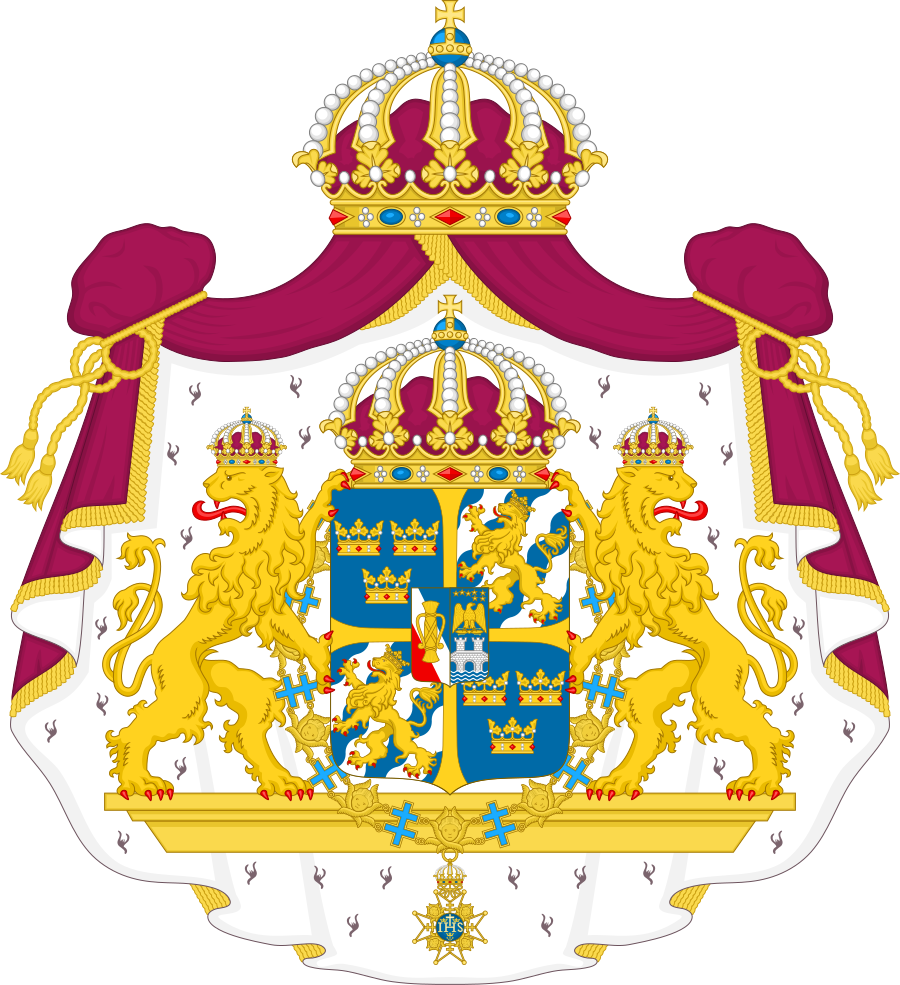

- Capital
- Stockholm
- Population
- 10,605,098
- Region
Travel guide
Understand
The "Nordic model" of economics and social policy was largely developed by Swedish social democrats and liberals during the early 20th century. The foundation is a strong welfare state, combined with market economics. Swedish society, as it has become through this policy, is often described as "folkhemmet", comparing solidarity in the society with that in a family:
Get in
thumb|The Öresund Bridge connects Sweden to [[Denmark.]]
Get around
thumb|The X40 train, used on many regional routes, has an upper deck, which gives a good view of the Swedish scenery.
The ancient right to access (allemansrätten) grants everybody a right to move freely on most land on foot, swimming, by horse, by ski, by bicycle or by boat, even on privately owned property – but not through private yards. With the right comes an obligation to respect the privacy of people and the integrity of nature. It is important to understand the limitations.
See
As modern as its society is, Sweden is a country full of seemingly untouched nature and ever-present history. The first stop for many visitors is historic and compact Stockholm, full of heritage, home to the Vasa Museum and gateway to the Stockholm Archipelago. There's the canals and cobblestoned streets of Gothenburg, with its famous botanical garden, or the modern architecture of Malmö. For more history, head to the port town of Visby, a recognized Unesco World Heritage Site, or the medieval town of Ystad, famous through the Kurt Wallander novels that are set here and for Ales stenar, one of the ancient iron-age burial monuments in the country.
Do
thumb|Besides [[association football and ice hockey, bandy is a major spectator sport in Sweden, with the 26th of December as a traditional game day. The stands are usually outdoors, so the audience needs to dress warm.]]
Eat
See Nordic cuisine for an in-depth description of Swedish food. Swedish food is typical of Nordic cuisine, based on meat (notably pork and game), fish, dairy products, potatoes and bread, together with berries and wild mushrooms. Fresh fruit and vegetables are rather recent additions to the menu.
thumbnail|Meatballs with mashed potatoes and a glass of milk Traditional everyday dishes are called husmanskost (pronounced whos-mans-cost). Some of them are: Pickled herring (sill) is eaten with bread or potatoes for summer lunch or as a starter on the smörgåsbord, at traditional holidays. Many forms of salmon (lax), especially cured salmon (gravlax). Meatballs (köttbullar), the internationally most famous Swedish dish. Served with potatoes, brown sauce and lingonberry jam. Hash (pytt i panna) consisting of meat, onions and potatoes, all diced and fried. Sliced beetroots and a fried or boiled whole egg are mandatory accessories. Pea soup (ärtsoppa) with diced pork, followed by thin pancakes, is traditionally eaten on Thursdays. Blodpudding, a black sausage made by pig's blood and flour, eaten with lingonberry jam. thumbnail|Falukorv in a supermarket fridge Falukorv, a big baloney from Falun. Sweden has many varieties of bread (bröd). Many of them are whole-grain or mixed grain, containing wheat, barley, oats, compact and rich in fiber. Some notable examples are tunnbröd (thin wrap bread), knäckebröd (hard bread - might has a bland taste, but is nearly always available), and differe…
~40 min read
Article
47 sectionsContents
- Etymology
- History
- Prehistory
- Viking Age
- Kingdom of Sweden
- Swedish Empire
- Modern history
- World War I and World War II
- Post-war era
- Recent history
- Geography
- Climate
- Vegetation
- Government and politics
- Constitutional framework
- Elections
- Administrative divisions
- Judicial system
- Foreign relations
- Military
- Economy
- Energy
- Transport
- Public policy
- Science and technology
- Waste management
- Taxes
- Pensions
- Demographics
- Language
- Religion
- Health
- Education
- Culture
- Music
- Architecture
- Media
- Literature
- Holidays
- Cinema
- Cuisine
- Sports
- See also
- Notes
- References
- Further reading
- External links
Sweden, formally the Kingdom of Sweden, is a Nordic country located on the Scandinavian Peninsula in Northern Europe. It borders Norway to the west and north, and Finland to the east, and shares a maritime border with Denmark to the south. At 450,295 square kilometres (173,860 sq mi) and with a population of 10.6 million, Sweden is the largest and most populous Nordic country, and is the fifth-largest country in Europe. Its capital and largest city is Stockholm. The population density is 25.5 inhabitants per square kilometre (66/sq mi), and 88% of Swedes reside in urban areas, mostly in the southern and central portions of the country. Sweden's urban areas together cover 1.5% of its land area. Sweden has a diverse climate owing to the length of the country, which ranges from 55°N to 69°N.
Sweden has been inhabited since prehistoric times around 12,000 BC. The inhabitants emerged as the Geats (Swedish: Götar) and Swedes (Svear), who formed part of the sea-faring peoples known as the Norsemen. A unified Swedish state was established during the late 10th century. In 1397, Sweden joined Norway and Denmark to form the Scandinavian Kalmar Union, which Sweden left in 1523. When Sweden became involved in the Thirty Years' War on the Protestant side, an expansion of its territories began, forming the Swedish Empire, which remained one of the great powers of Europe until the early 18th century. During this era Sweden controlled much of the Baltic Sea. Most of the conquered territories outside the Scandinavian Peninsula were lost during the 18th and 19th centuries. The eastern half of Sweden, present-day Finland, was lost to Imperial Russia in 1809. The last war in which Sweden was directly involved was in 1814, when Sweden by military means forced Norway into a personal union, a union which lasted until 1905.
Gallery (39)
On the map
4 mapped locations
Connections
Categories
Countries and territories where Swedish is an official languageCountries in EuropeFormer Christian statesKingdom of SwedenMembers of the Nordic CouncilMember states of NATOMember states of the European UnionMember states of the Union for the MediterraneanMember states of the United NationsOECD membersScandinaviaSweden