Category
page 1Countries and territories where German is an official language
Germany
Germany, officially the Federal Republic of Germany, is a country in Western and Central Europe. It lies between the Baltic Sea and the North Sea to the north with the Alps to the south. Its sixteen constituent states have a total population of over 82 million, making it the most populous member state of the European Union (EU). Germany borders Denmark to the north; Poland and the Czech Republic to the east; Austria and Switzerland to the south; and France, Luxembourg, Belgium, and the Netherlands to the west. The nation's capital and most populous city is Berlin and its main financial centre

Switzerland

Belgium
Belgium, officially the Kingdom of Belgium, is a country in Northwestern Europe. Situated in a coastal lowland region known as the Low Countries, it is bordered by the Netherlands to the north, Germany to the east, Luxembourg to the southeast, France to the south, and the North Sea to the west. The country also shares a maritime boundary with the United Kingdom to the northwest. Belgium covers an area of and has a population of more than 11.8 million; its population density of ranks 22nd in the world and sixth in Europe. The capital and largest metropolitan region is Brussels; other major citi

Austria
Austria, formally the Republic of Austria, is a landlocked country in Central Europe, lying in the Eastern Alps. It is a federation of nine states, of which the capital Vienna is the most populous city and state. Austria is bordered by Germany to the northwest, the Czech Republic to the north, Slovakia to the northeast, Hungary to the east, Slovenia and Italy to the south, and Switzerland and Liechtenstein to the west. The country occupies an area of and has a population of around 9 million.

Luxembourg
Luxembourg, officially the Grand Duchy of Luxembourg, is a landlocked country in Western Europe. It is bordered by Belgium to the west and north, Germany to the east, and France on the south. Its capital and most populous city, Luxembourg City, is one of the four institutional seats of the European Union and hosts several EU institutions, notably the Court of Justice of the European Union, the highest judicial authority in the EU.
Liechtenstein
Liechtenstein (, ; ; ), officially the Principality of Liechtenstein ( ), is a doubly landlocked country in the Central European Alps. It is located between Austria to the east and north-east and Switzerland to the north-west, west and south. Formed in 1719, Liechtenstein became fully independent upon the dissolution of the German Confederation in 1866. Liechtenstein is a monarchy headed by the prince of Liechtenstein. Hans-Adam II, Prince of Liechtenstein has reigned over Liechtenstein since 1989. Liechtenstein is Europe's fourth-smallest country, with an area of just over and a population of
Trentino-South Tyrol
autonomous region in Northern Italy

South Tyrol
autonomous province of Italy
Opole Voivodeship
voivodeship of Poland
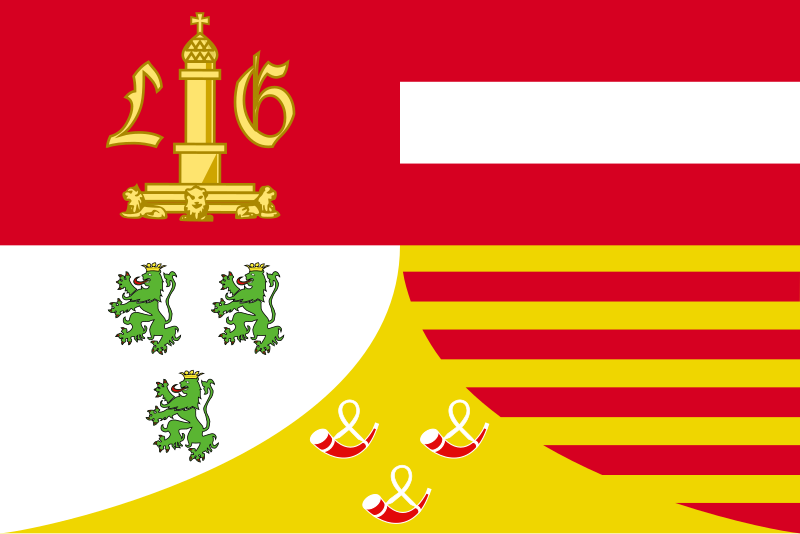
Province of Liege
province in Wallonia, Belgium

Southern Denmark
administrative region of Denmark

German-speaking Community
one of the three official communities in Belgium

Electoral Palatinate
state of the Holy Roman Empire (1085–1803)
German-speaking Switzerland
area of Switzerland with a predominantly German or Swiss German speaking population
list of countries and territories where German is an official language
Wikimedia list article
bilingual communes in Poland
Polish municipalities with a second official language
German-speaking Europe
parts of Europe where German is everyday language