Liechtenstein
Sign in to saveAlso known as Principality of Liechtenstein, FL, li
Liechtenstein (, ; ; ), officially the Principality of Liechtenstein ( ), is a doubly landlocked country in the Central European Alps. It is located between Austria to the east and north-east and Switzerland to the north-west, west and south. Formed in 1719, Liechtenstein became fully independent upon the dissolution of the German Confederation in 1866. Liechtenstein is a monarchy headed by the prince of Liechtenstein. Hans-Adam II, Prince of Liechtenstein has reigned over Liechtenstein since 1989. Liechtenstein is Europe's fourth-smallest country, with an area of just over and a population of
OverviewAI-generated
Liechtenstein, officially the Principality of Liechtenstein, is a country in Western Europe. Its capital is Vaduz. The nation has a population of 40,900 and covers an area of 160 square kilometers. It is located next to the Rhine river. The official language is German. The basic form of government is a constitutional monarchy, with the head of state holding the office of Prince of Liechtenstein. The foundational text is the Constitution of Liechtenstein. The legislative body is the Landtag of Liechtenstein.
The country has diplomatic relations with Germany, Switzerland, Belgium, and the United States. It was established on 1806-07-12. Liechtenstein observes Central European Time. Public holidays include Liechtenstein State Celebration, Easter Monday, Feast of the Ascension, and Feast of Corpus Christi. The emergency phone number is 112. The electrical plug type is the Europlug, SN 441011. The top-level domain is .li. The native label is Fürstentum Liechtenstein.
Synthesized by Vinony from 70 facts across 10 sources: Wikidata, REST Countries, Openweathermap, Open Meteo, World Bank, OpenStreetMap, Firecrawl, PubMed, Vinony graph, Geo. Generated from structured data (not the Wikipedia text) and checked against those facts — may still contain errors.
In the Vinony graph
Liechtenstein is indexed among the 215 entries in Vinony's Countries collection.
Vinony's link graph records 8,612 inbound references to Liechtenstein, and connects out to Protestantism, landlocked country and House of Habsburg.
The entry is geolocated on the map in country, across 6 mapped points.
It sits within the topics 1719 establishments in the Holy Roman Empire, Christian states and Countries and territories where German is an official language.
Weather now
cached 10h ago7-day forecast
via Open-Meteo
Country
- Capital
- Vaduz
- Population
- 40,900
- Region
- Europe · Western Europe
- Demonym
- Liechtensteiner
- Currencies
- CHF (Fr)
- Languages
- German
- Calling code
- +423
- Drives on
- Right
- FIFA code
- LIE
- TLD
- .li
- Timezones
- UTC+01:00
- Borders
- AUT, CHE
via REST Countries
Indicators · World Bank
- GDP
- $8.2B(2023)
- Population
- 40,450(2024)
- Life expectancy
- 84.2 yrs(2024)
- Urban population
- 14.7 %(2024)
- Internet users
- 98.3 %(2024)
- Forest area
- 41.9 %(2023)
- Renewable energy
- 56.9 %(2022)
via World Bank Open Data · CC BY 4.0
Wikipedia views (30d)
152,328 totalvia Wikimedia Pageviews API
Key facts
- Country.conventional_long_name
- Principality of Liechtenstein
- Country.common_name
- Liechtenstein
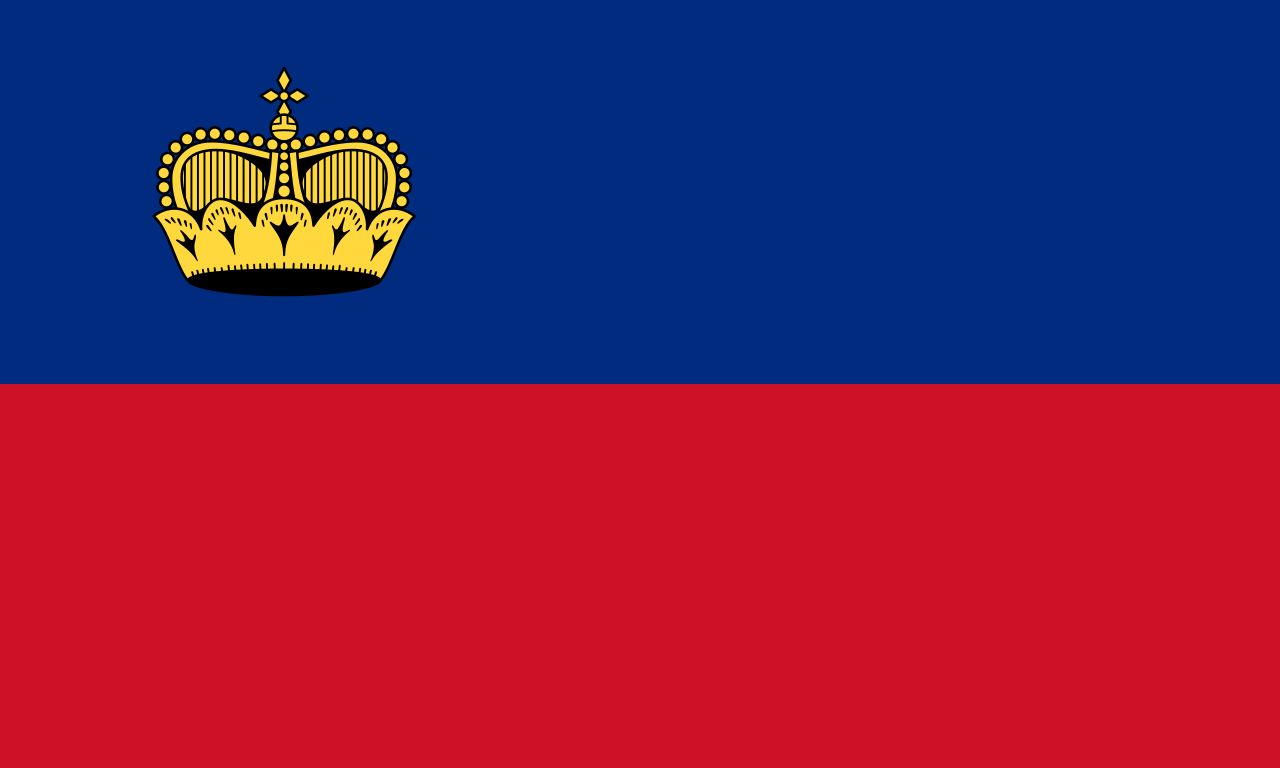
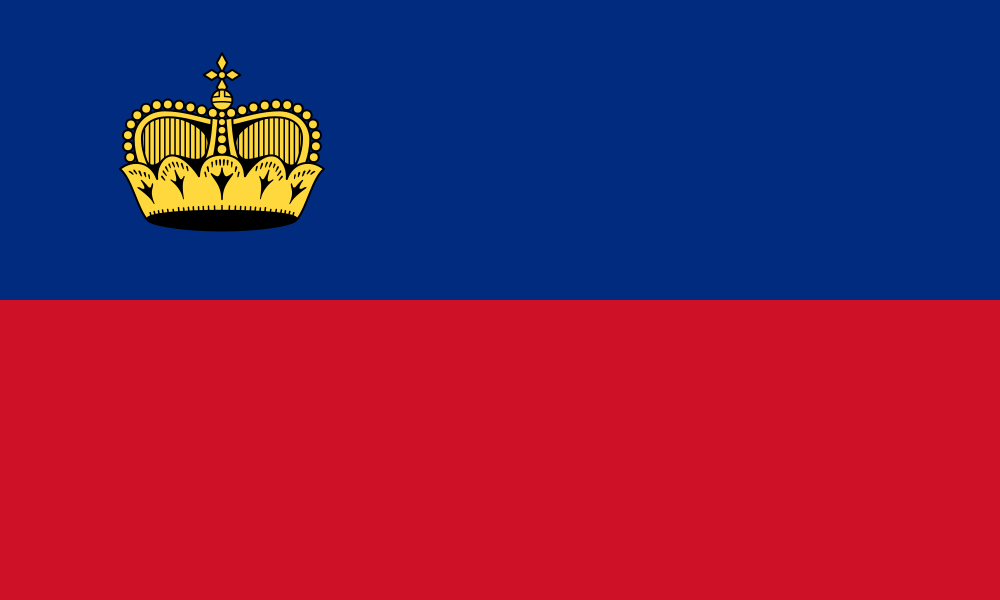
- Country.image_flag
- Flag of Liechtenstein.svg
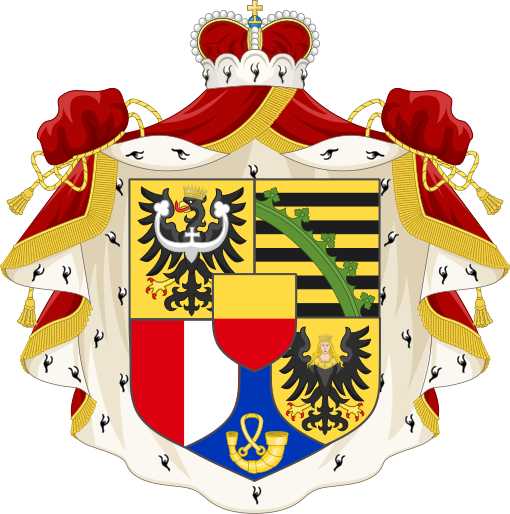
- Country.image_coat
- Coat of arms of Liechtenstein.svg
- Country.national_motto
- "Für Gott, Fürst und Vaterland""For God, Prince and Fatherland"
- Country.image_map
- Europe-Liechtenstein.svg
- Country.image_map2
- Liechtenstein - Location Map (2013) - LIE - UNOCHA.svg
- Country.capital
- Vaduz
- Country.largest_settlement
- Schaan
- Country.largest_settlement_type
- municipality
- Country.official_languages
- German
- Country.religion_year
- 2020
- Country.demonym
- Liechtensteiner
- Country.government_type
- Unitary parliamentary semi-constitutional monarchy with elements of a direct democracy
- Country.leader_title1
- Monarch
- Country.leader_name1
- Hans-Adam II
- Country.leader_title2
- Regent and Heir Apparent
- Country.leader_name2
- Alois
via Wikipedia infobox
Research
1,314 papers- Management of the Difficult Airway.ReviewThe New England journal of medicine · 2021Heidegger TDOI: 10.1056/NEJMra1916801
- Liechtenstein.Department of State publication. Background notes series · 1985United States. Department of State. Bureau of Public Affairs
- Liechtenstein.Department of State publication. Background notes series · 1989United States. Department of State. Bureau of Public Affairs
- [Borna disease in Switzerland and in the principality of Liechtenstein].ReviewSchweizer Archiv fur Tierheilkunde · 1999Caplazi P, Melzer K, Goetzmann R et al.
- LIECHTENSTEIN VERSUS LAPAROSCOPIC TRANSABDOMINAL PREPERITONEAL (TAPP) HERNIA REPAIR: A PROSPECTIVE COMPARATIVE STUDY FOCUSED ON POSTOPERATIVE OUTCOMES IN A GENERAL SURGERY UNIT.Arquivos brasileiros de cirurgia digestiva : ABCD = Brazilian archives of digestive surgery · 2022Gomes CA, Gomes FC, Podda M et al.DOI: 10.1590/0102-672020210002e1642
- Noise-Induced Hearing Loss: Overview and Future Prospects for Research on Oxidative Stress.ReviewInternational journal of molecular sciences · 2025Kitama T, Nishiyama T, Hosoya M et al.DOI: 10.3390/ijms26104927
- Metastatic cancer in a medieval skeleton from the Principality of Liechtenstein.Anthropologischer Anzeiger; Bericht uber die biologisch-anthropologische Literatur · 2024Cooper C, Goritschnig NDOI: 10.1127/anthranz/2024/1749
- All-ceramic crowns.ReviewCurrent opinion in dentistry · 1992Lehner CR, Schärer P
via PubMed
Official website

Fürstentum Liechtenstein – Fürstentum Liechtenstein
Das Fürstentum Liechtenstein liegt in der Mitte Europas, zwischen der Schweiz und Österreich. Liechtenstein ist der sechstkleinste Staat der Welt.
liechtenstein.li →Link to the official site · 17,687 chars · not written by Vinony
Wikidata facts
- Instance of
- country
- Part of
- European Economic Area
- Named after
- House of Liechtenstein
- Official name
- Fyrstedømmet Liechtenstein
- Demonym
- Liechtensteinerinnen
- Country
- Liechtenstein
- Contains
- Balzers
- Continent
- Europe
- Capital
- Vaduz
- Official language
- German
- Currency
- Austrian krone
- Population
- 38020
- Area
- 160
- Body of water
- Rhine
- Head of government
- Daniel Risch
- Head of state
- Hans-Adam II, Prince of Liechtenstein
- Form of government
- constitutional monarchy
- Legislature
- Landtag of Liechtenstein
- Anthem
- Oben am jungen Rhein
- Shares border with
- Vorarlberg
- Highest point
- Grauspitz
- Official website
- www.liechtenstein.li/en
- Image
- Liechtenstein asv2022-10 img02 Vaduz Aussicht beim Schloss.jpg
- Life expectancy
- 84
Show 59 more facts
- Nominal GDP
- 7186428783
- Calling code
- +423
- Licence plate code
- FL
- Electrical plug type
- SN 441011
- Mains voltage
- 230
- Motto
- Ji bo Xwedê, Mîr û Welêt
- Coat of arms
- coat of arms of Liechtenstein
- topic's main Wikimedia portal
- Portal:Liechtenstein
- Unicode character
- 🇱🇮
- foundational text
- Constitution of Liechtenstein
- geography of topic
- Geography of Liechtenstein
- native label
- Liechtenstein
- public holiday
- Feast of the Immaculate Conception
- topic has template
- Template:Liechtenstein topics
- diplomatic relation
- China
- inception
- 1806-07-12
- office held by head of state
- Prince of Lichtenstein
- Commons gallery
- Liechtenstein
- history of topic
- history of Liechtenstein
- has characteristic
- free country
- mobile country code
- 295
- total fertility rate
- 1.45
- maritime identification digits
- 252
- retirement age
- 64
- marriageable age
- 18
- topic's main category
- Category:Liechtenstein
- age of majority
- 18
- executive body
- Cabinet of Liechtenstein
- category for people who died here
- Category:Deaths in Liechtenstein
- Commons category
- Liechtenstein
- top-level Internet domain
- .li
- category for people born here
- Category:Births in Liechtenstein
- number of out-of-school children
- 299
- driving side
- right
- lowest point
- Rhine
- IPA transcription
- lʲɪxtɛnˈʂtɛjn
- postal code
- 9485–9498
- language used
- German
- GS1 country code
- 760-769
- VAT rate
- 7.7
- economy of topic
- economy of Liechtenstein
- demographics of topic
- demographics of Liechtenstein
- Human Development Index
- 0.935
- P11012
- Uranus
- central bank
- Swiss National Bank
- hashtag
- Liechtenstein
- on focus list of Wikimedia project
- Wikipedia:Vital articles/Level/4
- budget
- 1486800000
- P12749
- Hoheluft-Ost
- birth rate
- 9.2
- male population
- 19502
- death rate
- 7.1
- rural population
- 33610
- female population
- 19825
- urban population
- 5717
- P8168
- Bone Sickness
- social media followers
- 5450
- located in/on physical feature
- Western Europe
Sources (15)
via Wikidata · CC0
Travel guide
See
Liechtenstein boasts a number of attractions that are of interest to visitors.
thumb|Balzers Castle Balzers Castle is a spectacular Gothic building. Schloss Vaduz in Vaduz - This imposing and historic castle, home to the royal family, overlooks the city of Vaduz and is approachable on the main Vaduz-Triesenberg road (bus route 21). It is not open to the public, but it is possible to view it from quite close up.
It is possible to encounter the royal family at the Kunstmuseum, coming in and out of Schloss Vaduz or skiing during winter time. This is one benefit of such a small country. They are recognizable in their cars, which use their birth year for their licence plate number.
The mountain ranges within Liechtenstein are filled with tall peaks. Both lie within the eastern and western Alps and display climbing options.
Do
Liechtenstein offers great hiking, road biking, and mountain biking terrain. Skiing and snowboarding are also offered at a reasonable price at the country's small resort, Malbun, in comparison to the expensive lift prices in neighbouring Switzerland or Austria.
Get up early one morning and drive up the mountains on the east side of the river. From here you have an incredible view over Vaduz & Switzerland.
Liechtenstein is popular among philatelists and even has a postal museum. You can also get an entry stamp of Liechtenstein in your passport at the tourist centre and some souvenir shops (Fr. 3 or €3).
Eat
You will find a few restaurants in the larger cities of Liechtenstein. There is also a McDonald's restaurant (opened in 1996; serves wine), which is very popular and is widely publicised by road signs throughout the country.
The many small bakeries are a great place to get a warm, fresh roll or pastry.
Drink
thumb|Wineyard in Balzers There is a small amount of wine that is produced in Liechtenstein that is available in supermarkets and tourist shops throughout the country. Expect to pay around Fr. 25 for an average bottle. The Prince owns his own vineyard in Vaduz, off the main road. Beer is also available for purchase that is made with malt from Liechtenstein, although most of the beer is brewed in Switzerland. A variety of other European wines, beers, and soft drinks are also available. There is now a brewery in Liechtenstein that produces a variety of beers; lagers including Helles (blonde) and Hefe Weizen (unfiltered wheat) styles are brewed.
There is also a one-man distillery in Triesen which makes liquors and schnapps from fruits. Tours on Saturdays.
Sleep
There are a few hotels in Liechtenstein, but they tend to be on the expensive side. There is one youth hostel located in Schaan, but it closes for the winter. You will probably be able to find cheaper accommodation in neighboring Feldkirch, Austria.
Camping Mittagspitz is the only full-service campsite in the Principality. It offers excellent facilities, a friendly reception and a fabulous reasonably priced restaurant. Fares for pitching a tent are around 22€ + 2€ tourist tax (April 2024) There are three other campgrounds in Liechtenstein: one in Bendern, one in Vaduz, and one in Triesen. All are pretty much full year round.
Stay safe
Liechtenstein is easily one of the safest countries in the world, though it is not without its problems. The most common crime in Liechtenstein is of a non-violent nature, though the principality maintains a well-equipped police force which maintains a presence on the streets. In the late 1990s, the Liechtenstein Landespolizei launched a crackdown on prostitution in Vaduz. Considering the largest cities nearby are Innsbruck and Zürich, outside of Schaan and Vaduz, the whole place can seem very rural. Drunk drivers and winter road conditions may be your only "realistic" concern. Speed limits are strictly enforced by speed cameras, which can lead to high fines. Don't speed, enjoy the scenery instead.
The country's beautiful scenery is also very dangerous. Cases of hikers finding themselves in difficulty are very common, and extreme care should be taken when leaving the well-marked trails. Follow local advice, read local weather forecasts (newspapers in the principality print individual forecasts for the different cities in Liechtenstein, which is beneficial because the difference in altitude often cause different weather conditions), and ensure that you have the correct equipment before setting out.
Stay healthy
There are excellent medical facilities in Liechtenstein, but it is more likely that you would be transferred to a hospital in Switzerland should you require medical attention. If you are an Austrian or EU citizen you may want to seek medical attention in next-door Feldkirch, Austria.
Tap water is safe to drink.
Respect
thumb|The Princely Liechtenstein Tattoo Parade in Schaan The Principality of Liechtenstein has existed for centuries as an independent state and this should be remembered. Liechtensteiners are very proud of their national identity and would take offence at being wrongly labelled "German", "Austrian" or "Swiss".
Remember that this is a traditional Catholic country. On Sundays, the streets are almost dead except for the tourists and the tourist shops.
The Prince of Liechtenstein and the Monarchy are well respected in Liechtenstein. Bear that in mind when conversing with the locals.
Connect
As of Sept 2021, the country has 4G from all Swiss carriers, but 5G has not yet arrived. The Austrian signal doesn't reach here because of the mountains. Wifi is widely available in public places.
Go next
From Liechtenstein, going to the picturesque Austrian city of Feldkirch is a natural choice. The closest larger city of Switzerland is St. Gallen with its monasterial complex.
Liechtenstein can be seen as part of the German-Swiss-Austrian Lake Constance with many wonderful destinations.
Travel guide from Wikivoyage (CC BY-SA 4.0)
~40 min read
Encyclopedic overview
32 sectionsContents
- History
- Early history
- Foundation of a dynasty
- Principality of Liechtenstein
- 20th and 21st centuries
- Geography
- Climate
- Rivers and lakes
- Mountains
- Government and politics
- Politics
- Foreign relations
- Security and defense<span class="anchor" id="Security_and_defense"></span>
- Human rights
- Economy
- Taxation
- Tourism
- Transport
- Road
- Rail
- Air
- Demographics
- Languages
- Religion
- Education
- Culture
- Media
- Sports
- See also
- Notes
- References
- External links
Liechtenstein (/ˈlɪk.tən.staɪn/ , LIK-tən-stine; pronounced [ˈlɪçtn̩ʃtaɪn] ; Alemannic German: Liachtaschta), officially the Principality of Liechtenstein (German: Fürstentum Liechtenstein [ˈfʏʁstn̩tuːm ˈlɪçtn̩ʃtaɪn] ), is a doubly landlocked country in the Central European Alps. It is located between Austria to the east and north-east and Switzerland to the north-west, west and south.
Formed in 1719, Liechtenstein became fully independent upon the dissolution of the German Confederation in 1866. Liechtenstein is a monarchy headed by the prince of Liechtenstein. Hans-Adam II, Prince of Liechtenstein has reigned over Liechtenstein since 1989. Liechtenstein is Europe's fourth-smallest country, with an area of just over 160 square kilometres (62 square miles) and a population of 41,389. It is the world's smallest country to border two countries. The official language of Liechtenstein is German.
Excerpted from Wikipedia’s “Liechtenstein” article, available under the CC BY-SA 4.0 licence.
Gallery (61)
On the map
6 mapped locations
Available in 264 languages
- Español
- Français
- Deutsch
- 中文
- 日本語
- Русский
- Português
- Italiano
- العربية
- हिन्दी
- Abkhazian
- Achinese
- Afrikaans
- Albanian
- Albanian
- Amharic
- ami
- Angika
Show 245 more
- Aragonese
- Aramaic
- Armenian
- Arpitan
- Asturian
- Awadhi
- azb
- Azerbaijani
- Bahasa Indonesia
- Balinese
- Bangla
- Bashkir
- Basque
- bat_smg
- Bavarian
- be_x_old
- Belarusian
- Betawi
- Bhojpuri
- Bikol
- Bishnupriya
- Bislama
- Bosnian
- Breton
- Bulgarian
- Buriat
- Burmese
- Catalan
- cbk_zam
- cdo
- Cebuano
- Central Kurdish
- Chechen
- Cherokee
- Church Slavic
- Chuvash
- Cornish
- Corsican
- Crimean Tatar
- Croatian
- Czech
- dag
- Danish
- Divehi
- dty
- Dzongkha
- Egyptian Arabic
- eml
- Erzya
- Esperanto
- Estonian
- Ewe
- Extremaduran
- Faroese
- Fiji Hindi
- Filipino
- Finnish
- fiu_vro
- Friulian
- Fula
- Gagauz
- Galician
- Ganda
- gcr
- Georgian
- Gilaki
- Goan Konkani
- Gothic
- Greek
- Guarani
- Gujarati
- Haitian Creole
- Hakka Chinese
- Hausa
- Hawaiian
- Hebrew
- Hungarian
- hyw
- Iban
- Icelandic
- Ido
- Igbo
- Iloko
- Inari Sami
- Interlingua
- Interlingue
- Irish
- Jamaican Creole English
- Javanese
- Kabardian
- Kabyle
- Kalmyk
- Kannada
- Kara-Kalpak
- Karachay-Balkar
- Kashubian
- Kazakh
- kbp
- Khmer
- Kinyarwanda
- Komi
- Komi-Permyak
- Kongo
- Kotava
- Kurdish
- Kyrgyz
- Ladino
- Lao
- Latgalian
- Latin
- Latvian
- Lezghian
- Ligurian
- Limburgish
- Lingala
- Lingua Franca Nova
- Lithuanian
- lld
- Lojban
- Lombard
- Low German
- Lower Sorbian
- Luxembourgish
- Macedonian
- Madurese
- Malagasy
- Malay
- Malayalam
- Maltese
- Manipuri
- Manx
- Māori
- map_bms
- Marathi
- Mari
- Mazanderani
- Minangkabau
- Mingrelian
- Mirandese
- Moksha
- Mongolian
- Moroccan Arabic
- Navajo
- nds_nl
- Neapolitan
- Nederlands
- Nepali
- Newari
- Northern Frisian
- Northern Sami
- Norwegian
- Norwegian Nynorsk
- Novial
- nrm
- Occitan
- Old English
- olo
- Oromo
- Ossetic
- Palatine German
- Pampanga
- Pangasinan
- Papiamento
- Pashto
- Pennsylvania German
- Picard
- Piedmontese
- Polski
- Pontic
- Punjabi
- Quechua
- roa_tara
- Romanian
- Romansh
- Rusyn
- Samoan
- Sanskrit
- Sardinian
- Saterland Frisian
- Scots
- Scottish Gaelic
- Serbian
- Serbian (Latin)
- Shan
- Shona
- Sicilian
- Silesian
- simple
- Sindhi
- Sinhala
- Slovak
- Slovenian
- Somali
- Sranan Tongo
- Sundanese
- Svenska
- Swahili
- Swati
- szy
- Tajik
- Talysh
- Tamil
- Taroko
- Tatar
- tay
- Telugu
- Tetum
- Tibetan
- Tiếng Việt
- Toki Pona
- Tongan
- Tsonga
- Tumbuka
- Türkçe
- Turkmen
- Udmurt
- Ukrainian
- Upper Sorbian
- Urdu
- Uyghur
- Uzbek
- Venetian
- Veps
- Volapük
- Walloon
- Waray
- Welsh
- West Flemish
- Western Frisian
- Western Panjabi
- Wolof
- Wu Chinese
- Xhosa
- Yakut
- Yiddish
- Yoruba
- Zaza
- Zeelandic
- zh_classical
- zh_min_nan
- zh_yue
- Zhuang
- فارسی
- ไทย
- 한국어
via Wikidata sitelinks · CC0