Category
page 1National museums of Italy
%20-%20Roma%20-%20Interno%20del%20Colosseo.jpg)
Colosseum
The Colosseum ( ; ) is an elliptical amphitheatre in the centre of the city of Rome, Italy, just east of the Roman Forum. It is the largest ancient amphitheatre ever built, and is the largest standing amphitheatre in the world. Construction began under the Emperor Vespasian () in 72 and was completed in AD 80 under his successor and heir, Titus (). Further modifications were made during the reign of Domitian (). The three emperors who were patrons of the work are known as the Flavian dynasty, and the amphitheatre was named the Flavian Amphitheatre (; ) by later classicists and archaeologists f

Pompeii
Pompeii (; ) was a city in what is now the municipality of Pompei, near Naples, in the Campania region of Italy. Along with Herculaneum, Stabiae, and many surrounding villas, it was buried under of volcanic ash and pumice in the eruption of Mount Vesuvius in 79 AD.

Uffizi Gallery
The Uffizi Gallery ( ; , ) is a prominent art museum adjacent to the Piazza della Signoria in the Historic Centre of Florence in the region of Tuscany, Italy. One of the most important Italian museums and the most visited, it is also one of the largest and best-known in the world and holds a collection of priceless works, particularly from the period of the Italian Renaissance.

Herculaneum
Herculaneum is an ancient Roman town located in the modern-day comune of Ercolano, Campania, Italy. Herculaneum was buried under a massive pyroclastic flow in the eruption of Mount Vesuvius in 79 AD.

Palatine Hill
centremost of the seven hills of Rome, Italy

Palace of Caserta
former royal residence in Caserta, Italy
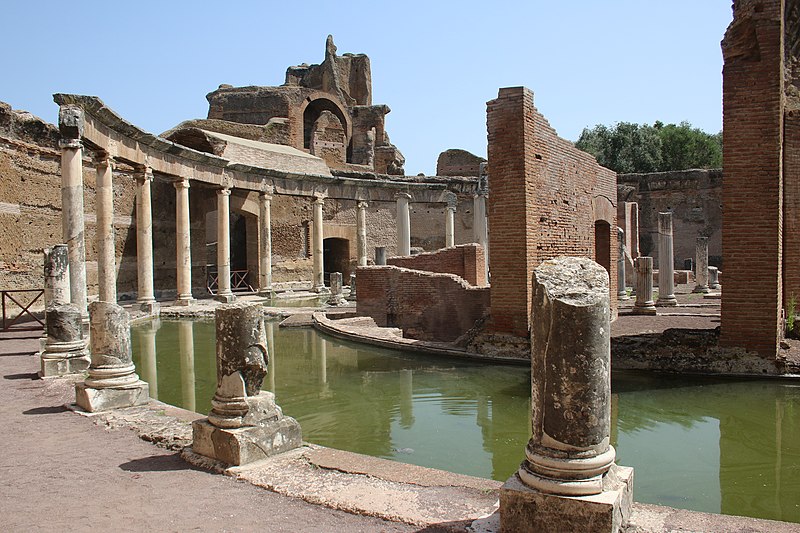
Hadrian's Villa
archaeological complex in Tivoli, Italy

Velia
Velia was the Roman name of an ancient city on the coast of the Tyrrhenian Sea. It is located near the modern village of Ascea in the Province of Salerno, Italy.

Luni
Italian comune

Cumae
Cumae ( or or ; ) was the first ancient Greek colony of Magna Graecia on the mainland of Italy and was founded by settlers from Euboea in the 8th century BCE. It became a rich Roman city, the remains of which lie near the modern village of Cuma, a frazione of the comune Bacoli and Pozzuoli in the Metropolitan City of Naples, Campania, Italy. The archaeological museum of the Campi Flegrei in the Aragonese castle contains many finds from Cumae.

Baths of Caracalla
public baths in ancient Rome
Altare della Patria
monument built in honour of Victor Emmanuel II of Italy

Veii
Veii (also Veius; ) was an important ancient Etruscan city situated on the southern limits of Etruria and north-northwest of Rome, Italy. It now lies in Isola Farnese, in the comune of Rome. Many other sites associated with and in the city-state of Veii are in Formello, immediately to the north. Formello is named after the drainage channels that were first created by the Veians.

Su Nuraxi di Barumini
nuraghe

Naples National Archaeological Museum
Italian archeological museum known for Roman materials
Domus Aurea
domus, palace of Roman emperor Nero, "Golden house"
Museo Egizio
ancient Egyptian art and history museum in Turin, Italy
Miramare Castle
castle in Trieste, Italy
Gulf of Salerno
gulf of the Tyrrhenian Sea
Museo di Capodimonte
art museum and historic site in Naples, Italy
Museo Nazionale Romano
museum in Italy

Sybaris
Sybaris (; ) was an important ancient Greek city situated on the coast of the Gulf of Taranto in modern Calabria, Italy.
Ca' d'Oro
palace and art gallery in Venice, Italy

Stabiae
350px|right|thumb|Stabiae and other cities affected by the eruption of Mount Vesuvius. The black cloud represents the general distribution of ash and cinder. Modern coast lines are shown.

Oplontis
Oplontis is an ancient Roman archaeological site, located in the town of Torre Annunziata, south of Naples in the Campania region of southern Italy. The excavated site comprises two Roman villas, the best-known of which is Villa A, the so-called Villa Poppaea.
Baths of Diocletian
ancient Roman bath, a landmark of Rome, Italy
Royal Palace of Turin
palace in Turin
Galleria dell'Accademia
art museum in Florence, Italy
Galleria Nazionale d'Arte Antica
art museum in Rome, Italy
Galleria Nazionale d'Arte Moderna e Contemporanea di Roma
National Museum in Rome, Italy
MAXXI
MAXXI (, 'national museum of 21st-century arts') is a national museum of contemporary art and architecture in the Flaminio neighborhood of Rome, Italy. The museum is managed by a foundation created by the Italian Ministry of Culture. The building was designed by Zaha Hadid, and won the Stirling Prize of the Royal Institute of British Architects in 2010.

Vulci
Vulci or Volci (Etruscan: Velch or Velx, depending on the romanization used) was a rich Etruscan city in what is now northern Lazio, central Italy.
Tomb of Caecilia Metella
Roman tomb on the Via Appia belonging to Caecilia Metella
Castel Sant'Elmo
fortification in Naples, Italy
Medici Chapels
structures at the Basilica of San Lorenzo, Florence, Italy
Villa Farnese
mansion in the town of Caprarola, Italy
Museum of San Marco
art museum in the former convent of San Marco in Florence, Italy
Palazzo Ducale
building in Urbino, Italy
National Archaeological Museum
archaeological museum of Florence, Italy
Palazzo Ducale Mantua
palace and museum in Mantua
Museo Nazionale Etrusco di Villa Giulia
archaeological museum in Rome
Palazzo Corsini
palace and museum in Rome
Palace of Venaria
former royal residence in Italy
Galleria Sabauda
art museum in Turin
%2001%2C1.JPG)
Tharros
Tharros (also spelled Tharras, , , Tárrai/Tárras; ) was an ancient city and former bishopric on the west coast of Sardinia, Italy.
Villa Castello
Medici Villa in the hills near Florence, Tuscany
Villa Jovis
historical building in Capri, Italy

Altinum
Altinum (in Altino, a frazione of Quarto d'Altino) was an ancient town of the Veneti 15 km southeast of modern Treviso, close to the mainland shore of the Lagoon of Venice. It was also close to the mouths of the rivers Dese, Zero and Sile. A flourishing port and trading centre during the Roman period, it was destroyed by Attila the Hun in 452. The town recovered, but was later abandoned when sea-borne sand began to cover it over. Its inhabitants moved to Torcello and other islands of the northern part of the lagoon.
Nora
ancient city in today's Pula, Sardinia, Italy
Castle of Racconigi
Castle in Racconigi, Cuneo, Italy
Alba Fucens
ancient town
Pinacoteca Nazionale di Bologna
museum of arts in Bologna
National Museum of Oriental Art
national museum in Rome, Italy
Villa of Livia
building in Prima Porta, Italy
Villa of the Quintilii
building in Rome, Italy

Amiternum
Amiternum was an ancient Sabine city, then Roman city and later bishopric and Latin Catholic titular see in the central Abruzzo region of modern Italy, located from L'Aquila. Amiternum was the birthplace of the historian Sallust (86 BC).
Galleria Estense
art museum in Modena
Villa Lante
renaissance villa in Bagnaia, Italy
Villa Medici
villa in Poggio a Caiano, Tuscany, Italy
Villa Pisani
palace and museum in Stra, Veneto, Italy