
File:Colosseo_2020.jpg · Wikimedia Commons · See Wikimedia Commons
Colosseum
Sign in to saveAlso known as Flavian Amphitheatre, Roman Colosseum, Roman Coliseum, Coliseum, Flavian Amphitheater, Flavius amphitheatre
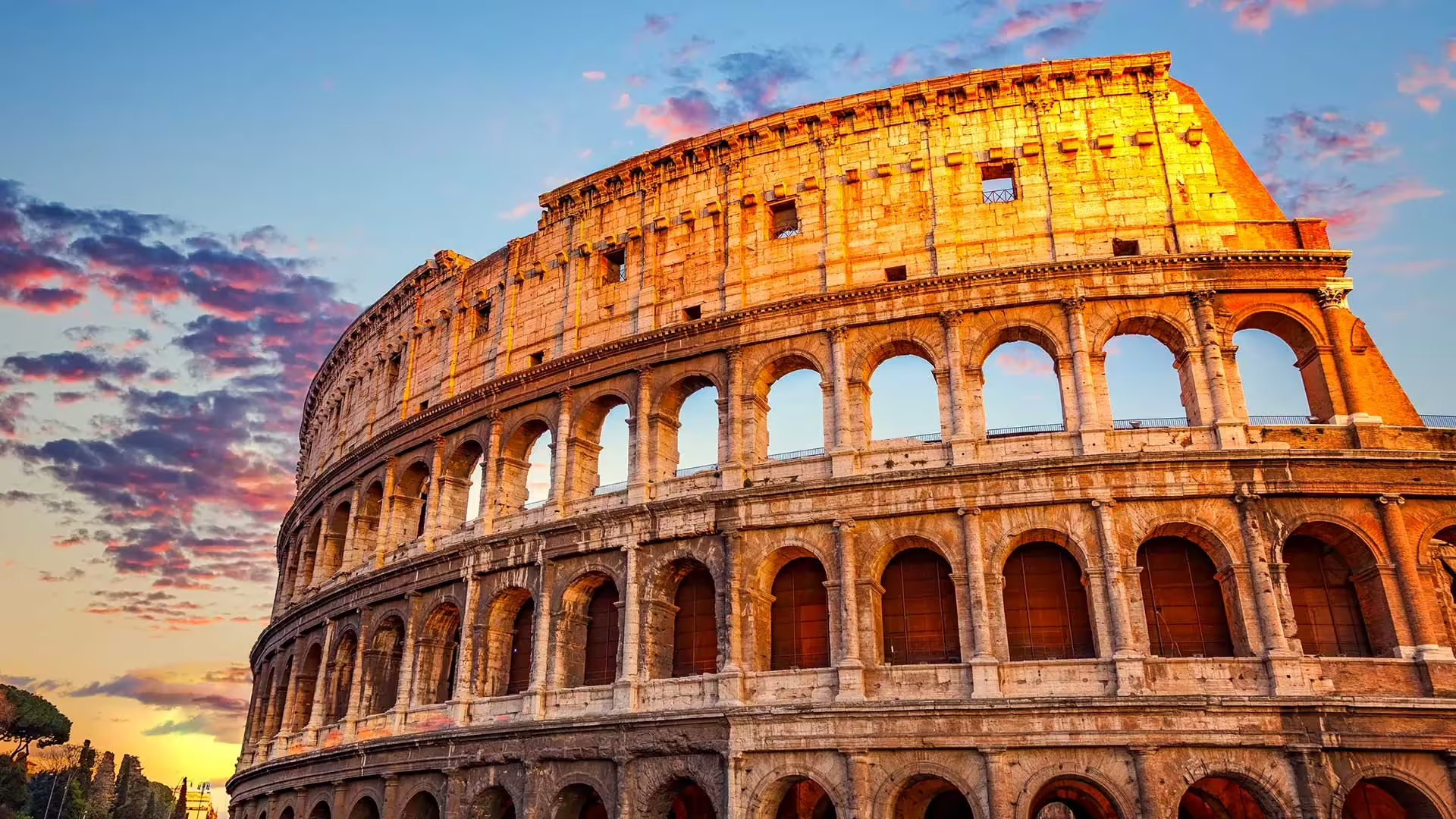
The Colosseum ( ; ) is an elliptical amphitheatre in the centre of the city of Rome, Italy, just east of the Roman Forum. It is the largest ancient amphitheatre ever built, and is the largest standing amphitheatre in the world. Construction began under the Emperor Vespasian () in 72 and was completed in AD 80 under his successor and heir, Titus (). Further modifications were made during the reign of Domitian (). The three emperors who were patrons of the work are known as the Flavian dynasty, and the amphitheatre was named the Flavian Amphitheatre (; ) by later classicists and archaeologists f
The Colosseum is a massive elliptical amphitheater located in Rome, Italy, that was built between 72 and 80 AD under the Roman emperors of the Flavian dynasty. It is the largest ancient amphitheater ever constructed and remains the largest standing amphitheater in the world today, making it a significant architectural achievement from ancient Rome.
AI-generated from the Wikipedia summary — may contain errors.
Key facts
- Ancient site.name
- Colosseum
- Ancient site.image
- Colosseo 2020.jpg
- Ancient site.caption
- Looking east from the Piazza di Santa Francesca Romana, 2020
- Ancient site.location
- Regio III Isis et Serapis, Rome, Italy
- Ancient site.built
- AD 70–
- Ancient site.builder
- Vespasian, Titus
- Ancient site.type
- Amphitheatre
- Ancient site.map_dot_label
- Colosseum
- Ancient site.map_label_position
- right
- Ancient site.map_type
- Italy Rome Antiquity
- Ancient site.map_overlay
- Roma PlanFXD.jpg
- Ancient site.map_caption
- Shown within Augustan Rome
- Ancient site.map_size
- 270
- Ancient site.image_size
- 270
- Ancient site.mapframe frame width
- 270
- Ancient site.mapframe
- yes
- Ancient site.mapframe caption
- Click on the map for a fullscreen view
- Ancient site.mapframe zoom
- 12
via Wikipedia infobox
Described at
Koloseum - Taliansko - PlaceMania
Najslávnejšia ruina sveta nie je tým, čím sa na prvý pohľad zdá. Väčšina turistov vidí len mŕtvy skelet z travertínu, no pod povrchom sa ukrýva inžiniersky zázrak postavený na „ukradnutom“ jazere, ktorý prežil premenu na stredoveký panelák aj exotickú džungľu.
placemania.sk →Link to a page describing this subject · 21,763 chars · not written by Vinony
Wikidata facts
- Country
- Italy
- Area
- 30000
- Founded by
- Vespasian
- Employees
- 21
- Material used
- concrete
- Official website
- colosseo.it/en/area/the-colosseum
- Image
- Panoramic photograph of interior of Colosseum.jpg
- Height
- 48
- Width
- 155
- Length
- 187
- Significant event
- Inaugural games of the Flavian Amphitheatre
- Has use
- quarry
Show 26 more facts
- on focus list of Wikimedia project
- Wikipedia:Vital articles/Level/4
- different from
- Colosseo district
- described by source
- Pauly–Wissowa
- Commons category
- Colosseum
- Commons gallery
- Colosseum
- inception
- 0082-00-00
- date of official opening
- 0081-00-00
- maximum capacity
- 65000
- culture
- Ancient Rome
- architectural style
- ancient Roman architecture
- topic's main category
- Category:Colosseum
- visitors per year
- 5832996
- phone number
- +39-06-774-0091
- email address
- mailto:[email protected]
- postal code
- 00184
- street address
- Piazza Del Colosseo 1, Roma
- ground level 360 degree view URL
- 360stories.com/rome/place/colosseum
- name
- Colosseum
- uses
- digital library
- Wi-Fi access
- no
- native label
- Colosseum
- collection or exhibition size
- 600
- has facility
- library
- hashtag
- ColosseoRoma
- P12749
- Ipomoea lobata
- described at URL
- www.placemania.sk/svetova-zaujimavost/koloseum
Sources (15)
via Wikidata · CC0
~38 min read
Encyclopedic overview
21 sectionsContents
- Name
- History
- Construction, inauguration, and Roman renovations
- Medieval
- Modern
- Physical description
- Exterior
- Interior seating
- Arena and hypogeum
- Supporting buildings
- Use
- Modern use<span class="anchor" id="Today"></span>
- Restoration
- Significance in Christianity
- Flora
- In popular culture
- Gallery
- See also
- References
- Bibliography
- External links
The Colosseum ( ; ) is an elliptical amphitheatre in the centre of the city of Rome, Italy, just east of the Roman Forum. It is the largest ancient amphitheatre ever built, and is the largest standing amphitheatre in the world. Construction began under the Emperor Vespasian () in 72 and was completed in AD 80 under his successor and heir, Titus (). Further modifications were made during the reign of Domitian (). The three emperors who were patrons of the work are known as the Flavian dynasty, and the amphitheatre was named the Flavian Amphitheatre (; ) by later classicists and archaeologists for its association with their family name (Flavius).
The Colosseum is built of travertine limestone, tuff (volcanic rock), and brick-faced Roman concrete. It could hold an estimated 50,000 to 80,000 spectators at various points in its history, having an average audience of some 65,000; it was used for gladiatorial contests and public spectacles including animal hunts, executions, re-enactments of famous battles, dramas based on Roman mythology, and briefly mock sea battles. The building ceased to be used for entertainment in the early medieval era. It was later reused for such purposes as housing, workshops, quarters for a religious order, a fortress, a quarry, and a Christian shrine.
Excerpted from Wikipedia’s “Colosseum” article, available under the CC BY-SA 4.0 licence.
Gallery (52)
On the map
Available in 140 languages
- Español
- Français
- Deutsch
- 中文
- 日本語
- Русский
- Português
- Italiano
- العربية
- हिन्दी
- abstract
- Afrikaans
- Akan
- Albanian
- Albanian
- Amharic
- Aragonese
- Armenian
Show 121 more
- Assamese
- Asturian
- azb
- Azerbaijani
- Bahasa Indonesia
- Bangla
- Bashkir
- Basque
- bat_smg
- Bavarian
- be_x_old
- Belarusian
- Bhojpuri
- Bikol
- Bosnian
- Breton
- Bulgarian
- Burmese
- Catalan
- Cebuano
- Central Kurdish
- Chechen
- Cornish
- Croatian
- Czech
- Danish
- Egyptian Arabic
- eml
- Esperanto
- Estonian
- Faroese
- Fiji Hindi
- Filipino
- Finnish
- Galician
- gcr
- Georgian
- Greek
- Guarani
- Gujarati
- Hebrew
- Hungarian
- hyw
- Icelandic
- Interlingua
- Irish
- Javanese
- Jju
- Kabyle
- Kazakh
- kbp
- Kurdish
- Kyrgyz
- Latin
- Latvian
- Ligurian
- Lingua Franca Nova
- Lithuanian
- Lombard
- Low German
- Luxembourgish
- Macedonian
- Madurese
- Maithili
- Malagasy
- Malay
- Malayalam
- Maltese
- Manipuri
- Marathi
- Mingrelian
- Mongolian
- Nederlands
- Nepali
- Newari
- Norwegian
- Norwegian Nynorsk
- Occitan
- Odia
- Piedmontese
- Polski
- Punjabi
- Quechua
- Romanian
- Rusyn
- Saterland Frisian
- Scots
- Serbian
- Serbian (Latin)
- Sicilian
- simple
- Sindhi
- Slovak
- Slovenian
- Sundanese
- Svenska
- Swahili
- Tamil
- Tatar
- Telugu
- Tiếng Việt
- Toki Pona
- Türkçe
- Ukrainian
- Urdu
- Uyghur
- Uzbek
- Veps
- Waray
- Welsh
- Western Frisian
- Western Panjabi
- Wu Chinese
- Yiddish
- Zaza
- Zeelandic
- zh_min_nan
- zh_yue
- فارسی
- ไทย
- 한국어
via Wikidata sitelinks · CC0