Category
page 1Personifications in Greek mythology

Hestia
In ancient Greek religion and mythology, Hestia (; ) is the virgin goddess of the hearth and the home. In myth, she is the firstborn child of the Titans Cronus and Rhea, and one of the Twelve Olympians.
%20(14783769792).jpg)
Eros
Eros (, ; ) is the Greek god of love and sex. The Romans referred to him as Cupid or Amor. In the earliest account, he is a primordial god, while in later accounts he is the child of Aphrodite.

Uranus
primordial Greek deity, god of the Sky; one of the Greek primordial deities

Gaia
In Greek mythology, Gaia (; , a poetic form of (''''), meaning 'land' or 'earth'), also spelled Gaea (), is the personification of Earth. She is the mother of Uranus (Sky), with whom she conceived the Titans (themselves parents of many of the Olympian gods), the Cyclopes, and the Giants, as well as of Pontus (Sea), from whose union she bore the primordial sea gods. Her equivalent in the Roman pantheon was Terra.

Oceanus
In Greek mythology, Oceanus or Okeanos was one of the Titans, the children of Uranus (Sky) and Gaia (Earth), and the god of great river which encircled the entire world. He was the brother and husband of the Titaness Tethys, and by her was the father of the river gods and the Oceanids.

Selene
In ancient Greek mythology and religion, Selene (; ) is the goddess and personification of the Moon. Also known as Mene (; ), she is traditionally the daughter of the Titans Hyperion and Theia, and sister of the sun god Helios and the dawn goddess Eos. She drives her moon chariot across the heavens. Several lovers are attributed to her in various myths, including Zeus, Pan, her brother Helios and the mortal Endymion. In post-classical times, Selene was often identified with Artemis, much as her brother, Helios, was identified with Apollo. Selene and Artemis were also associated with Hecate and

Helios
In ancient Greek religion and mythology, Helios (; ; Homeric Greek: ) is the god who personifies the Sun. His name is also Latinized as Helius, and he is often given the epithets Hyperion ("the one above") and Phaethon ("the shining"). Helios is often depicted in art with a radiant crown and driving a horse-drawn chariot through the sky. He was a guardian of oaths and also the god of sight. Though Helios was a relatively minor deity in Classical Greece, his worship grew more prominent in late antiquity thanks to his identification with several major solar divinities of the Roman period, partic

Themis
In Greek mythology and religion, Themis (; ) is the goddess and personification of justice, divine order, law, and custom. She is one of the twelve Titan children of Gaia and Uranus, and the second wife of Zeus. She is associated with oracles and prophecies, including the Oracle of Delphi.

Nyx
In Greek mythology, Nyx (; ) is the goddess and personification of the night. In Hesiod's Theogony, she is the offspring of Chaos, and the mother of Aether (Upper Sky) and Hemera (Day) by Erebus (Darkness). By herself, she produces a brood of children which are mainly personifications of primarily negative forces. She features in a number of early cosmogonies, which place her as one of the first deities to exist. In the works of poets and playwrights, she lives at the ends of the Earth, and is often described as a black-robed goddess who drives through the sky in a chariot pulled by horses. In

Eos
In ancient Greek mythology and religion, Eos (; Ionic and Homeric Greek Ēṓs, Attic Héōs, "dawn", or ; Aeolic Aúōs, Doric Āṓs) is the goddess and personification of the dawn, who rose each morning from her home at the edge of the river Oceanus to deliver light and disperse the night. In Greek tradition and poetry, she is characterized as a goddess with a great sexual appetite, who took numerous human lovers for her own satisfaction and bore them several children. Like her Roman counterpart Aurora and Rigvedic Ushas, Eos continues the name of an earlier Indo-European dawn goddess, Hausos. Eos, o

Nike
goddess of victory in Greek mythology

Mnemosyne
In Greek mythology, Mnemosyne (; ) was one of the Titans, who are the children of Uranus (Sky) and Gaia (Earth). She was the goddess of memory and the mother of the nine Muses by Zeus. The name Mnemosyne is derived from the Greek word mnēmē ('remembrance, memory').

Hebe
ancient Greek goddess of youth

Pontus
sea god of Greek mythology

Eris
Greek goddess of discord
.jpg)
Nemesis
In ancient Greek religion and myth, Nemesis (; ), also called Rhamnousia (or Rhamnusia; ), was the goddess who personified retribution for the sin of hubris: arrogance before the gods.
%20at%20the%20National%20Archaeological%20Museum%20of%20Athens%20on%2030%20August%202018.jpg)
Thanatos
In Greek mythology, Thanatos (; , Thánatos, pronounced in "Death", from θνῄσκω thnēskō "(I) die, am dying") was the personification of death. He was a minor figure in Greek mythology, often referred to but rarely appearing in person.
Erebos
In Greek mythology, Erebus (; ), or Erebos, is the personification of darkness. In Hesiod's Theogony, he is the offspring of Chaos, and the father of Aether and Hemera (Day) by Nyx (Night); in other Greek cosmogonies, he is the father of Aether, Eros, and Metis, or the first ruler of the gods. In genealogies given by Roman authors, he begets a large progeny of personifications upon Nox (the Roman equivalent of Nyx), while in an Orphic theogony, he is the offspring of Chronos (Time).

Iris
the personification of the rainbow in ancient Greek religion and mythology

Aether
primordial Greek deity, personification of the upper air

Metis
Oceanid of Greek mythology, goddess of wisdom, daughter of Oceanid and Tethys
%20-%20Day%20(1884).jpg)
Hemera
thumb|Hemera (1884) by William-Adolphe Bouguereau
.jpg)
Hypnos
In Greek mythology, Hypnos (; Ancient Greek: , 'sleep'), also spelled Hypnus, is the personification of sleep. The Roman equivalent is Somnus. His name is the origin of the word hypnosis. Pausanias wrote that Hypnos was the dearest friend of the Muses.

Horae
thumb|upright=1.3|Dionysus leads the Horae. Dionysus carries his [[thyrsus, and the middle Hora hold ears of wheat. Neo-Attic Roman relief, c. 50–25 BC.]]
In Greek mythology, the Horae (), Horai () or Hours (, ) were the goddesses of the seasons and the natural portions of time.

Phobos
personification of fear in Greek mythology

Harmonia
thumb|250px|Statue of Harmonia in the Harmony Society gardens in Old Economy Village, Pennsylvania.
%20-%20Time%20Clipping%20Cupid's%20Wings%20(1694).jpg)
Chronos
thumb|''Time Clipping Cupid's Wings'' (1694), by Pierre Mignard
Chronos (; ; , Modern Greek: ), also spelled Chronus, is a personification of time in Greek mythology, who is also discussed in pre-Socratic philosophy and later literature. His consort is the goddess Ananke.
%20-%2002.jpg)
Hermaphroditus
thumb|Herculaneum fresco 1–50 AD, [[National Archaeological Museum, Naples]]
In ancient Greek religion and mythology, Hermaphroditus (; , ) is a child of Aphrodite and Hermes. According to Ovid, he was born a remarkably beautiful boy whom the naiad Salmacis attempted to rape and prayed to be united with forever. A god, in answer to her prayer, merged their two forms into one and transformed him into a being of two sexes, both male and female. His name is compounded of his parents' names, Hermes and Aphrodite, and is the origin of the term hermaphrodite.

Tyche
Tyche (; Ancient Greek: Τύχη Túkhē, 'Luck', , ; Roman equivalent: Fortuna) was the presiding tutelary deity who governed the fortune and prosperity of a city, its destiny. In Classical Greek mythology, she is the daughter of the Titans Tethys and Oceanus, and she brings positive messages to people relating to external events outside their control.

Deimos
personal god of dread and terror in Greek mythology

Ananke
thumb|Ananke as represented by a modern illustration of Plato's Republic

Plutus
In ancient Greek religion and mythology, Plutus (; ) is the god and the personification of wealth, and the son of the goddess of agriculture Demeter and the mortal Iasion.

Dike
greek goddess of law and justice, the spirit of moral order and fair judgment

Kratos
God from Greek mythology

Hymen
Greek god of marriage ceremonies
Bia
ancient Greek goddess, personification of force
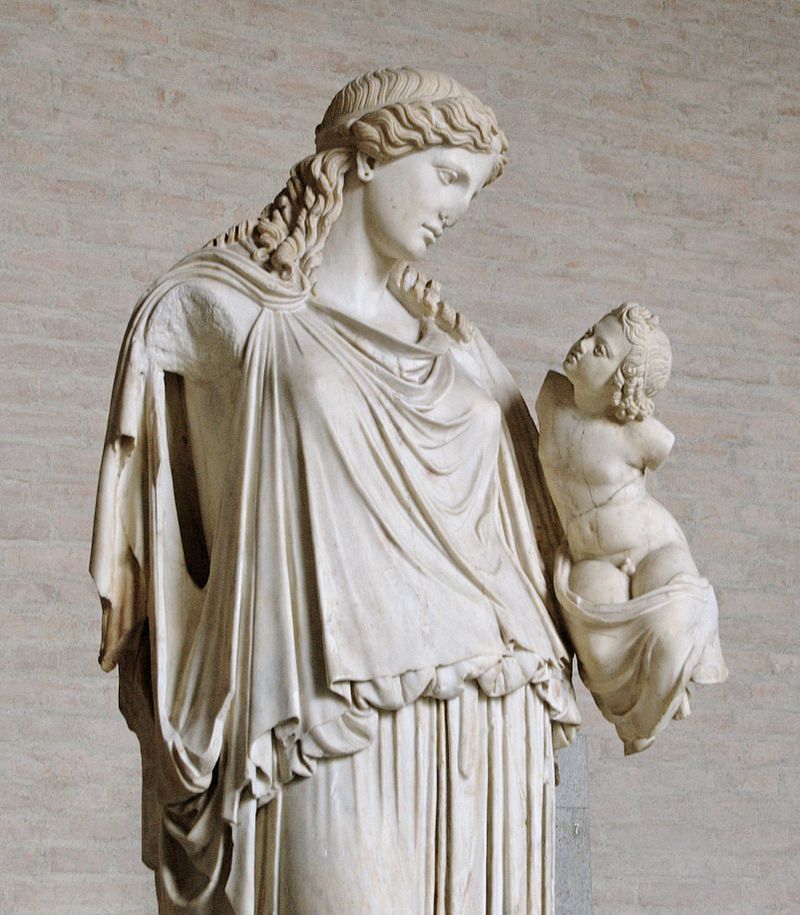
Eirene
ancient Greek goddess of peace

Momus
thumb|upright=1.6|''Momus Criticizes the Gods' Creations, by Maarten van Heemskerck, 1561, [[Gemäldegalerie, Berlin]]
Momus (; Ancient Greek: Μῶμος Momos'') in Greek mythology was the personification of satire and mockery, two stories about whom figure among Aesop's Fables. During the Renaissance, several literary works used him as a mouthpiece for their criticism of tyranny, while others later made him a critic of contemporary society. Onstage he finally became the figure of harmless fun. Today, celebrations of Momus survive in the Momoeria New Year's festivals of Northern Greece.
Zelus
In Greek mythology, Zelus or Zelos (; ) was the daimon that personifies dedication, emulation, eager rivalry, envy, jealousy, and zeal. The English word "zeal" is derived from his name.

Thalassa
upright=1.5|thumb|A 5th-century Roman mosaic of Thalassa, in the Hatay Archaeological Museum

Anemoi
thumb|Wind rose of ancient Greece, created by the scholar [[Adamantios Korais around 1796]]
Atë
ancient Greek goddess of mischief

Anteros
In Greek mythology, Anteros (; ) is the god of requited love (literally "love returned" or "counter-love") and also the punisher of those who scorn love and the advances of others, or the avenger of unrequited love.
Keres
In Greek mythology, the Keres (; Ancient Greek: Κῆρες) were female death-spirits. They were the goddesses who personified violent death and who were drawn to bloody deaths on battlefields. Although they were present during death and dying, they did not have the power to kill. All they could do was wait and then feast on the dead. The Keres were daughters of Nyx, and as such the sisters of beings such as Moirai, who controlled the fate of souls, and Thanatos, the god of peaceful death. Some later authorities, such as Cicero, called them by a Latin name, Tenebrae ("the Darknesses"), and named th
%20MET%20SF0728651b.jpg)
Peitho
In Greek mythology, Peitho ( or 'winning eloquence') is the personification of persuasion. She is a goddess of charming speech. She is typically presented as an important companion of Aphrodite. Her opposite is Bia, the personification of force. As a personification, she was sometimes imagined as a goddess and sometimes an abstract power with her name used both as a common and proper noun. There is evidence that Peitho was referred to as a goddess before she was referred to as an abstract concept, which is rare for a personification. Peitho represents both sexual and political persuasion. She

Eunomia
right|thumb|Eunomia top right with Dike, Eirene and Themis, on a ceiling painting in Den Haag
Apate
In Greek mythology, Apate (; Ancient Greek: Ἀπάτη Apátē) is the goddess and personification of deceit. Her mother is Nyx, the personification of the night. In Roman mythology her equivalent is Fraus (Fraud), while her male counterpart is Dolus (Deception), both considered children of Nyx and Erebus according to Cicero. Her opposite number Aletheia, the goddess of truth.
Agon
'''''' () is the Greek deity who personified conflict, struggle or contest. This could be a contest in athletics, in chariot or horse racing, or in music or literature at a public festival in ancient Greece. is the word-forming element in 'agony', explaining the concept of agon(y) in tragedy by its fundamental characters, the protagonist and antagonist.
Geras
In Greek mythology, Geras () is the god of old age. He was typically depicted as a tiny, shriveled old man. Gēras's opposite was Hebe, the goddess of youth. In Latin, he is referred to as Senectus. He is known primarily from vase depictions that show him with the hero Heracles; the mythic story that inspired these depictions has been lost. Otherwise, Geras has a very limited role in both religion and mythology.

Oneiroi
thumb|"Nestor Appearing in a Dream to Agamemnon" (1805) by Henry Fuseli
Moros
In Greek mythology, Moros /ˈmɔːrɒs/ () or Morus /ˈmɔːrəs/ is the personified spirit of impending doom, who drives mortals to their deadly fate. It was also said that Moros gave people the ability to foresee their death. His Roman equivalent was Fatum.
Pheme
In Greek mythology, Pheme ( ; Greek: , Phēmē), also known as Ossa ("Rumor") in Homeric literature, was the divine personification of fame, renown, and rumors. Her equivalent in Roman mythology, Fama, was likewise the personification of fame, and was depicted similarly in Roman literature and art. Both goddesses represented the two-sided nature of fame; those in their favor received notability and praise, while those subject to their wrath were haunted by scandal and rumors.
Aion
deity in Hellenistic mythology
.jpg)
Philotes
In Greek mythology, Philotes (; Ancient Greek: ) was a minor goddess or spirit (daimones) personifying affection, friendship, and sexual intercourse.

Erotes
thumb|Two Erotes, depicted on a Campanian [[hydria by the Danaid Painter, c. 340–320 BC]]
In Ancient Greek religion and mythology, the Erotes (; , érōtes) are a collective of winged gods associated with love and sexual intercourse. They are part of Aphrodite's retinue, along with the Charites. Erotes is the plural of Eros ("Love, Desire"), who as a singular deity has a more complex mythology.

Himeros
In Greek mythology and ancient Greek religion, Himeros () is a winged love deity who is part of Aphrodite's procession. Often described as "sweet", he is the god and personification of desire and lust.

Iacchus
thumb|Iacchus (?), with a torch in each hand, on the Ninnion Tablet, 350s BC, [[National Archaeological Museum of Athens 11036.]]
Dysnomia
ancient Greek deity
Pandia
In Greek mythology, the goddess Pandia or Pandeia (, meaning "all brightness") was a daughter of Zeus and the goddess Selene, the Greek personification of the moon. From the Homeric Hymn to Selene, we have: "Once the Son of Cronos [Zeus] was joined with her [Selene] in love; and she conceived and bare a daughter Pandia, exceeding lovely amongst the deathless gods." An Athenian tradition perhaps made Pandia the wife of Antiochus, the eponymous hero of Antiochis, one of the ten Athenian tribes (phylai).
Oizys
In Greek mythology, Oizys (; ), or Oezys (Οἰζύς), is the personification of pain or distress. In Hesiod's Theogony, Oizys is one of the offspring of Nyx (Night), produced without the assistance of a father. Oizys has no distinct mythology of her own.