Category
page 1Soviet Union–United Kingdom relations

Yalta Conference
1945 WWII Allied discussion of post-war reorganization
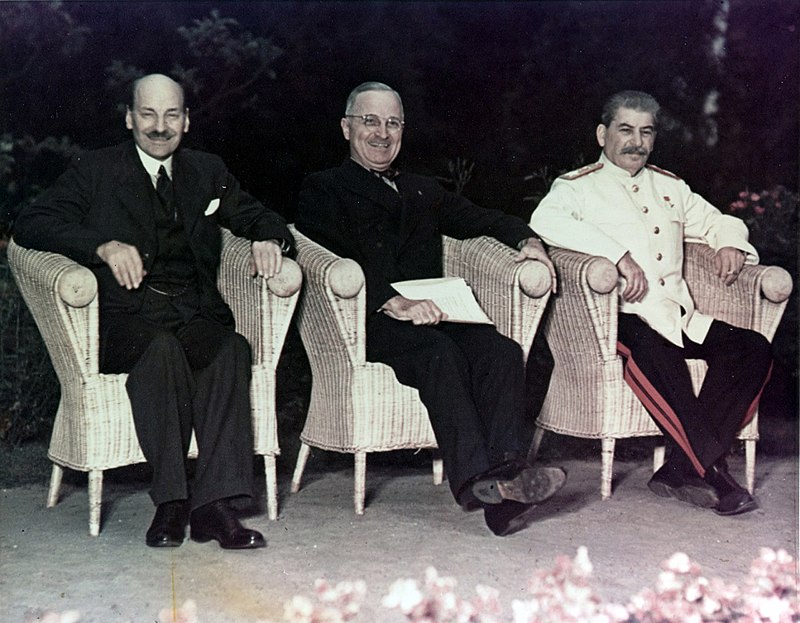
Potsdam Conference
meeting of the Allied heads of state near the end of World War II
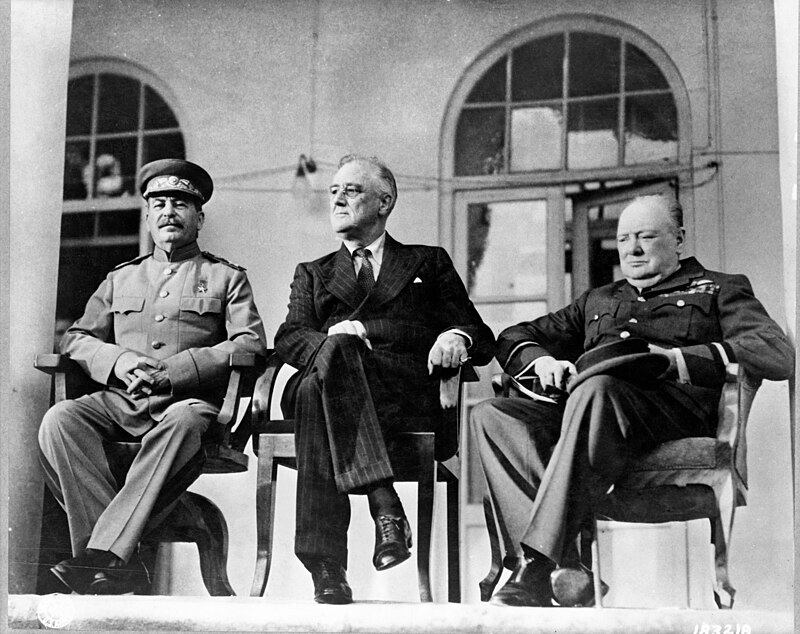
Tehran Conference
strategy meeting of the leaders of the USSR, the USA, and the UK in Tehran in 1943 during World War 2

Curzon Line
historical demarcation line between territories kept by post-WW2 Poland and territories given to the Soviet Union

T-26

Treaty on the Final Settlement with Respect to Germany
1990 treaty making Germany fully independent

T-35
The T-35 was a Soviet multi-turreted heavy tank of the interwar period and early Second World War that saw limited service with the Red Army. Often called a "land battleship", it was the only five-turreted heavy tank in the world to reach production, but proved to be slow and mechanically unreliable. Most of the T-35 tanks still operational at the time of Operation Barbarossa were lost due to mechanical failure rather than enemy action. It was designed to complement the contemporary T-28 medium tank; however, very few were built.
Montreux Convention
agreement regulating naval vessels in the Turkish Straits
Cambridge Five
former ring of spies in the United Kingdom
Operation Unthinkable
two plans commissioned by Winston Churchill for a war between the Western Allies and the Soviet Union in 1945
Allied Control Council
military occupation governing body of the Allied Occupation Zones in Germany
Profumo Affair
British political scandal
Antonov Airlines
Ukrainian cargo airline
GIUK gap
the passages between the northern Atlantic Ocean and the Norwegian Sea (Greenland - Iceland - United Kingdom)
Moscow Declaration
allied Powers' agreement in the wane of WWII
percentages agreement
secret informal agreement between British Prime Minister Winston Churchill and Soviet leader Joseph Stalin during the Fourth Moscow Conference in October 1944
Moscow Conference (1943)
Collective term for several conferences of the Allied Great Powers in Moscow
Zinoviev letter
political forgery, falsely attributed to Grigory Zinoviev
Soyuz TM-12
1991 Soviet crewed spaceflight to Mir
United Nations Security Council Resolution 135
United Nations Security Council resolution
Moscow Conference (1944)
conference Held in Moscow
Sword of Stalingrad
King George VI's historic sword of the United Kingdom
Seven Days to the River Rhine
1979 Soviet military simulation exercise
Lionel Crabb
British Royal Navy frogman, lost at sea under mysterious circumstances (1909–1956)
Operation Keelhaul
forced repatriation of former Soviet Armed Forces POWs of Germany
HMS Royal Sovereign
1915 Revenge-class super-dreadnought battleship
Four Power Agreement on Berlin
International treaty
Geneva Summit
Cold War-era meeting in Geneva, Switzerland, held on July 18, 1955
Moscow Conference (1941)
first Moscow conference
1972 European Cup Winners' Cup Final
association football match
Moscow Conference 1945
allied Powers' meeting for post-war plans in Asia

Dunsterforce
Dunsterforce was an Allied military force, established in December 1917 and named after its commander, Major-General Lionel Dunsterville. The force comprised fewer than 350 Australian, New Zealand, British and Canadian officers and NCOs, who were drawn from the Western and Mesopotamian fronts. The force was intended to organise local units in northern Iran (Persia) and South Caucasus, to replace the Tsarist army that had fought the Ottoman armies in Armenia. The Russians had also occupied northern Iran in co-operation with the British occupation of southern Iran, to create a cordon to prevent
Anglo-Soviet Treaty of 1942
treaty
Anglo-Soviet Agreement
1941 alliance between the United Kingdom and Soviet Union
atomic spies
WWII Soviet nuclear-research spies in the West
Moscow Conference (1942)
Allied conference during WWII
Operation Sunrise
secret surrender negotiations between the US and German military forces in Italy

Embassy of Russia, London
diplomatic mission of Russia in the United Kingdom

Raid on Kirkenes and Petsamo
military operation in 1941

Embassy of the United Kingdom, Moscow
Operation Jungle
1945–1955 British Secret Intelligence Service program to infiltrate its agents into Poland and Baltic states
Repatriation of Cossacks after World War II
forcible repatriation of Cossacks to the Soviet Union
Berlin Conference
Diplomatic conference
HMS Unbroken
1941 U-class submarine
European Advisory Commission
commission that was set up by the Allies during WW2 to make recommendations about postwar political problems in Europe
HMS Sunfish
1936 S-class submarine
Ain Mere
Estonian SS officer (1903–1969)
Council of Foreign Ministers
international body
Lord Byron School
school in Gyumri, Shirak, Armenia
Town-class destroyer
1940 class of British destroyers
Portland spy ring
Soviet spy ring that operated in England
Information Research Department
government agency
RMS Ivernia
Saxonia class ocean liner
All Russian Co-operative Society
UK business
Dubna 48K
home computer
World Congress of Intellectuals in Defense of Peace
convened in Wrocław, Poland, 1948
HMS L55
1918 L-class submarine
Hobbit
computer
Lucy spy ring
World War II spy ring
Operation Silver
operation in Allied-occupied Austria which ran from 1949 to 1955 that covertly tapped into the landline communications of the Soviet Army headquarters in Vienna