Category
page 1Writers of the Edo period

Matsuo Bashō
Japanese poet (1644–1694)
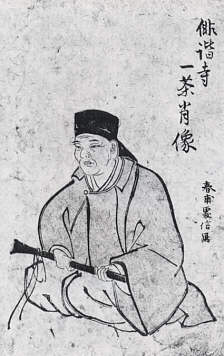
Kobayashi Issa
Japanese writer (1763-1828)

Yosa Buson
poet and painter from Japan (1716–1784)
Ihara Saikaku
Japanese writer
Takakazu Seki
Japanese mathematician
Chikamatsu Monzaemon
Japanese playwright
Yamamoto Tsunetomo
samurai (1659-1719)
Motoori Norinaga
Japanese scholar and philosopher (1730–1801)
Arai Hakuseki
Japanese scholar and official (1657–1725)
KYOKUTEI Bakin
Japanese novelist in the late Edo period (1767 - 1848)

Ryōkan
was a quiet and unorthodox Sōtō Zen Buddhist monk who lived much of his life as a hermit. Ryōkan is remembered for his poetry and calligraphy, which present the essence of Zen life.

Ueda Akinari
Japanese writer (1734–1809)
Fukuda Chiyo-ni
Japanese writer (1703-1775)
Hayashi Razan
Japanese philosopher (1583–1657)
Hiraga Gennai
Japanese pharmacologist and writer (1728-1780)
Ogyū Sorai
Japanese philosopher (1666–1728)
Tokugawa Nariaki
Japanese daimyo (1800-1860)
Hirata Atsutane
conventionally ranked as one of the four great men of kokugaku studies, and one of the most significant theologians of the Shintō religion
Kaibara Ekken
Japanese Confucianist Philosopher, Pre-Linnaean botanist, physician (1630-1714)
Yamazaki Ansai
Japanese philosopher
Yasuaki Aida
Japanese mathematician
Hanabusa Itchō
Japanese artist (1652–1724)
Ōshio Heihachirō
Japanese samurai, Neo-Confucianism scholar and rebel leader in the late-Edo period
Sugita Genpaku
Japanese scholar
Takarai Kikaku
Japanese poet
Hanawa Hokiichi
Japanese philosopher (1746-1821)
Kamo no Mabuchi
Japanese philosopher
Santō Kyōden
Japanese poet and artist (1761–1816)
Nakae Tōju
Japanese philosopher
Jippensha Ikku
Japanese writer (1765–1831)
Yamaga Sokō
Japanese philosopher (1622-1685)
Fujiwara Seika
philosopher (1561-1619)
Ōtagaki Rengetsu
Japanese Buddhist nun, poet, potter and artist (1791–1875)
Itō Jinsai
Japanese philosopher (1627–1705)
Yoshida Mitsuyoshi
Japanese Mathematician

Keichū
thumb|upright=1.5|Keichū
was a Buddhist priest and a scholar of Kokugaku in the mid Edo period. Keichū's grandfather was a personal retainer of Katō Kiyomasa but his father was a rōnin from the Amagasaki fief. When he was 13, Keichū left home to become an acolyte of the Shingon sect, studying at Kaijō in Myōhōji, Imasato, Osaka. He subsequently attained the post of Ajari (or Azari) at Mount Kōya, and then became chief priest at Mandara-in in Ikutama, Osaka. It was at this time that he became friends with the poet-scholar Shimonokōbe Chōryū (下河辺長流, 1624–1686).
Kada no Azumamaro
poet
Ogata Kōan
Japanese physician (1810–1863)
Shikitei Sanba
Japanese writer (1776–1822)
Tanomura Chikuden
Japanese artist (1777-1835)
Matsunaga Teitoku
Japanese poet
Ajima Naonobu
Japanese mathematician
Takebe Katahiro
Japanese mathematician
Hayashi Gahō
Japanese philosopher (1618–1688)
Nishiyama Sōin
Japanese writer (1605-1682)
Aoki Kon'yō
Confucian scholar (1698-1769)
Kawatake Mokuami
Japanese dramatist of Kabuki (1816–1893)
Kumazawa Banzan
Japanese philosopher (1619–1691)
Daidōji Yūzan
samurai in Edo period (1639–1730)
Satō Nobuhiro
Japanese scientist (1769-1850)
Ōta Nanpo
Japanese poet, fiction writer and samurai bureaucrat of the late-edo period (1749–1823)
Uejima Onitsura
Japanese poet and writer
Mukai Kyorai
Japanese poet
Wada Nei
Japanese mathematician
Hayashi Shihei
samurai
Hayashi Hōkō
Japanese philosopher (1644-1732)
Yokoi Kinkoku
Japanese poet and painter (1761-1832)
Satō Issai
Japanese Confucian scholar
Kambei Mori
Japanese mathematician
Tachibana Akemi
Japanese writer (1812–1868)