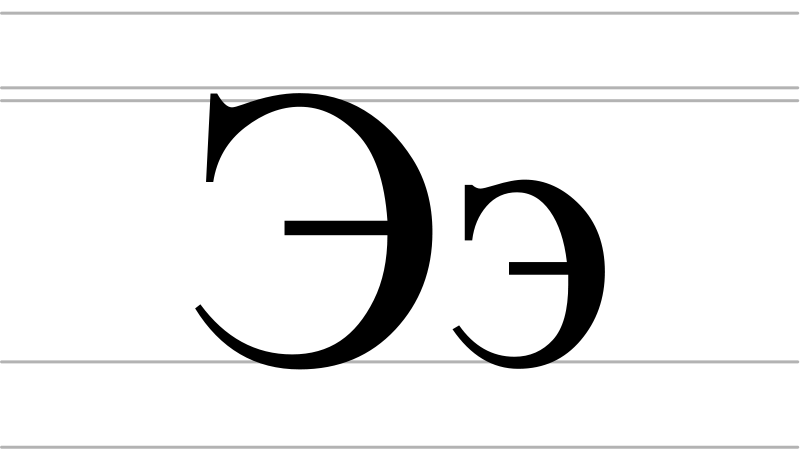
File:Cyrillic_letter_E_-_uppercase_and_lowercase.svg · Wikimedia Commons · See Wikimedia Commons
Also known as Backwards E
letter found amongst Slavonic languages only in Russian and Belarusian
"Э" is a vowel letter used in Russian and Belarusian that doesn't appear in other Slavonic languages. It represents a specific vowel sound and is important for correctly spelling and pronouncing words in these two languages.
AI-generated from the Wikipedia summary — may contain errors.
Wikidata facts
- Part of
- Belarusian Cyrillic alphabet
- Image
- Cirila-э-minuskla.svg
Show 2 more facts
- Unicode character
- э
- Commons category
- Э (cyrillic letter)
Sources (2)
via Wikidata · CC0
~7 min read
Encyclopedic overview
E, from the Alphabet Book оf the Red Army Soldier (1921) E (Э э; italics: Э э or Э э; italics: Э э); also known as backwards ye, from Russian е оборо́тное, ye oborótnoye, [ˈjɛ ɐbɐˈrotnəjə] is a letter found in three Slavic languages: Russian, Belarusian, and West Polesian. It represents the vowels [e] and [ɛ], as the e in the word "editor". In other Slavic languages that use the Cyrillic script, the sounds are represented by Ye (Е е), which in Russian and Belarusian represents [je] in initial and postvocalic position or [e] with palatalization of the preceding consonant. This letter closely resembles and should not be confused with the older Cyrillic letter Ukrainian Ye (Є є), of which Э is a backwards version.
In Cyrillic Moldovan, which was used in the Moldovan SSR during the Soviet Union and is still used in Transnistria, the letter corresponds to ă in the Latin Romanian alphabet, and the phoneme [ə]. It is also used in the Cyrillic alphabets used by Mongolian and many Uralic, Caucasian and Turkic languages of the former Soviet Union.
Excerpted from Wikipedia’s “Э” article, available under the CC BY-SA 4.0 licence.
Gallery (3)
Available in 64 languages
- Español
- Français
- Deutsch
- 中文
- 日本語
- Русский
- Português
- Italiano
- العربية
- Abkhazian
- Afrikaans
- Avaric
- Bahasa Indonesia
- Bashkir
- be_x_old
- Belarusian
- Breton
- Bulgarian
Show 45 more
- Catalan
- Chuvash
- Czech
- Egyptian Arabic
- Esperanto
- Estonian
- Finnish
- Georgian
- Haitian Creole
- Hausa
- Hebrew
- Kalmyk
- Kazakh
- kge
- Komi
- Kyrgyz
- lbe
- Macedonian
- Mari
- Nederlands
- Northern Frisian
- Northern Sami
- Norwegian
- Norwegian Nynorsk
- Polski
- Romanian
- Serbian
- Silesian
- simple
- Slovak
- Slovenian
- Svenska
- Tatar
- Türkçe
- Tuvinian
- Udmurt
- Ukrainian
- Uzbek
- Wu Chinese
- Yakut
- zh_min_nan
- zh_yue
- فارسی
- ไทย
- 한국어
via Wikidata sitelinks · CC0