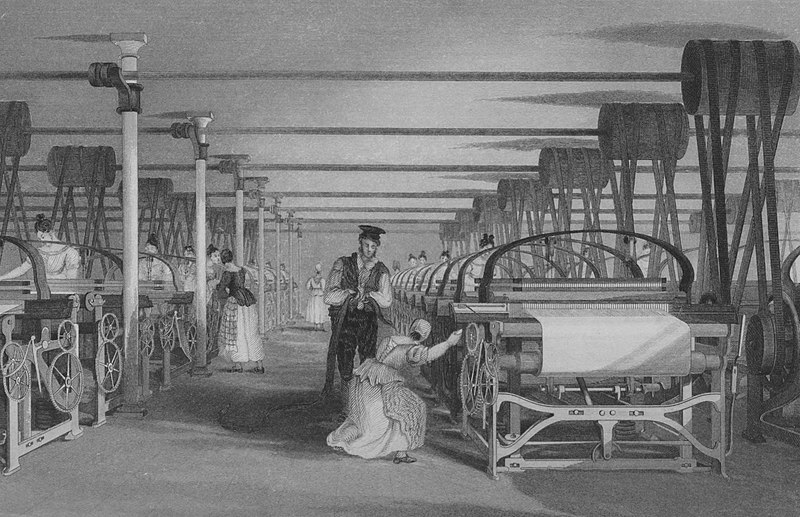
File:Powerloom_weaving_in_1835.jpg · Wikimedia Commons · See Wikimedia Commons
19th century
Sign in to saveAlso known as 19th-century, nineteenth century, 19. century, XIX Century
time period between January 1, 1801, and ended on December 31, 1900
OverviewAI-generated
The 19th century is a period of time defined by a start time of 1801 and an end time of 1900. It is identified as the 19th series ordinal in historical chronology. A specific point in time associated with this era is 1900-01-01.
This subject appears in the Commons category "19th century" and is tagged on Stack Exchange sites for history and history of science and medicine. In academic literature, it corresponds to a PubMed query count of 123963. Additionally, the concept is referenced by 1,406 other encyclopedia articles.
Synthesized by Vinony from 9 facts across 3 sources: Wikidata, PubMed, Vinony graph. Generated from structured data (not the Wikipedia text) and checked against those facts — may still contain errors.
Research
123,963 papers- Shining a Light on Some of the Most Famous 19th and 20th Century's Neuropsychologists.ReviewFrontiers of neurology and neuroscience · 2019Walusinski O, Boller F, Henderson VWDOI: 10.1159/000494964
- The history of tuberculosis.Respiratory medicine · 2006Daniel TMDOI: 10.1016/j.rmed.2006.08.006
- Hallmarks in 18th- and 19th-century epilepsy research.ReviewEpilepsy & behavior : E&B · 2010Sidiropoulou K, Diamantis A, Magiorkinis EDOI: 10.1016/j.yebeh.2010.04.004
- Surgical revolutions.Journal of investigative surgery : the official journal of the Academy of Surgical Research · 2008Toledo-Pereyra LHDOI: 10.1080/08941930802255573
- Is Today's 21st Century Burnout 19th Century's Neurasthenia?The Journal of nervous and mental disease · 2019Lipsitt DRDOI: 10.1097/NMD.0000000000001014
- Art and dystonia.ReviewJournal of the neurological sciences · 2015Garcia-Ruiz PJ, Slawek J, Sitek EJ et al.DOI: 10.1016/j.jns.2015.06.049
- [Public health services and healthcare workforce in Bakar of the 18th and 19th century].ReviewLijecnicki vjesnik · 2014Čulina T
- Brazilian plants with possible action on the central nervous system: a study of historical sources from the 16th to 19th century.ReviewJournal of ethnopharmacology · 2007Giorgetti M, Negri G, Rodrigues EDOI: 10.1016/j.jep.2006.08.003
via PubMed
Wikidata facts
- Instance of
- century
- Part of
- 2nd millennium
- Has part
- 1810s
- Followed by
- 20th century
- Follows
- 18th century
- Image
- Claude Monet, Impression, soleil levant.jpg
Show 13 more facts
- Commons category
- 19th century
- topic's main category
- Category:19th century
- point in time
- 1900-01-01
- name
- Ottocento
- start time
- 1801-00-00
- end time
- 1900-00-00
- series ordinal
- 19
- related category
- Category:19th century-related lists
- Stack Exchange tag
- hsm.stackexchange.com/tags/19th-century
- category for births in this time period
- Category:19th-century births
- category for deaths in this time period
- Category:19th-century deaths
- P8168
- cover girl
via Wikidata · CC0
~40 min read
Encyclopedic overview
An 1835 illustration of power loom weaving, as part of the Industrial Revolution
The 19th century began on 1 January 1801 (represented by the Roman numerals MDCCCI), and ended on 31 December 1900 (MCM). It was the 9th century of the 2nd millennium. It was characterized by vast social upheaval. Slavery was abolished in much of Europe and the Americas. The First Industrial Revolution, though it began in the late 18th century, expanded beyond its British homeland for the first time during the 19th century, particularly remaking the economies and societies of the Low Countries, France, the Rhineland, Northern Italy, and the Northeastern United States. A few decades later, the Second Industrial Revolution led to ever more massive urbanization and much higher levels of productivity, profit, and prosperity, a pattern that continued into the 20th century. The Catholic Church, in response to the growing influence and power of modernism, secularism and materialism, formed the First Vatican Council in the late 19th century to deal with such problems and confirm certain Catholic doctrines as dogma. Religious missionaries were sent from the Americas and Europe to Asia, Africa and the Middle East.
Excerpted from Wikipedia’s “19th century” article, available under the CC BY-SA 4.0 licence.
Gallery (12)
Available in 168 languages
- Español
- Français
- Deutsch
- 中文
- 日本語
- Русский
- Português
- Italiano
- العربية
- हिन्दी
- Afrikaans
- Albanian
- Albanian
- Amharic
- Aragonese
- Armenian
- Arpitan
- Asturian
Show 149 more
- Avaric
- azb
- Azerbaijani
- Bahasa Indonesia
- Balinese
- Bangla
- Bashkir
- Basque
- bat_smg
- be_x_old
- Belarusian
- Bosnian
- Breton
- Bulgarian
- Burmese
- Catalan
- cdo
- Cebuano
- Central Kurdish
- Chechen
- Chuvash
- Cornish
- Corsican
- Croatian
- Czech
- Danish
- Egyptian Arabic
- eml
- Erzya
- Esperanto
- Estonian
- Extremaduran
- Faroese
- Fiji Hindi
- Filipino
- Finnish
- fiu_vro
- Friulian
- Gagauz
- Galician
- Gan Chinese
- Georgian
- Greek
- Guarani
- Haitian Creole
- Hebrew
- Hungarian
- Icelandic
- Ido
- Inari Sami
- Ingush
- Interlingua
- Irish
- Javanese
- Kabyle
- Kazakh
- Komi
- Kotava
- Kurdish
- Kyrgyz
- Lao
- Latgalian
- Latin
- Latvian
- Lezghian
- Ligurian
- Limburgish
- Lingua Franca Nova
- Lithuanian
- Lojban
- Lombard
- Low German
- Luxembourgish
- Macedonian
- Malay
- Malayalam
- Manx
- Māori
- map_bms
- Marathi
- Mari
- Mingrelian
- Mongolian
- Moroccan Arabic
- nah
- nds_nl
- Neapolitan
- Nederlands
- Northern Frisian
- Northern Sami
- Northern Sotho
- Norwegian
- Norwegian Nynorsk
- Novial
- nrm
- Occitan
- Ossetic
- Papiamento
- Polski
- Punjabi
- Quechua
- Romanian
- Romansh
- Rusyn
- Saterland Frisian
- Scots
- Scottish Gaelic
- Serbian
- Serbian (Latin)
- Shan
- Sicilian
- Silesian
- simple
- Sindhi
- Sinhala
- Slovak
- Slovenian
- Sundanese
- Svenska
- Swahili
- Tajik
- Talysh
- Tamil
- Tatar
- Telugu
- Tiếng Việt
- Türkçe
- Turkmen
- Ukrainian
- Urdu
- Uyghur
- Uzbek
- Venetian
- Volapük
- Walloon
- Waray
- Welsh
- Western Frisian
- Western Panjabi
- Wu Chinese
- Yakut
- Yiddish
- Zaza
- Zeelandic
- zh_min_nan
- zh_yue
- فارسی
- ไทย
- 한국어
via Wikidata sitelinks · CC0