
Image by Ortiz2000 on Pixabay · Pixabay License
Picture of the Day · NASA
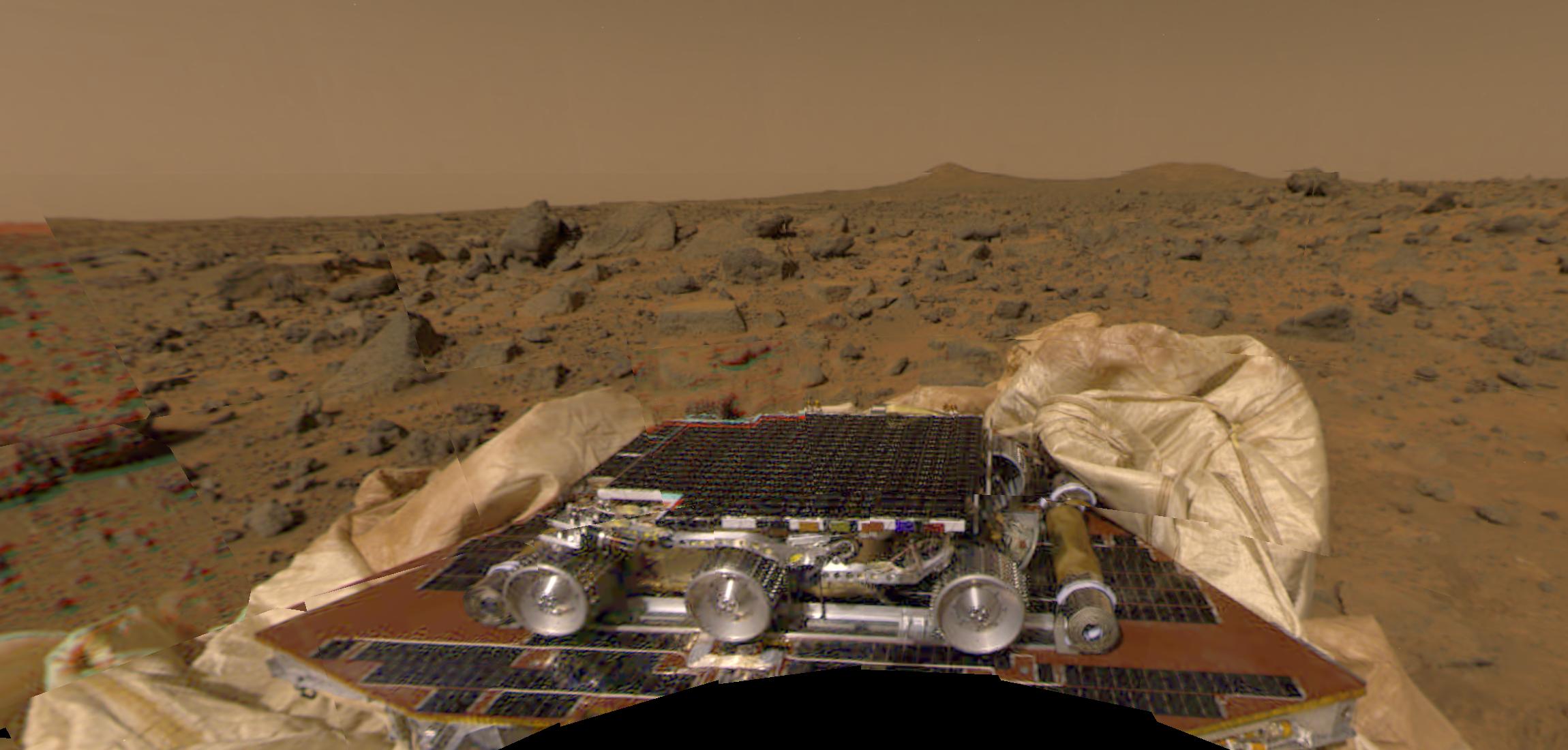
Pathfinder on Mars
2026-07-04
On July 4th, 1997, using its own array of fireworks, a parachute, and a cocoon of airbags, the Mars Pathfinder spacecraft bounced like a giant beach ball at least 15 times before it came to rest on the surface of Mars at 10:07 AM Pacific Daylight Time. After its then novel airbag-assisted landing sequence was completed, Pathfinder transmitted this color mosaic to mission operators on Earth. In the scene from another world, the Mars Sojourner robot rover is visible in the foreground, crouched on top of the unfolded Pathfinder. About the size of a large house cat, the six-wheeled, solar-powered Sojourner became the first successful Martian rover. Surrounding Pathfinder are deflated airbags and the rock-strewn terrain of the Ares Vallis floodplain. In the distance Martian hills appear against a dusty brownish sky. The Pathfinder lander was subsequently renamed the Carl Sagan Memorial Station.
via NASA APOD
Key facts
- Discovered by
- D. Stewart
- Discovery date
- 14 August 1901
- Pronunciation
- / ˈ ɒ k l oʊ /
- Named after
- Mama Uqllu , legendary first queen of the Kingdom of Cuzco
- Alternative designations
- 1901 HN; 1959 JS;, 1979 DD
- Minor planet category
- Mars-crosser
- Observation arc
- 97.47 yr (35601 d)
- Aphelion
- 3.5821 AU (535.87 Gm )
- Perihelion
- 1.60661 AU (240.345 Gm)
- Semi major axis
- 2.59436 AU (388.111 Gm)
- Orbital period sidereal
- 4.18 yr (1526.3 d )
- Mean anomaly
- 174.037 °
- Mean motion
- 0° 14 9.096 / day
- Inclination
- 18.926°
- Longitude of ascending node
- 34.496°
- Argument of perihelion
- 305.68°
- Earth moid
- 0.670978 AU (100.3769 Gm)
- Mars moid
- 0.3173 AU (47.47 Gm)
via Wikipedia infobox
Wikidata facts
- Instance of
- asteroid
- Named after
- Mama Ocllo
- Followed by
- 476 Hedwig
- Follows
- 474 Prudentia
- Parent body
- Sun
- Minor-planet group
- Mars-crossing asteroid
- Diameter
- 17.83
- Mass
- 31
- Orbital period
- 1525.462154072521
Show 18 more facts
- discoverer or inventor
- DeLisle Stewart
- provisional designation
- 1979 DD
- time of discovery or invention
- 1901-08-14
- orbital inclination
- 18.95097221048167
- Commons category
- 475 Ocllo
- albedo
- 0.057
- rotation period
- 7.3151
- asteroid spectral type
- X-type asteroid
- absolute magnitude
- 11.54
- orbital eccentricity
- 0.3790444628956401
- semi-major axis of an orbit
- 2.593395027141812
- periapsis
- 1.61038300200262
- apoapsis
- 3.576407052281003
- longitude of ascending node
- 34.40548430445712
- argument of periapsis
- 305.8510239597227
- mean anomaly
- 255.7218441402239
- time of periapsis
- 2461442.367722946
- epoch
- November 21, 2025
Sources (2)
via Wikidata · CC0
~1 min read
Encyclopedic overview
475 Ocllo is a large Mars-crossing asteroid. It was discovered by American astronomer DeLisle Stewart on August 14, 1901, and was assigned a provisional name of 1901 HN.
Photometric observations of this asteroid at the Organ Mesa Observatory in Las Cruces, New Mexico during 2010 gave a light curve with a period of 7.3151 ± 0.0002 hours and a brightness variation of 0.66 ± 0.04 in magnitude.
Excerpted from Wikipedia’s “475 Ocllo” article, available under the CC BY-SA 4.0 licence.