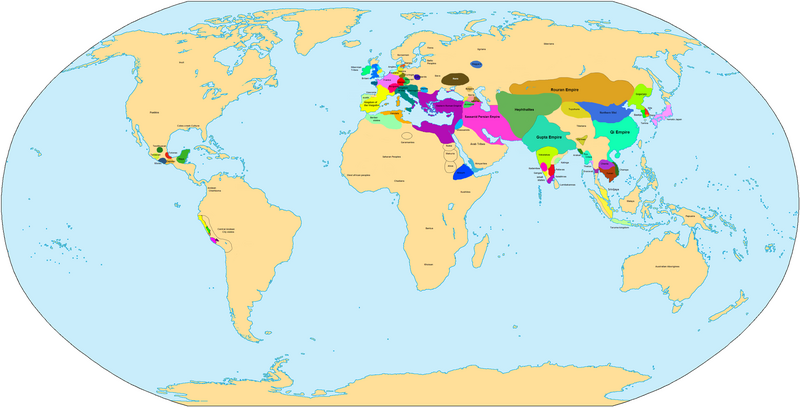
File:The_world_in_500_CE.PNG · Wikimedia Commons · See Wikimedia Commons
Also known as AD 500, 500 AD, 500 A.D., 500 CE
year
I don't have enough context to write an accurate overview. You've indicated that "500" relates to the year, but without knowing which specific "500" you're referring to (500 CE, 500 BC, the year 500 in some calendar system, etc.) or what makes it significant, I cannot provide accurate information. Please provide additional context so I can write an accurate overview.
AI-generated from the Wikipedia summary — may contain errors.
Wikidata facts
Show 7 more facts
- topic's main category
- Category:500
- Commons category
- 500
- point in time
- 0500-01-01
- Commons gallery
- 500
- has list
- list of state leaders in 500
- category for births in this time period
- Category:500 births
- category for deaths in this time period
- Category:500 deaths
via Wikidata · CC0
~4 min read
Encyclopedic overview
The world in 500 Mosaic of the Arian Baptistry Codex Argenteus (c. 500)
Year 500 (D) was a leap year starting on Saturday of the Julian calendar. At the time, it was known as the Year of the Consulship of Patricius and Hypatius (or, less frequently, year 1253 Ab urbe condita). The denomination 500 for this year has been used since the early medieval period, when the Anno Domini calendar era became the prevalent method in Europe for naming years. The year 500 AD is considered the beginning of the Middle Ages, approximately.
Excerpted from Wikipedia’s “500” article, available under the CC BY-SA 4.0 licence.
Gallery (3)
Available in 127 languages
- Español
- Français
- Deutsch
- 中文
- 日本語
- Русский
- Português
- Italiano
- العربية
- हिन्दी
- Abkhazian
- Afrikaans
- Albanian
- Albanian
- Amharic
- Aragonese
- Armenian
- Asturian
Show 108 more
- azb
- Azerbaijani
- Bahasa Indonesia
- Balinese
- Bangla
- Basque
- Bavarian
- be_x_old
- Belarusian
- Bishnupriya
- Bosnian
- Breton
- Bulgarian
- Catalan
- cbk_zam
- cdo
- Cebuano
- Chuvash
- Crimean Tatar
- Croatian
- Czech
- Danish
- Egyptian Arabic
- eml
- Esperanto
- Estonian
- Faroese
- Filipino
- Finnish
- Galician
- Gan Chinese
- Georgian
- Greek
- Haitian Creole
- Hebrew
- Hungarian
- Icelandic
- Ido
- Irish
- Javanese
- Kazakh
- Latin
- Latvian
- Ligurian
- Lithuanian
- Lombard
- Low German
- Luxembourgish
- Macedonian
- Malagasy
- Malay
- map_bms
- Marathi
- Mari
- Mazanderani
- Mingrelian
- Moksha
- nah
- nds_nl
- Neapolitan
- Nederlands
- Newari
- Northern Frisian
- Northern Sotho
- Norwegian
- Norwegian Nynorsk
- Occitan
- Odia
- Ossetic
- Polski
- Punjabi
- Quechua
- Romanian
- Rusyn
- Sanskrit
- Scottish Gaelic
- Serbian
- Serbian (Latin)
- Shan
- simple
- Sindhi
- Slovak
- Slovenian
- Sundanese
- Svenska
- Swahili
- Tajik
- Talysh
- Tatar
- Tiếng Việt
- Türkçe
- Turkmen
- Ukrainian
- Urdu
- Uzbek
- Venetian
- Waray
- Welsh
- West Flemish
- Western Frisian
- Western Mari
- Western Panjabi
- Wu Chinese
- zh_min_nan
- zh_yue
- فارسی
- ไทย
- 한국어
via Wikidata sitelinks · CC0