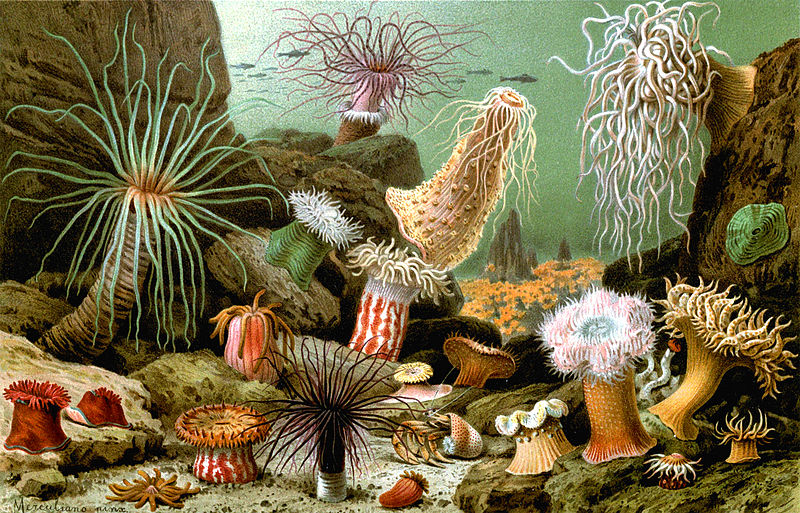
File:Actiniaria.jpg · Wikimedia Commons · See Wikimedia Commons
OverviewAI-generated
Actiniaria is an order of sea anemones within the class Hexacorallia, phylum Cnidaria, and kingdom Animalia. The taxon was described by Hertwig in 1882 and is currently accepted. It has existed since approximately 508 million years ago. Common names for this group include sea anemones, sasanky, Søanemone, and Seeanemonen.
The order inhabits marine, brackish, and freshwater environments. Records from iDigBio indicate presence in the United States, El Salvador, Israel, Brazil, and Ecuador, with specimens held by institutions such as YPM, CAS, and SIO. The taxon has been documented in 2,490 PubMed entries and 2,665,358 GBIF occurrences.
Synthesized by Vinony from 34 facts across 7 sources: Wikidata, GBIF, PubMed, Gbif Occ, iDigBio, WoRMS, Vinony graph. Generated from structured data (not the Wikipedia text) and checked against those facts — may still contain errors.
Species
sea anemones
Actiniaria
ORDER
- KingdomAnimalia
- PhylumCnidaria
- ClassAnthozoa
- OrderActiniaria
本文介紹的是一種水生生物。關於名為海葵的颱風,請見「颱風海葵」。 海葵目(學名:Actiniaria,英语:sea anemones),六放珊瑚亚纲的一目。虽然海葵目动物看上去很像花朵,但其实是捕食性动物,有些海葵本身是透明的,產生黃褐色乃至紅、綠等的色彩是靠共生藻和本身的色素生成,因而牠主要還是以光合作用來提供能源。这种无脊椎动物没有骨骼,锚靠在海底固定的物体上,如岩石和珊瑚。它们可以很缓慢的移动,但緊急的時候少數品種甚至會擺動軀體來游泳。海葵非常长寿,通常可以生存數百年,甚至有發現到2000多歲的高齡海葵。寄居蟹有时会把海葵背在背上作为伪装,也有很多生物與之共生。 目录 1 分布 2 特征 3 习性 3.1 食物 3.2 繁殖 3.3 共生 3.4 天敌 4 外部链接 分布 海葵多数栖息在浅海和岩岸的水洼或石缝中,少数生活在大洋深渊,生活在水深100m至10210m深的水域。在超深海底栖动物组成中,所占的比例较大。这类动物的巨型个体一般见于热带海区,如口盘直径有1米的大海葵只分布在珊瑚礁上。海葵目共有1000种以上,产于泥沙或石隙中。 特征 口盘中央为口,周围有触手,由十几个到多的达千个以上的都有,如珊瑚礁上的大海葵。珊瑚利用触手捕捉獵物維生。 一类隔膜以6为基数,一般为不分泌骨骼的单体珊瑚; 触手一般都按6和6的倍数,在口周排成多环,彼此互生;内环先生较大,外环后生较小,在海水中延展形似葵花,故名; 触手上布满刺细胞,用做御敌和捕食。大多数海葵的基盘用于固着,有时也能作缓慢移动。少数无基盘,埋栖于泥沙质海底,有的海葵能以触手在水中游泳。 海葵形态,颜色和体形各异。辐射对称,桶型躯干,上端有一个开口,开口旁边有触手。触手起保护作用,还可以抓紧食物。触手上面布有微小的倒刺。海葵通常身長1.8~3厘米(0.71~1.18英寸),但有一些甚至可长到2米(6英尺7英寸),或小於4毫米(0.16英寸)。[1] 习性 食物 海葵是肉食性动物,捕食鱼、贝壳和浮游动物(如橈腳類、甲壳类动物还有微小的海洋幼虫)以及蠕虫。它们用带有分泌毒液的刺胞細胞(nematocysts)的触手去捕取食物。 繁殖 海葵可以行斷裂生殖,也可以行有性生殖,生成浮游的幼蟲。 海葵为雌雄同体或雌雄异体。在雌雄同体的种类中,雄性先熟。多数海葵的精子和卵是在海水中受精,发育成浮浪幼虫;少数海葵幼体在母体内发育。有些种类通过无性生殖,由亲体分裂为2个个体;还有些种类是在基盘上出芽,然后发育出新的海葵。 共生 海葵与小丑鱼 小丑鱼(學名:Amphiprion ocellaris)总生活在海葵旁边,其对海葵的有毒触手免疫,还借助后者保护自己。而雀鲷类珊瑚鱼则帮助海葵清理触手甚至赶走入侵者,此即「互利共生」。 有一种叫拳击蟹(Lybia tesselata,或叫啦啦隊員蟹)的动物,用它们的螯去拿着两个海葵,
via GBIF
Museum specimens
- Specimen records
- 6,847
- With media
- 642
- Collections
- YPM, CAS, SIO
- Recorded in
- United States, El Salvador, Israel, Brazil, Ecuador
Research
2,490 papers- Towards the Exploration and Evolution of Insulin-like Venoms in Actiniaria (Sea anemones).ReviewMarine drugs · 2024Delgado A, Sozanski KS, Daly MDOI: 10.3390/md22030136
- Sea anemone (Cnidaria, Anthozoa, Actiniaria) toxins: an overview.ReviewMarine drugs · 2012Frazão B, Vasconcelos V, Antunes ADOI: 10.3390/md10081812
- Sea anemone (Anthozoa, Actiniaria) diversity in Mo'orea (French Polynesia).Molecular phylogenetics and evolution · 2024Benedict C, Delgado A, Pen I et al.DOI: 10.1016/j.ympev.2024.108118
- Cytolytic peptide and protein toxins from sea anemones (Anthozoa: Actiniaria).ReviewToxicon : official journal of the International Society on Toxinology · 2002Anderluh G, Macek PDOI: 10.1016/s0041-0101(01)00191-x
- Anthropogenic radioactive isotopes in Actiniaria from the Svalbard archipelago.Marine pollution bulletin · 2020Saniewski M, Balazy P, Saniewska DDOI: 10.1016/j.marpolbul.2020.111369
- Giant sea anemones.Current biology : CB · 2024Kashimoto R, Rickards E, Khalturin K et al.DOI: 10.1016/j.cub.2024.03.060
- Halcurias uchidai sp. nov. (Cnidaria: Actiniaria): putting a name with a face of a deep-sea anemone and amending a nomenclature lapsus.Zootaxa · 2023Rodríguez E, Lauretta DDOI: 10.11646/zootaxa.5258.1.8
- The clownfish-hosting sea anemones (Anthozoa: Actiniaria): updated nomenclature, biogeography, and practical field guide.Zootaxa · 2024Titus BM, Bennett-Smith MF, Chiodo T et al.DOI: 10.11646/zootaxa.5506.1.1
via PubMed
Wikidata facts
- Instance of
- taxon
- Parent taxon
- Hexacorallia
- Image
- Anemone monterey madrabbit.jpg
Show 7 more facts
- Commons category
- Actiniaria
- taxon name
- Actiniaria
- topic's main category
- Category:Actiniaria
- taxon common name
- morske vetrnice
- exact match
- wordnet-rdf.princeton.edu/wn30/01914609-n
- taxon rank
- order
- start time
- 508000000-
via Wikidata · CC0
~23 min read
Encyclopedic overview
Sea anemones (/əˈnɛm.ə.niː/ ə-NEM-ə-nee) are a group of predatory marine invertebrate animals constituting the order Actiniaria. Because of their colourful appearance, they are named after the Anemone, a terrestrial flowering plant. Sea anemones are classified in the phylum Cnidaria, class Anthozoa, subclass Hexacorallia. As cnidarians, sea anemones are related to corals, jellyfish, tube-dwelling anemones, and Hydra. Unlike jellyfish, sea anemones do not have a medusa stage in their life cycle.
A typical sea anemone is a single polyp attached to a hard surface by its base, but some species live in soft sediment, and a few float near the surface of the water. The polyp has a columnar trunk topped by an oral disc with a ring of tentacles and a central mouth. The tentacles can be retracted inside the body cavity or expanded to catch passing prey. They are armed with cnidocytes (stinging cells). In many species, additional nourishment comes from a symbiotic relationship with single-celled dinoflagellates, with zooxanthellae, or with green algae, zoochlorellae, that live within the cells. Some species of sea anemone live in association with clownfish, hermit crabs, small fish, or other animals to their mutual benefit.
Excerpted from Wikipedia’s “Actiniaria” article, available under the CC BY-SA 4.0 licence.
Gallery (13)
Available in 76 languages
- Español
- Français
- Deutsch
- 中文
- 日本語
- Русский
- Português
- Italiano
- العربية
- Afrikaans
- Armenian
- azb
- Azerbaijani
- Bahasa Indonesia
- Balinese
- Bangla
- Basque
- Belarusian
Show 57 more
- Bikol
- Breton
- Bulgarian
- Burmese
- Catalan
- Cebuano
- Croatian
- Czech
- Danish
- Dzongkha
- Egyptian Arabic
- Esperanto
- Estonian
- Finnish
- Galician
- Georgian
- Greek
- Hebrew
- Hungarian
- Icelandic
- Ido
- Irish
- Javanese
- Kannada
- Kazakh
- Kyrgyz
- Latvian
- Malay
- Malayalam
- Navajo
- Nederlands
- Northern Frisian
- Norwegian Nynorsk
- Ossetic
- Pashto
- Polski
- Romanian
- Sardinian
- Serbian
- Serbian (Latin)
- simple
- Slovak
- Slovenian
- Svenska
- Tajik
- Tamil
- Tiếng Việt
- Türkçe
- Ukrainian
- Urdu
- Uzbek
- Waray
- Wu Chinese
- zh_yue
- فارسی
- ไทย
- 한국어
via Wikidata sitelinks · CC0