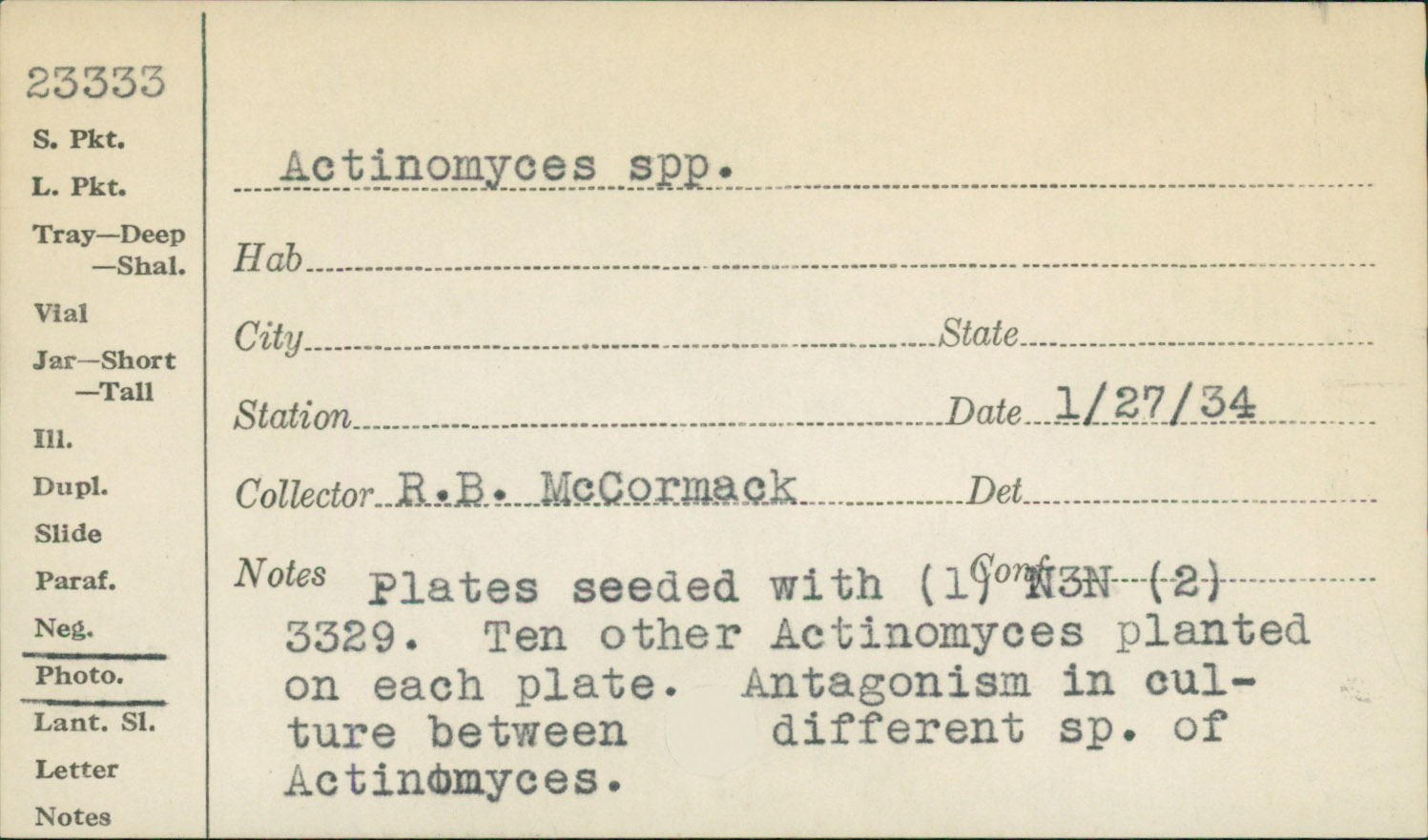
Specimen image via iDigBio · BY-NC-SA
Actinomyces
Sign in to saveActinomyces is a genus of the Actinomycetia class of bacteria. They all are Gram-positive and facultatively anaerobic, growing best under anaerobic conditions. While individual bacteria are rod-shaped, Actinomyces colonies form fungus-like branched networks of hyphae. The aspect of these colonies initially led to the incorrect assumption that the organism was a fungus and to the name Actinomyces, "ray fungus" (from Greek , ray or beam, and , fungus).
Species
GENUS
- KingdomBacteria
- PhylumActinobacteriota
- ClassActinomycetia
- OrderActinomycetales
- FamilyActinomycetaceae
via GBIF
Museum specimens
- Specimen records
- 51
- With media
- 36
- Family
- Actinomycetaceae
- Collections
- MICH, CUP, UFPE
- Recorded in
- Romania, United States, Germany, Brasil, ?, Netherlands
Research
9,516 papers- Actinomyces and related organisms in human infections.Clinical microbiology reviews · 2015
- Antimicrobial susceptibility testing of Actinomyces species with 12 antimicrobial agents.The Journal of antimicrobial chemotherapy · 2005
- Actinomyces in Pregnancy: A Review of the Literature.Obstetrical & gynecological survey · 2017
- Actinomyces and Alimentary Tract Diseases: A Review of Its Biological Functions and Pathology.BioMed research international · 2018
- Actinomyces--gathering evidence of human colonization and infection.Anaerobe · 2008
via PubMed
Wikidata facts
- Instance of
- taxon
- Parent taxon
- Actinomycetaceae
- Image
- Actinomyces israelii.jpg
Show 7 more facts
- Commons category
- Actinomyces
- taxon rank
- genus
- taxon name
- Actinomyces
- Gram staining
- gram-positive bacteria
- LPSN URL
- lpsn.dsmz.de/genus/actinomyces
- taxonomic type
- Actinomyces bovis
- nomenclatural type of
- Actinomycetaceae
Sources (3)
via Wikidata · CC0
~7 min read
Encyclopedic overview
8 sectionsContents
- Genomics
- Pathology
- Diagnosis
- Treatment
- Species
- Gallery
- References
- External links
Actinomyces is a genus of the Actinomycetia class of bacteria. They all are Gram-positive and facultatively anaerobic, growing best under anaerobic conditions. While individual bacteria are rod-shaped, Actinomyces colonies form fungus-like branched networks of hyphae. The aspect of these colonies initially led to the incorrect assumption that the organism was a fungus and to the name Actinomyces, "ray fungus" (from Greek , ray or beam, and , fungus).
Actinomyces species are ubiquitous, occurring in soil and in the microbiota of animals, including the human microbiota. They are known for the important role they play in soil ecology; they produce a number of enzymes that help degrade organic plant material, lignin, and chitin. Thus, their presence is important in the formation of compost. Certain species are commensal in the skin flora, oral flora, gut flora, and vaginal flora of humans and livestock. They are also known for causing diseases in humans and livestock, usually when they opportunistically gain access to the body's interior through wounds. As with other opportunistic infections, people with immunodeficiency are at higher risk. In all of the preceding traits and in their branching filament formation, they bear similarities to Nocardia.
Excerpted from Wikipedia’s “Actinomyces” article, available under the CC BY-SA 4.0 licence.
Available in 20 languages
- Español
- Français
- Deutsch
- 中文
- 日本語
- Русский
- Português
- Italiano
- العربية
- Bangla
- Basque
- Catalan
- Egyptian Arabic
- Filipino
- Galician
- Nederlands
- Norwegian Nynorsk
- Tiếng Việt
Show 1 more
via Wikidata sitelinks · CC0