File:Airplane_vortex_edit.jpg · Wikimedia Commons · See Wikimedia Commons
aerodynamics
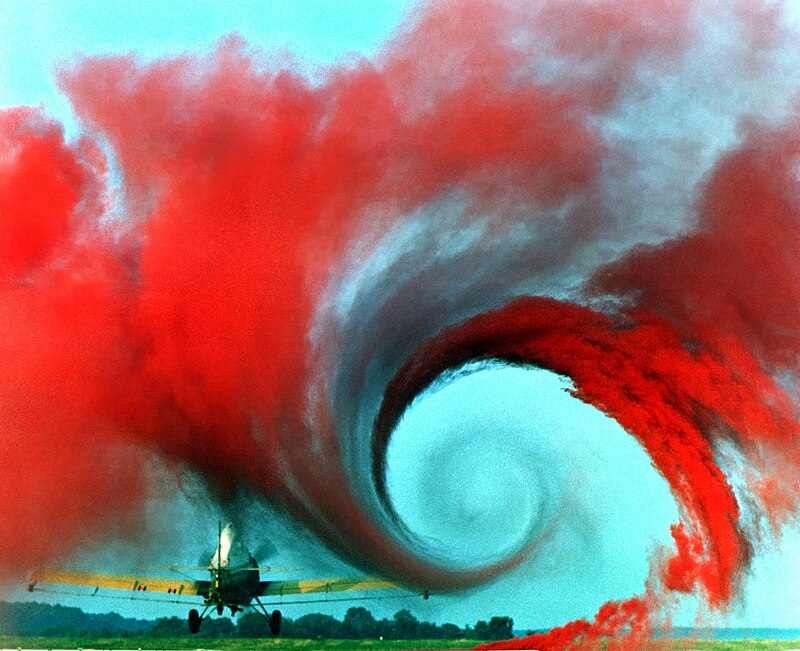
Sign in to save300px|thumb|upright=1.6|A NASA wake turbulence study at Wallops Island in 1990. A [[vortex is created by passage of an aircraft wing, revealed by smoke. Vortices are one of the many phenomena associated with the study of aerodynamics.]]
Aerodynamics is the study of how air behaves around moving objects, such as aircraft wings, and includes phenomena like the vortices that form behind them. Understanding aerodynamics matters because it helps explain and predict how air movement affects the performance and safety of aircraft and other objects in flight.
AI-generated from the Wikipedia summary — may contain errors.
Wikidata facts
- Instance of
- academic discipline
- Subclass of
- aeromechanics
- Has part
- flight dynamics
- Image
- Airplane vortex edit.jpg
Show 3 more facts
- Commons category
- Aerodynamics
- topic's main category
- Category:Aerodynamics
- on focus list of Wikimedia project
- Wikipedia:Vital articles/Level/4
Sources (7)
via Wikidata · CC0
~24 min read
Encyclopedic overview
23 sectionsContents
- History
- Fundamental concepts
- Flow classification
- Continuum assumption
- Conservation laws
- Branches of aerodynamics
- Incompressible aerodynamics
- Subsonic flow
- Compressible aerodynamics
- Transonic flow
- Supersonic flow
- Hypersonic flow
- Associated terminology
- Boundary layers
- Turbulence
- Aerodynamics in other fields
- Engineering design
- Environmental design
- Ball-control in sports
- See also
- References
- Further reading
- External links
300px|thumb|upright=1.6|A NASA wake turbulence study at Wallops Island in 1990. A [[vortex is created by passage of an aircraft wing, revealed by smoke. Vortices are one of the many phenomena associated with the study of aerodynamics.]]
Aerodynamics () is the study of the motion of air, particularly when affected by a solid object, such as an airplane wing. It involves topics covered in the field of fluid dynamics and its subfield of gas dynamics, and is an important domain of study in aeronautics. The term aerodynamics is often used synonymously with gas dynamics, the difference being that "gas dynamics" applies to the study of the motion of all gases, and is not limited to air. The formal study of aerodynamics began in the modern sense in the eighteenth century, although observations of fundamental concepts such as aerodynamic drag were recorded much earlier. Most of the early efforts in aerodynamics were directed toward achieving heavier-than-air flight, which was first demonstrated by Otto Lilienthal in 1891. Since then, the use of aerodynamics through mathematical analysis, empirical approximations, wind tunnel experimentation, and computer simulations has formed a rational basis for the development of heavier-than-air flight and a number of other technologies. Recent work in aerodynamics has focused on issues related to compressible flow, turbulence, and boundary layers and has become increasingly computational in nature.
Excerpted from Wikipedia’s “aerodynamics” article, available under the CC BY-SA 4.0 licence.
Gallery (192)
Available in 80 languages
- Español
- Français
- Deutsch
- 中文
- 日本語
- Русский
- Português
- Italiano
- العربية
- हिन्दी
- Afrikaans
- Albanian
- Armenian
- Asturian
- azb
- Azerbaijani
- Bahasa Indonesia
- Bangla
Show 61 more
- Basque
- Bavarian
- Belarusian
- Bosnian
- Bulgarian
- Burmese
- Catalan
- Central Kurdish
- Croatian
- Czech
- Danish
- Esperanto
- Estonian
- Filipino
- Finnish
- Galician
- Georgian
- Goan Konkani
- Greek
- Hebrew
- Hungarian
- Irish
- Kannada
- Kashmiri
- Kazakh
- Kyrgyz
- Latin
- Latvian
- Lithuanian
- Macedonian
- Malay
- Malayalam
- Mongolian
- Nederlands
- Norwegian
- Norwegian Nynorsk
- Occitan
- Pashto
- Polski
- Romanian
- Serbian
- Serbian (Latin)
- simple
- Slovak
- Slovenian
- Svenska
- Swahili
- Tajik
- Tamil
- Tiếng Việt
- Türkçe
- Ukrainian
- Urdu
- Uzbek
- Waray
- Welsh
- Wu Chinese
- zh_yue
- فارسی
- ไทย
- 한국어
via Wikidata sitelinks · CC0