Afghanistan
Sign in to saveAlso known as Affghanistan, Afghania, Affghanisthan, Affghaunistan, Afghanisthan, Afghaunistan, Afghaunistaun
Afghanistan, officially the Islamic Emirate of Afghanistan, is a landlocked country located at the crossroads of Central and South Asia. It is bordered by Pakistan to the east and south, Iran to the west, Turkmenistan to the northwest, Uzbekistan to the north, Tajikistan to the northeast, and China to the northeast and east. Occupying of land, the country is predominantly mountainous with plains in the north and the southwest, which are separated by the Hindu Kush mountain range. Kabul is the country's capital and largest city. Afghanistan's population is estimated to be between 35 and 50 mill
Afghanistan is a landlocked country in Central and South Asia bordered by Pakistan, Iran, Turkmenistan, Uzbekistan, Tajikistan, and China, with a predominantly mountainous landscape and a capital in Kabul. It matters as a strategically located crossroads between major regions and is home to an estimated 35-50 million people.
AI-generated from the Wikipedia summary — may contain errors.
In the Vinony graph
Afghanistan appears in Vinony's Countries collection — one of 215 entries.
Vinony's link graph records 23,649 inbound references to Afghanistan, and connects out to Supreme Leader of Afghanistan, Central Asia and Amu Darya.
The entry is geolocated on the map in AF, across 31 mapped points.
It is catalogued under topics including 1709 establishments in Asia, Afghanistan and Countries and territories where Pashto is an official language.
Weather now
7-day forecast
via Open-Meteo
Country
- Capital
- Kabul
- Population
- 43,844,000
- Region
- Asia · Southern Asia
- Demonym
- Afghan
- Currencies
- AFN (؋)
- Languages
- Dari, Pashto, Turkmen
- Calling code
- +93
- Drives on
- Right
- FIFA code
- AFG
- TLD
- .af
- Timezones
- UTC+04:30
- Borders
- IRN, PAK, TKM, UZB, TJK, CHN
via REST Countries
Indicators · World Bank
- GDP
- $17.2B(2023)
- Population
- 42,647,492(2024)
- Life expectancy
- 66.3 yrs(2024)
- Unemployment
- 13.4 %(2025)
- Urban population
- 25.7 %(2024)
- Internet users
- 16.1 %(2024)
- Forest area
- 1.9 %(2023)
- Renewable energy
- 20 %(2022)
via World Bank Open Data · CC BY 4.0
Wikipedia views (30d)
218,174 totalvia Wikimedia Pageviews API
Key facts
- Country.symbol_type
- Emblem
- Country.demonym
- Afghan
- Country.national_motto
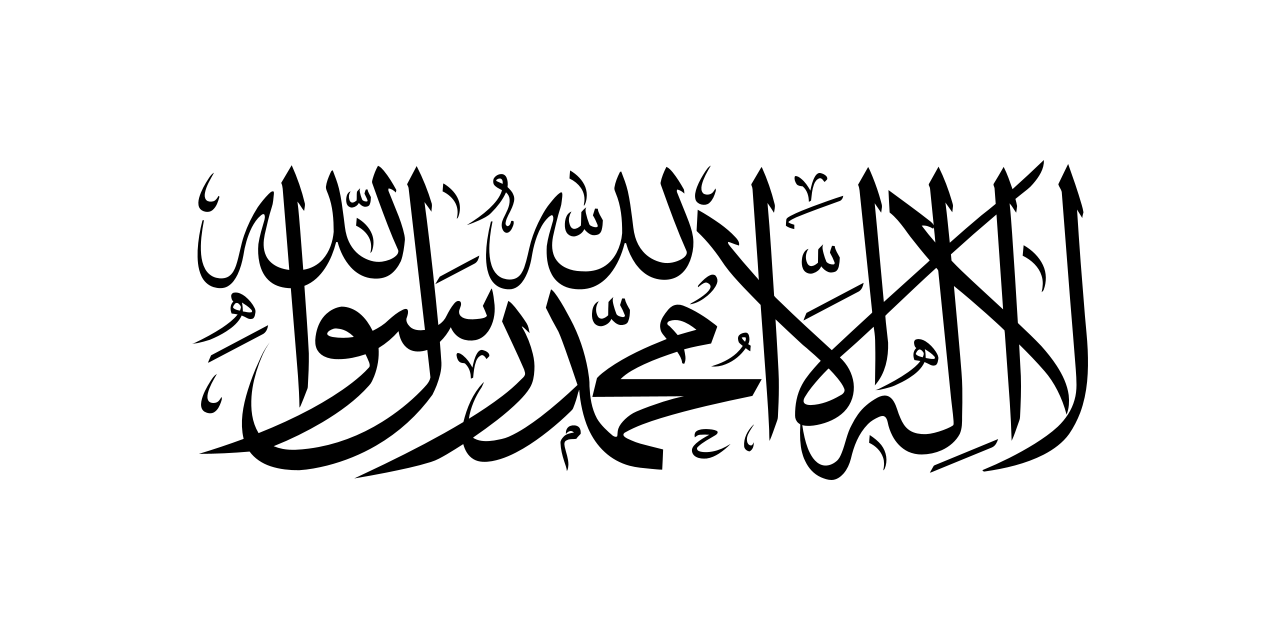
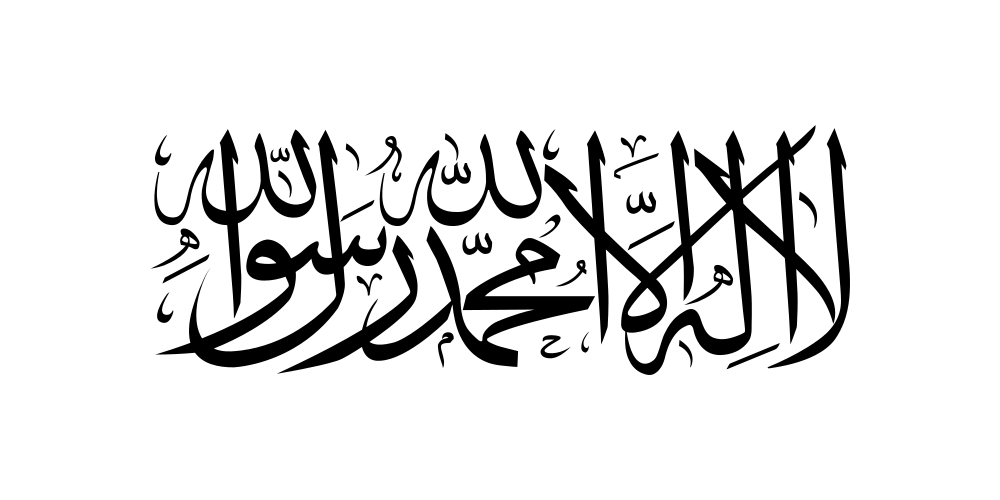
- (Arabic) "There is no god but God; Muhammad is the messenger of God." (Shahada)
- Country.image_coat
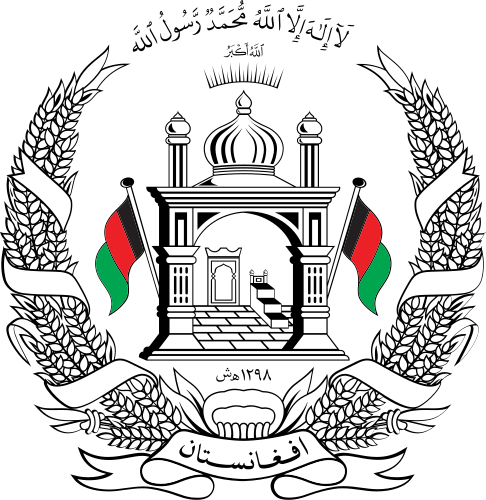
- Arms of the Islamic Emirate of Afghanistan.svg
- Country.conventional_long_name
- Islamic Emirate of Afghanistan
- Country.common_name
- Afghanistan
- Country.image_flag
- Flag of Taliban.svg
- Country.flag_caption
- Flag
- Country.alt_coat
- Coat of Arms of the Islamic Emirate
- Country.national_anthem
- (Pashto)''''"This is the Home of the Brave"
- Country.map_width
- 250px
- Country.capital
- Kabul
- Country.largest_city
- Kabul
- Country.ethnic_groups_year
- 2010, unofficial estimates
- Country.religion
- 99.9% Islam 89.1% Sunni (official) 10.8% Shia 0.1% other
- Country.religion_year
- 2020
- Country.government_type
- Unitary totalitarian theocratic Islamic emirate
- Country.leader_title1
- Supreme Leader
via Wikipedia infobox
Research
11,651 papersvia PubMed
Wikidata facts
- Instance of
- country
- Official name
- Islamic Emirate of Afghanistan
- Demonym
- афганцы
- Country
- Afghanistan
- Contains
- Daykundi Province
- Continent
- Asia
- Capital
- Kabul
- Official language
- Turkmen
- Currency
- afghani
- Population
- 41454761
- Area
- 652230
- Head of government
- Mohammad Hasan Akhund
- Head of state
- Hibatullah Akhundzada
- Form of government
- Islamic state
- Shares border with
- India
- Highest point
- Noshaq
- Official website
- alemarahenglish.af
- Image
- Afghanistan - Location Map (2013) - AFG - UNOCHA.svg
- Life expectancy
- 63
- Nominal GDP
- 3521418059
- Unemployment rate
- 8.5
- Calling code
- +93
- Licence plate code
- AFG
Show 72 more facts
- Electrical plug type
- Schuko
- Mains voltage
- 240
- Coat of arms
- emblem of Afghanistan
- Significant event
- Anglo-Afghan Treaty of 1919
- language used
- Moghol
- topic's main Wikimedia portal
- Portal:Afghanistan
- ethnic group
- Kyrgyz people
- Unicode character
- 🇦🇫
- category of associated people
- Category:Afghan people
- trunk prefix
- 0
- geography of topic
- Geography of Afghanistan
- office held by head of government
- Chief Executive Officer of Afghanistan
- Gini coefficient
- 27.8
- number of out-of-school children
- 2941796
- diplomatic relation
- Hungary
- office held by head of state
- Supreme Leader of Afghanistan
- Commons gallery
- افغانستان
- history of topic
- history of Afghanistan
- marriageable age
- 16
- on focus list of Wikimedia project
- Wikipedia:Vital articles/Level/4
- Commons category
- Afghanistan
- mobile country code
- 412
- total fertility rate
- 4.843
- maritime identification digits
- 401
- topic's main category
- Category:Afghanistan
- central bank
- Da Afghanistan Bank
- category for people buried here
- Category:Burials in Afghanistan
- age of majority
- 18
- category for films shot at this location
- Category:Films shot in Afghanistan
- executive body
- Government of Islamic Emirate of Afghanistan
- category for people who died here
- Category:Deaths in Afghanistan
- top-level Internet domain
- .af
- category for people born here
- Category:Births in Afghanistan
- water as percent of area
- 0
- lowest point
- Amu Darya
- foreign direct investment net outflow
- -10795104
- driving side
- right
- described by source
- Pax Leksikon
- maintained by WikiProject
- WikiProject Afghanistan
- foreign direct investment net inflow
- 53390000
- literacy rate
- 43
- suicide rate
- 5.7
- culture
- culture of Afghanistan
- P6413
- Afghanistan
- Democracy Index
- 0.32
- BTI Status Index
- 2.92
- BTI Governance Index
- 4.36
- economy of topic
- economy of Afghanistan
- demographics of topic
- demographics of Afghanistan
- inception
- 2021-00-00
- highest judicial authority
- Afghan Supreme Court
- social media followers
- 89500
- hashtag
- afghanistan
- madhhab
- Malikism
- topic has template
- Template:Provinces of Afghanistan
- Human Development Index
- 0.478
- P11012
- fairy tale
- Happy Planet Index score
- 29.4
- Inequality-adjusted Human Development Index
- 0.323
- official religion
- Islam
- P12749
- Francesco Cossiga
- native label
- افغانستان
- birth rate
- 35.143
- male population
- 20766442
- death rate
- 6.906
- rural population
- 30181937
- female population
- 20362329
- urban population
- 10946834
- located in/on physical feature
- South Asia
Sources (15)
via Wikidata · CC0
Travel guide
Understand
thumb|View of [[Herat from a hill in 2009]] thumb|[[Band-e Amir National Park in Bamyan province]]
Afghanistan has been in the news since the late 1970s for all the wrong reasons. While visiting has not been advisable for many years, it has much to offer the intrepid traveller. However, even the more adventurous tourists should consider looking elsewhere for thrill-seeking.
Get in
Border crossings may get closed on short notice. Regulations on entry and exit may change without notice.
Get around
thumb|Long distance coach in [[Mazar-i-Sharif in 2011]] thumb|Colourful Afghan truck
To visit different places and objects in the country you need to buy permits. These are both for your security (checked at police checkpoints, need to register them in local tourist bureaus) and to support the country. In Kabul these permits are issued by Afghan Tour (Abdullhaq crossroad, {{phone|+93 20 210 6837]) and cost 1000 Afs (2025) for each area you want. Getting these permits can take considerable time, and the officers demand you to have a "translator" (kind of guide which helps you with language and getting around). You may want to find a local travel agency or a guide to help you with this. They would also give you practical information, safety tips and take you on a tour. To find an agency or a guide, search the Internet or Facebook at home, or ask at your hotel when you come.
See
While Taliban repression has put an almost full stop to tourism in Afghanistan, the lack of visitors has nothing to do with the country's sights. This is a land full of mystical attractions, telling tales of ancient times and offering beautiful Islamic architecture, medieval city quarters and unexpectedly stunning nature.
Several sites are listed on UNESCO's World Heritage List. Most famous of course, were the ancient Buddhist sculptures of Bamiyan. The Taliban destroyed most of the 6th century statues in a cultural crime that outraged the world. What remains in the Bamiyan valley is the silencing and still worthwhile sight of the empty niches. The salvaged pieces of what were once the largest statues of their kind in the world continue to provide a fascinating insight in the history of this place. Band-e Amir National Park, with its six interlinked lakes, is perhaps the finest natural attraction. At an altitude of 2900 meters, the blue waters in this protected natural area almost seem unreal against the sandy mountain sides that surround them.
Excellent mosques are to be found all around, with particularly grand examples in Mazar-i-Sharif and Herat. The Minaret of Jam, just north of Herat, is UNESCO listed.
Eat
thumb|Some of the popular Afghan dishes, from left to right: 1. Lamb grilled kebab (seekh kebob); 2. Afghan palao and salad; 3. Tandoori chicken; and 4. Mantu (dumplings). Afghan cuisine includes a blend of Central, Eastern, South Asian, and Middle Eastern cuisines. Nearly all the dishes are non-spicy.
There are three main types of Afghan bread:
Naan — Literally "bread". Thin, long and oval shaped, its mainly a white/whole wheat blend. Topped with poppy seeds, sesame seeds, nigella seeds, or some combination of these. Upon request, customers may be able to get all white flour and a helping of oil, which makes it rich and delicious. Obi Non — Uzbek-style bread. Shaped like a disc and thicker than naan. Usually made with white flour. Lavash — Very thin bread. Similar to the lavash elsewhere. Usually used as plating for meats and stews.
Rice dishes are the "king" of all foods in Afghanistan. The Afghans have certainly taken much time and effort in creating their rice dishes, as they are considered the best part of any meal. Wealthier families will eat one rice dish per day. The Afghan royalty spent much time on rice preparation and invention as evidenced in the sheer number of rice dishes in their cookbooks. Weddings and family gatherings must feature several rice dishes and certainly reputations can be made in the realm of rice preparation.
Kabuli Pulao (or Kabuli Palaw, Qabili Palaw, Qabili Palau or simply Palau) — An Afghan rice dish consisting of steamed rice mixed with …
Drink
Since Afghanistan is an Islamic country, alcohol consumption is illegal.
Sleep
Hotels and guesthouses are available in all major cities, and while some may not meet international standards they are usually friendly and reliable.
Stay safe
thumb|150px|A marked minefield – if you are at the red-end side, you are in serious trouble.
Afghanistan is a volatile and dangerous country. Non-essential travel is strongly discouraged. Banditry is somewhat of an ancient tradition in many parts of the country, including in the northern areas. Foreigners may be targets for kidnapping.
The Islamic State in Khorasan Province (IS-KP) is an anti-Taliban and Islamic extremist militant group that has an active presence in the country. It has strongly anti-Western and anti-Chinese views far exceeding those of the Taliban, and often targets hotels and other areas frequented by foreigners, though Taliban security operations have greatly reduced the frequency of these attacks in the mid-2020s.
Landmines and other UXO (Unexploded Ordnance) remain a problem across the country, so plan to stick to well-worn paths, avoid red and white painted rocks, and do not touch or move any suspicious-looking item. Hundreds of people are injured or killed every year in accidents due to landmines and UXO.
Insects and snakes are also something to be careful of, and the mountainous country has many vicious tiny creatures such as scorpions, spiders, centipedes, and bees.
In some areas, altitude sickness is a significant risk.
Earthquakes are common. Summers are hot and winters cold. Traveling around the country becomes difficult in winter as snow blocks roads; avalanches are a risk factor.
Since the Taliban takeover, it is illegal for women to sho…
Stay healthy
Afghanistan has more than its share of health issues, and it is pretty much essential to consult a travel doctor ahead of your trip about vaccinations and health risks. Travellers' diarrhea will afflict most visitors at least occasionally, and other food-related illnesses are moderately common. Respiratory diseases such as tuberculosis are common, and malaria is a risk in many parts of the country. Meningitis, hepatitis, cholera and rabies are major health issues, especially in the countryside with lacking health infrastructure.
Afghanistan is one of the dustiest countries in the world, and you should be prepared to be covered in it and breathing it for most of your stay, even in the major cities. Consider bringing facemasks. Pollution from diesel engines can also make life unpleasant.
Flies are notoriously heinous here, likely due to poor sanitation. Winter brings some relief, but they come back full-strength when spring arrives.
Food should be approached with a discerning eye, as hygiene standards can often be lacking. Hot, freshly cooked food is generally safer. Bottled water is also advised, unless you have your own purification system.
Do not approach any animals, especially dogs and cats and preferably take a rabies shot before going to the country, it's one of the most rabies-affected countries in the world and finding medical attention and medications will be hard – even with the shot you need to get urgent medical treatment if you get a scratch from an infected a…
Respect
thumb|250px|Inside the Maulana Jalaludin Cultural Park in the northern city of [[Mazar-e-Sharif]]
Despite all that they have been through since 1979, Afghans in general are welcoming and hospitable to foreign visitors. Hospitality is a cornerstone of Afghan culture, and it is very likely that you'll be treated as a celebrity by the locals.
With the regime change in 2021, a large proportion of the population, especially women, are very afraid of what will be in the future. Those who worked for the government, for foreign organisations, for human rights or for the media, or held any high profile positions may be afraid for their lives. Tread extremely lightly.
Travel guide from Wikivoyage (CC BY-SA 4.0)
~40 min read
Encyclopedic overview
54 sectionsContents
- Etymology
- History
- Prehistory and antiquity
- Medieval period
- Hotak dynasty
- Durrani Empire
- Barakzai dynasty and British wars
- Democratic Republic and Soviet War
- Post–Cold War conflict
- US invasion and the Islamic Republic
- Second Taliban era
- Geography
- Climate
- Biodiversity
- Government and politics
- Development of Taliban government
- Administrative divisions
- Foreign relations
- Military
- Human rights
- Economy
- Agriculture
- Mining
- Energy
- Tourism
- Communication
- Transportation
- Demographics
- Population
- Fertility rate
- Urbanization
- Ethnicity and languages
- Religion
- Education
- Health
- Culture
- Architecture
- Art and ceramics
- Literature
- Music
- Media and entertainment
- Cuisine
- Holidays and festivals
- Sports
- See also
- Explanatory notes
- References
- Citations
- General and cited sources
- Further reading
- External links
- Government
- History
- Maps
Afghanistan, officially the Islamic Emirate of Afghanistan, is a landlocked country located at the crossroads of Central and South Asia. It is bordered by Pakistan to the east and south, Iran to the west, Turkmenistan to the northwest, Uzbekistan to the north, Tajikistan to the northeast, and China to the northeast and east. Occupying 652,864 square kilometers (252,072 sq mi) of land, the country is predominantly mountainous with plains in the north and the southwest, which are separated by the Hindu Kush mountain range. Kabul is the country's capital and largest city. Afghanistan's population is estimated to be between 35 and 50 million.
Human habitation in Afghanistan dates to the Middle Paleolithic era. Popularly referred to as the graveyard of empires, the land has witnessed numerous military campaigns, including those by the Persians, Alexander the Great, the Maurya Empire, Arab Muslims, the Mongols, the British, the Soviet Union, and a US-led coalition. Afghanistan also served as the source from which the Greco-Bactrians and the Mughals, among others, rose to form major empires. Because of the various conquests and periods in both the Iranian and Indian cultural spheres, the area was a center for Zoroastrianism, Buddhism, Hinduism, and later Islam. The modern state of Afghanistan began with the Durrani Empire in the 18th century under Ahmad Shah Durrani, although Dost Mohammad Khan is sometimes considered to be the founder of the first modern Afghan state. Afghanistan became a buffer state in the Great Game between the British Empire and the Russian Empire. From India, the British attempted to subjugate Afghanistan but were repelled in the First Anglo-Afghan War; the Second Anglo-Afghan War saw a British victory. Following the Third Anglo-Afghan War in 1919, Afghanistan became free of foreign political hegemony, and emerged as the independent Kingdom of Afghanistan in 1926; this monarchy lasted almost half a century.
Excerpted from Wikipedia’s “Afghanistan” article, available under the CC BY-SA 4.0 licence.
Gallery (639)
On the map
31 mapped locations
Available in 286 languages
- Español
- Français
- Deutsch
- 中文
- 日本語
- Русский
- Português
- Italiano
- العربية
- हिन्दी
- Abkhazian
- abstract
- Achinese
- Adyghe
- Afrikaans
- Albanian
- Albanian
- Amharic
Show 267 more
- ami
- Angika
- Aragonese
- Aramaic
- Armenian
- Arpitan
- Assamese
- Asturian
- Avaric
- Awadhi
- Aymara
- azb
- Azerbaijani
- Bahasa Indonesia
- Balinese
- Bangla
- Bashkir
- Basque
- bat_smg
- Batak Toba
- Bavarian
- be_x_old
- Belarusian
- Betawi
- Bhojpuri
- Bikol
- Bishnupriya
- Bislama
- Bosnian
- Breton
- btm
- Buginese
- Bulgarian
- Buriat
- Burmese
- Catalan
- cbk_zam
- cdo
- Cebuano
- Central Dusun
- Central Kurdish
- Chamorro
- Chechen
- Cherokee
- Cheyenne
- Church Slavic
- Chuvash
- Colognian
- Cornish
- Corsican
- Crimean Tatar
- Croatian
- Czech
- dag
- Danish
- Divehi
- dty
- Dzongkha
- Egyptian Arabic
- Erzya
- Esperanto
- Estonian
- Extremaduran
- Faroese
- Fiji Hindi
- Filipino
- Finnish
- fiu_vro
- Friulian
- Fula
- Gagauz
- Galician
- gcr
- Georgian
- Gilaki
- Goan Konkani
- Gorontalo
- Gothic
- gpe
- Greek
- Guarani
- Gujarati
- Haitian Creole
- Hakka Chinese
- Hausa
- Hawaiian
- Hebrew
- Hungarian
- hyw
- Iban
- Icelandic
- Ido
- Igbo
- Iloko
- Inari Sami
- Ingush
- Interlingua
- Interlingue
- Irish
- isv
- Jamaican Creole English
- Javanese
- Kabardian
- Kabyle
- kai
- Kannada
- Kanuri
- Kara-Kalpak
- Karachay-Balkar
- Kashmiri
- Kashubian
- Kazakh
- kbp
- kge
- Khmer
- Kikuyu
- Kinyarwanda
- Komi
- Kongo
- Kotava
- Kurdish
- Kyrgyz
- Ladino
- Lao
- Latin
- Latvian
- Lezghian
- Ligurian
- Limburgish
- Lingala
- Lingua Franca Nova
- Lithuanian
- lld
- Lojban
- Lombard
- Low German
- Lower Sorbian
- Luxembourgish
- Macedonian
- Madurese
- Maithili
- Malagasy
- Malay
- Malayalam
- Maltese
- Manipuri
- Manx
- Māori
- map_bms
- Marathi
- Mari
- Mazanderani
- Minangkabau
- Mingrelian
- Mirandese
- mnw
- Moksha
- Mongolian
- Moroccan Arabic
- nds_nl
- Neapolitan
- Nederlands
- Nepali
- Newari
- Northern Frisian
- Northern Sami
- Norwegian
- Norwegian Nynorsk
- Novial
- Occitan
- Odia
- Old English
- olo
- Oromo
- Ossetic
- Pampanga
- Pangasinan
- Papiamento
- Pashto
- Pennsylvania German
- Picard
- Piedmontese
- Polski
- Punjabi
- Quechua
- roa_tara
- Romanian
- Romansh
- Rusyn
- Samoan
- Sanskrit
- Santali
- Sardinian
- Saterland Frisian
- Scots
- Scottish Gaelic
- Serbian
- Serbian (Latin)
- Shan
- Shona
- Sicilian
- Silesian
- simple
- Sindhi
- Sinhala
- skr
- Slovak
- Slovenian
- Somali
- Sranan Tongo
- Standard Moroccan Tamazight
- Sundanese
- Svenska
- Swahili
- Swati
- syl
- szy
- Tachelhit
- Tajik
- Talysh
- Tamil
- Taroko
- Tatar
- tay
- Telugu
- Tetum
- Tibetan
- Tiếng Việt
- Tigrinya
- Tok Pisin
- Toki Pona
- Tongan
- Tsonga
- Tulu
- Tumbuka
- Türkçe
- Turkmen
- Tyap
- Udmurt
- Ukrainian
- Upper Sorbian
- Urdu
- Uyghur
- Uzbek
- Venetian
- Veps
- Volapük
- Waray
- Welsh
- West Flemish
- Western Frisian
- Western Panjabi
- Wolof
- Wu Chinese
- Yakut
- Yiddish
- Yoruba
- Zaza
- Zeelandic
- zh_classical
- zh_min_nan
- zh_yue
- Zhuang
- Zulu
- فارسی
- ไทย
- 한국어
via Wikidata sitelinks · CC0