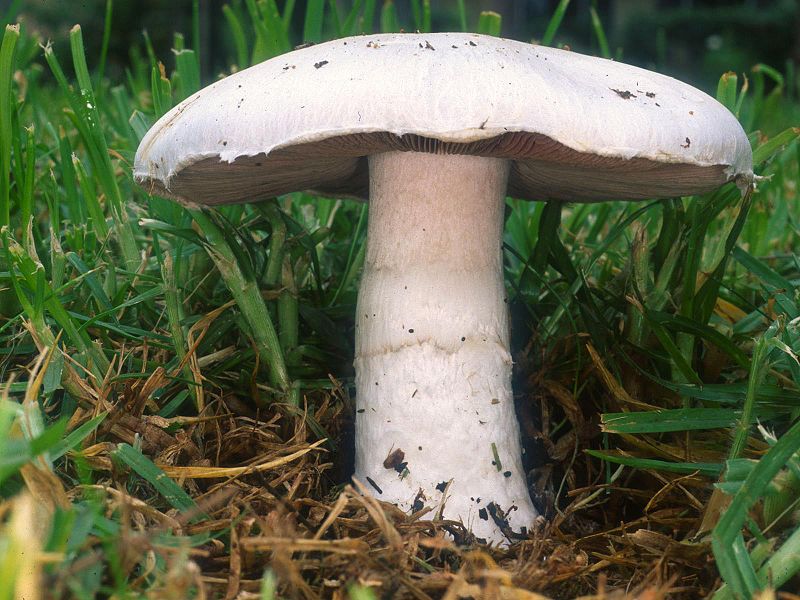
File:Agaricus_campestris.jpg · Wikimedia Commons · See Wikimedia Commons
Agaricales
Sign in to saveThe Agaricales are an order of fungi in the division Basidiomycota. As originally conceived, the order contained all the agarics (gilled mushrooms), but subsequent research has shown that not all agarics are closely related and some belong in other orders, such as the Russulales and Boletales. Conversely, DNA research has also shown that many non-agarics, including some of the clavarioid fungi (clubs and corals) and gasteroid fungi (puffballs and false truffles) belong within the Agaricales. The order has 46 extant families, more than 400 genera, and over 25,000 described species, along with s
OverviewAI-generated
Agaricales is an order of fungi within the class Agaricomycetes and phylum Basidiomycota. It belongs to the subphylum Agaricomycetidae. The taxon was described by Underw. in 1899 and holds an accepted status. Common names for this group include agarics, plaatjeszwammen, and listarji.
The order is found in marine and brackish habitats. Records indicate 11,927,230 occurrences. The name Agaricales has been referenced by 3,097 other encyclopedia articles.
Synthesized by Vinony from 29 facts across 6 sources: Wikidata, GBIF, PubMed, Gbif Occ, WoRMS, Vinony graph. Generated from structured data (not the Wikipedia text) and checked against those facts — may still contain errors.
Species
agarics
Agaricales
ORDER
- KingdomFungi
- PhylumBasidiomycota
- ClassAgaricomycetes
- OrderAgaricales
via GBIF
Research
15,852 papers- Secondary metabolites from mushrooms.The Journal of antibiotics · 2020Anke TDOI: 10.1038/s41429-020-0358-6
- Advances in the phylogenesis of Agaricales and its higher ranks and strategies for establishing phylogenetic hypotheses.ReviewJournal of Zhejiang University. Science. B · 2008Zhao RL, Desjardin DE, Soytong K et al.DOI: 10.1631/jzus.B0860012
- Genomic Analysis Enlightens Agaricales Lifestyle Evolution and Increasing Peroxidase Diversity.Molecular biology and evolution · 2021Ruiz-Dueñas FJ, Barrasa JM, Sánchez-García M et al.DOI: 10.1093/molbev/msaa301
- Fungal get-together.Nature · 2000Money NPDOI: 10.1038/35015659
- Cyptotrama (Physalacriaceae, Agaricales) from Asia.Fungal biology · 2016Qin J, Yang ZLDOI: 10.1016/j.funbio.2016.01.009
- Agaricales of the Hawaiian Islands 9. Five new white-spored species from native montane wet forests.Mycologia · 2011Desjardin DE, Hemmes DEDOI: 10.3852/11-114
- A Puff of Spores.ReviewWilderness & environmental medicine · 2018Diaz JHDOI: 10.1016/j.wem.2017.08.004
- Major clades of Agaricales: a multilocus phylogenetic overview.Mycologia · 2006Matheny PB, Curtis JM, Hofstetter V et al.DOI: 10.3852/mycologia.98.6.982
via PubMed
Wikidata facts
- Instance of
- taxon
- Parent taxon
- Agaricomycetidae
- Image
- Tricholoma terreum.jpg
Show 6 more facts
- taxon rank
- order
- Commons category
- Agaricales
- taxon name
- Agaricales
- topic's main category
- Q8875899
- taxon common name
- listarji
- topic has template
- Template:Taxonomy/Agaricales
Sources (3)
via Wikidata · CC0
~6 min read
Encyclopedic overview
6 sectionsContents
- History, classification and phylogeny
- Distribution and habitat
- Genera ''incertae sedis''
- See also
- References
- External links
The Agaricales are an order of fungi in the division Basidiomycota. As originally conceived, the order contained all the agarics (gilled mushrooms), but subsequent research has shown that not all agarics are closely related and some belong in other orders, such as the Russulales and Boletales. Conversely, DNA research has also shown that many non-agarics, including some of the clavarioid fungi (clubs and corals) and gasteroid fungi (puffballs and false truffles) belong within the Agaricales. The order has 46 extant families, more than 400 genera, and over 25,000 described species, along with six extinct genera known only from the fossil record. Species in the Agaricales range from the familiar Agaricus bisporus (cultivated mushroom) and the deadly Amanita virosa (destroying angel) to the coral-like Clavaria zollingeri (violet coral) and bracket-like Fistulina hepatica (beefsteak fungus).
==History, classification and phylogeny==
Excerpted from Wikipedia’s “Agaricales” article, available under the CC BY-SA 4.0 licence.