File:Alieron_A-44_(PSF).png · Wikimedia Commons · See Wikimedia Commons
aileron
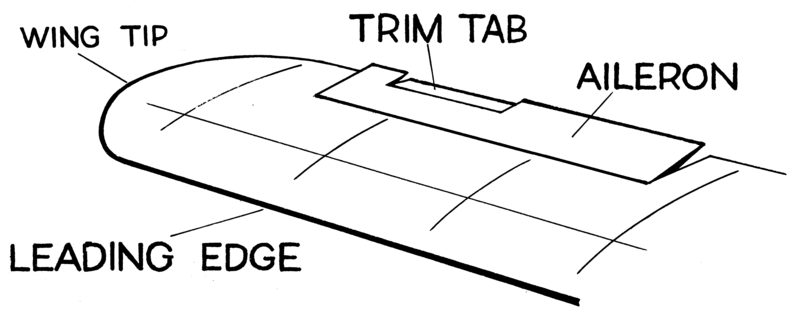
Sign in to savethumb|right thumb|right|An aircraft "rolling" or "banking", with its ailerons thumb|An aileron and roll trim tab of a light aircraft An aileron (French for 'little wing' or 'fin') is a hinged flight control surface usually forming part of the trailing edge of each wing of a fixed-wing aircraft. Ailerons are used in pairs to control the aircraft in roll (or movement around the aircraft's longitudinal axis), which normally results in a change in flight path due to the tilting of the lift vector. Movement around this axis is called rolling or banking.
Wikidata facts
- Has use
- control
Show 3 more facts
- Commons category
- Ailerons
- partially coincident with
- flaperon
- different from
- wing warping
Sources (2)
via Wikidata · CC0
~31 min read
Encyclopedic overview
28 sectionsContents
- History
- Other early aileron designers
- Patents and lawsuits
- Ongoing controversy
- Flight dynamics
- Aileron components
- Horns and aerodynamic counterbalances
- Trim tabs
- Spades
- Mass balance weights
- Aileron fences
- Types of ailerons
- Single acting ailerons
- Wingtip ailerons
- Frise ailerons
- Differential ailerons
- Roll control without ailerons
- Wing warping
- Differential spoilers
- Roll induced by rudder
- Other methods
- Combinations with other control surfaces
- See also
- References
- Footnotes
- Citations
- Bibliography
- External links
thumb|right thumb|right|An aircraft "rolling" or "banking", with its ailerons thumb|An aileron and roll trim tab of a light aircraft An aileron (French for 'little wing' or 'fin') is a hinged flight control surface usually forming part of the trailing edge of each wing of a fixed-wing aircraft. Ailerons are used in pairs to control the aircraft in roll (or movement around the aircraft's longitudinal axis), which normally results in a change in flight path due to the tilting of the lift vector. Movement around this axis is called rolling or banking.
Considerable controversy exists over credit for the invention of the aileron. The Wright brothers and Glenn Curtiss fought a years-long legal battle over the Wright patent of 1906, which described a method of wing-warping to achieve lateral control. The brothers prevailed in several court decisions which found that Curtiss's use of ailerons violated the Wright patent. Ultimately, the First World War compelled the U.S. Government to legislate a legal resolution. A much earlier aileron concept was patented in 1868 by British scientist Matthew Piers Watt Boulton, based on his 1864 paper On Aërial Locomotion.
Excerpted from Wikipedia’s “aileron” article, available under the CC BY-SA 4.0 licence.