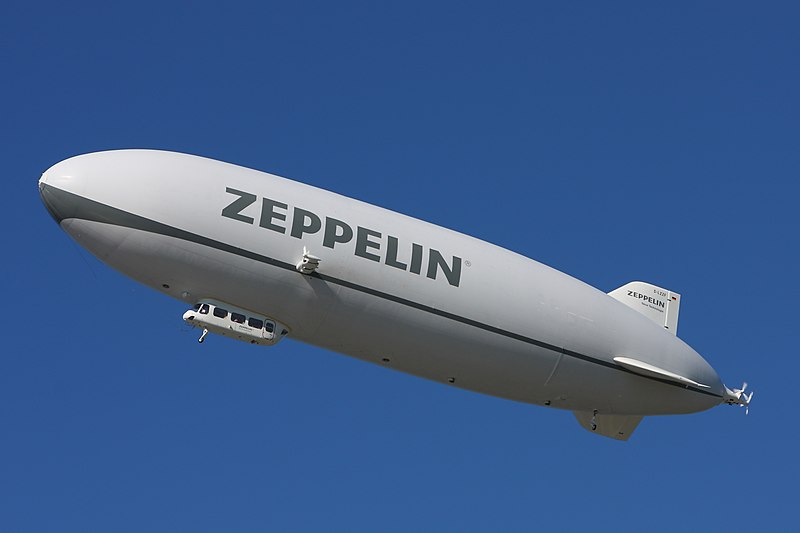
File:Zeppellin_NT_amk.JPG · Wikimedia Commons · See Wikimedia Commons
airship
Sign in to savethumb|A modern airship, Zeppelin NT D-LZZF in 2010 thumb|The LZ 129 Hindenburg|LZ 129 Hindenburg was the largest airship ever built and was destroyed in 1937. thumb|120px|upright|Dirigible airships compared with related aerostats, from the Brockhaus and Efron Encyclopedic Dictionary, 1890–1907 An airship, dirigible balloon or dirigible is a type of aerostat (lighter-than-air) aircraft that can navigate through the air flying under its own power. Aerostats use buoyancy from a lifting gas that is less dense than the surrounding air to achieve the lift needed to stay airborne.
An airship is a lighter-than-air aircraft that can steer and fly under its own power by using a gas less dense than air for lift. Airships have historical significance as early aircraft, most notably exemplified by the Hindenburg, the largest airship ever built before its destruction in 1937.
AI-generated from the Wikipedia summary — may contain errors.
Wikidata facts
- Subclass of
- aircraft
- Operator
- United States Navy
- Image
- Zeppellin NT amk.JPG
Show 7 more facts
- topic's main category
- Category:Airships
- Commons gallery
- Airship
- Commons category
- Airships
- exact match
- wordnet-rdf.princeton.edu/wn30/02692877-n
- time of discovery or invention
- 1852-00-00
- military designation
- ZR
- on focus list of Wikimedia project
- Wikipedia:Vital articles/Level/4
via Wikidata · CC0
~80 min read
Encyclopedic overview
56 sectionsContents
- Terminology
- Airship
- Aerostat
- Blimp
- Zeppelin
- Hybrid airship
- Classification
- Rigid
- Semi-rigid
- Non-rigid
- Construction
- Envelope
- Ballonet
- Lifting gas
- Gondola
- Propulsion and control
- Fins and rudders
- Empennage
- Fuel and power systems
- Navigation and communication equipment
- Landing gear
- Performance
- Efficiency
- History
- Early pioneers
- 17th–18th century
- 19th century
- Early 20th century
- World War I
- The interwar period
- World War II
- Postwar period
- Postwar projects
- Modern airships
- Military
- Passenger transport
- Exploration
- Thermal
- Unmanned remote
- Adventures
- Current design projects
- Heavy lifting and buoyancy compensation
- Metal-clad airships
- Hybrid airships
- Airships in space exploration
- Cruiser feeder transport airship
- Airships for humanitarian and cargo transport
- Comparison with heavier-than-air aircraft
- Safety
- Licensing
- See also
- Notes
- References
- Citations
- Bibliography
- External links
thumb|A modern airship, Zeppelin NT D-LZZF in 2010 thumb|The LZ 129 Hindenburg|LZ 129 Hindenburg was the largest airship ever built and was destroyed in 1937. thumb|120px|upright|Dirigible airships compared with related aerostats, from the Brockhaus and Efron Encyclopedic Dictionary, 1890–1907 An airship, dirigible balloon or dirigible is a type of aerostat (lighter-than-air) aircraft that can navigate through the air flying under its own power. Aerostats use buoyancy from a lifting gas that is less dense than the surrounding air to achieve the lift needed to stay airborne.
In early dirigibles, the lifting gas used was hydrogen, due to its high lifting capacity and ready availability, but the inherent flammability led to several fatal accidents that rendered hydrogen airships obsolete. The alternative lifting gas, helium, is not flammable, but is rare and relatively expensive. Significant amounts were first discovered in the United States and for a while helium was only available for airship usage in North America. Most airships built since the 1960s have used helium, though some have used hot air.
Excerpted from Wikipedia’s “airship” article, available under the CC BY-SA 4.0 licence.
Gallery (52)
Available in 85 languages
- Español
- Français
- Deutsch
- 中文
- 日本語
- Русский
- Português
- Italiano
- العربية
- Afrikaans
- Albanian
- Armenian
- Asturian
- Bahasa Indonesia
- Bangla
- Basque
- be_x_old
- Belarusian
Show 66 more
- Bulgarian
- Buriat
- Burmese
- Catalan
- Chuvash
- Croatian
- Czech
- Danish
- Esperanto
- Estonian
- Filipino
- Finnish
- Galician
- Georgian
- Hebrew
- Hungarian
- Ido
- Interlingua
- Irish
- Kazakh
- Kyrgyz
- Latin
- Latvian
- Lithuanian
- Malay
- Malayalam
- Minangkabau
- Moroccan Arabic
- Nederlands
- Northern Frisian
- Norwegian
- Norwegian Nynorsk
- Old English
- Picard
- Piedmontese
- Polski
- Romanian
- Rusyn
- Saterland Frisian
- Serbian
- Serbian (Latin)
- Sicilian
- simple
- Slovak
- Slovenian
- Svenska
- Swahili
- Tamil
- Tatar
- Tiếng Việt
- Türkçe
- Ukrainian
- Urdu
- Uzbek
- Venetian
- Waray
- Welsh
- Western Frisian
- Western Panjabi
- Wu Chinese
- Yiddish
- zh_min_nan
- zh_yue
- فارسی
- ไทย
- 한국어
via Wikidata sitelinks · CC0