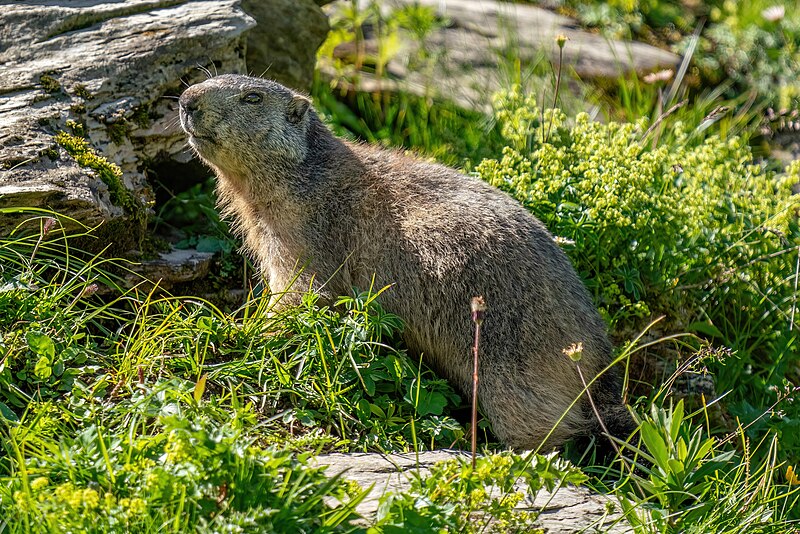
File:071_Wild_marmot_at_Grand_Muveran_Nature_Reserve_Photo_by_Giles_Laurent.jpg · Wikimedia Commons · See Wikimedia Commons
OverviewAI-generated
The Alpine marmot, scientifically named *Marmota marmota*, is a species within the genus *Marmota*. It is a diurnal mammal with a gestation period of 33 days. The longest observed lifespan for this species is 17.4 years. Common names for the animal include Marmota Alpina, Marmotte Des Alpes, and Alpenmurmeltier.
According to the 2024 IUCN Red List assessment, the Alpine marmot has a conservation status of Least Concern. The species has been recorded in 13,306 observations on the iNaturalist platform.
Synthesized by Vinony from 20 facts across 4 sources: Wikidata, iNaturalist, IUCN Red List, Vinony graph. Generated from structured data (not the Wikipedia text) and checked against those facts — may still contain errors.
Species
Least ConcernAlpine Marmot
species
La marmotte des Alpes (Marmota marmota) est un mammifère fouisseur de l'ordre des rongeurs. Il s'agit de l'une des espèces les plus répandues du genre Marmota, qui en compte une quinzaine. Elle vit entre 800 et 3 000 mètres d'altitude. On la rencontre également dans les Carpates. Elle a été réintroduite avec succès dans les Pyrénées en 1948 ; elle avait disparu à la fin du Pléistocène. Une réintroduction réussie a également été menée dans le massif du Vercors et dans le Massif central (dans les années 1980). L'implantation de l'espèce a été envisagée dans les massifs de montagne où elle est absente, sans suite à ce jour.
via IUCN
Wikidata facts
- Instance of
- taxon
- Image
- 071 Wild marmot at Grand Muveran Nature Reserve Photo by Giles Laurent.jpg
Show 10 more facts
- taxon rank
- species
- IUCN conservation status
- Least Concern
- Commons category
- Marmota marmota
- taxon name
- Marmota marmota
- Commons gallery
- Marmota marmota
- gestation period
- 33
- longest observed lifespan
- 17.4
- diel cycle
- diurnality
- short name
- M. marmota
- taxon common name
- alpski svizec
Sources (3)
via Wikidata · CC0
~9 min read
Encyclopedic overview
The alpine marmot (Marmota marmota) is a large ground-dwelling squirrel, from the genus of marmots. It is found in high numbers in mountainous areas of central and southern Europe, at heights between 800 and 3,200 m (2,600–10,500 ft) in the Alps, Carpathians, Tatras and Northern Apennines. In 1948 they were reintroduced with success in the Pyrenees, where the alpine marmot had disappeared at end of the Pleistocene epoch.
Evolution
Excerpted from Wikipedia’s “Alpine marmot” article, available under the CC BY-SA 4.0 licence.