File:Uhandre_goimenditarra.jpg · Wikimedia Commons · See Wikimedia Commons
Alpine newt
Sign in to saveAlso known as Ichthyosaura alpestris, Triturus alpestris
species of amphibian
Species
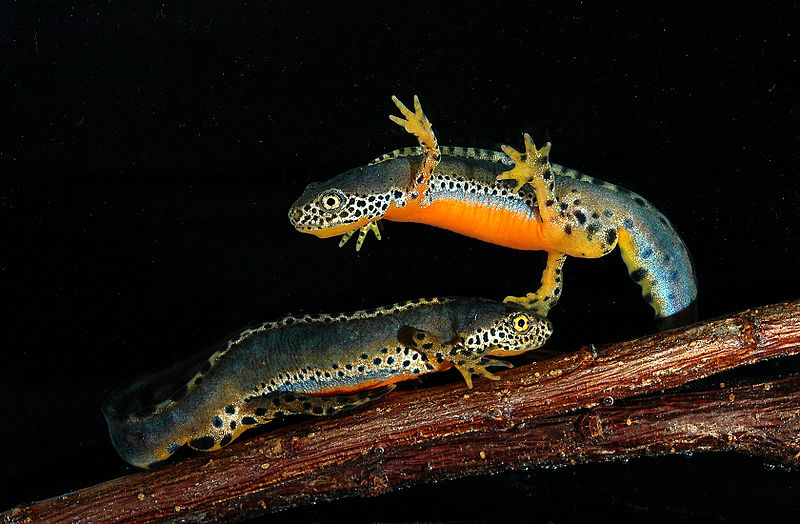
Least ConcernСамка альпийского тритона, водная стадия Альпийский тритон[2], или горный тритон[3] (лат. Ichthyosaura alpestris) — вид тритонов, выделяемый в монотипный род Альпийские тритоны[2] (Ichthyosaura)[1] семейства настоящих саламандр отряда хвостатых земноводных. Альпийский тритон известен своей яркой расцветкой. Редкий вид. Содержание 1 Распространение 2 Классификация и подвиды 3 Описание 4 Жизненный цикл 5 Образ жизни 6 Охрана вида 7 Примечания 8 Ссылки Распространение Альпийский тритон распространён на большей территории Центральной Европы — от Франции на западе до Румынии и украинских Карпат на востоке. Северная граница ареала проходит по территории Германии, южным областям Польши. Редко встречается на севере Испании, севере Италии, в Венгрии, Болгарии, Австрии, Дании, Греции. Вид не встречается в Португалии.[4] Классификация и подвиды Альпиского тритона традиционно относили к роду тритонов (лат. Triturus). По результатам недавних генетических исследований род Triturus был разделён на несколько самостоятельных родов, и альпийский тритон был отнесён к роду Mesotriton (Bolkay, 1927). В настоящее время выделяют девять подвидов альпийского тритона: Альпийский тритон, номинативный подвид
via IUCN
Wikidata facts
- Instance of
- taxon
- Parent taxon
- Ichthyosaura
- Image
- Mesotriton aplestris side view chrischan.jpeg
Show 6 more facts
- taxon rank
- species
- taxon name
- Ichthyosaura alpestris
- Commons gallery
- Ichthyosaura alpestris
- Commons category
- Ichthyosaura alpestris
- IUCN conservation status
- Least Concern
- taxon common name
- planinski pupek
Sources (7)
via Wikidata · CC0
~20 min read
Encyclopedic overview
The alpine newt (Mesotriton alpestris) is a species of newt native to continental Europe and introduced to Great Britain and New Zealand. Adults measure 7–12 cm (2.8–4.7 in) and are usually dark grey to blue on the back and sides, with an orange belly and throat. Males are more conspicuously coloured than the drab females, especially during breeding season.
The alpine newt occurs at high altitude as well as in the lowlands. Living mainly in forested land habitats for most of the year, the adults migrate to puddles, ponds, lakes or similar water bodies for breeding. Males court females with a ritualised display and deposit a spermatophore. After fertilisation, females usually fold their eggs into leaves of water plants. The aquatic larvae grow up to 5 cm (2.0 in) in around three months before metamorphosing into terrestrial juvenile efts, which mature into adults at around three years. In the southern range, the newts sometimes do not metamorphose but keep their gills and stay aquatic as paedomorphic adults. Larvae and adults feed mainly on diverse invertebrates and themselves fall prey to dragonfly larvae, large beetles, fish, snakes, birds or mammals.
Excerpted from Wikipedia’s “Alpine newt” article, available under the CC BY-SA 4.0 licence.