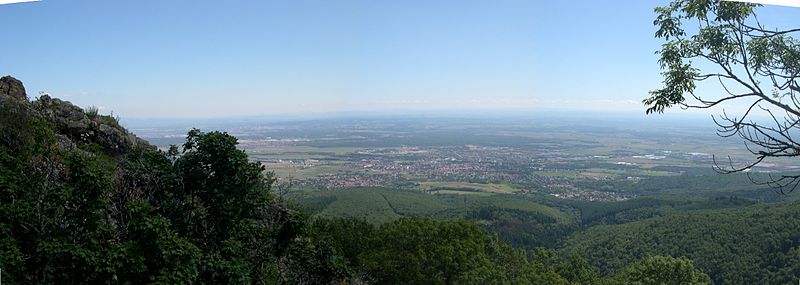
File:Pano.cernay.JPG · Wikimedia Commons · See Wikimedia Commons
Alsace
Sign in to saveAlso known as Elsass
Alsace is a cultural region and a territorial collectivity in the Grand Est administrative region of northeastern France, on the west bank of the upper Rhine, next to Germany and Switzerland. In January 2021, it had a population of 1,919,745. Alsatian culture is characterized by a blend of German and French influences.
Alsace is a region in northeastern France, located along the Rhine River near the German and Swiss borders, with a distinctive culture shaped by both German and French traditions. With nearly two million residents, it serves as a cultural crossroads between France and its neighboring countries.
AI-generated from the Wikipedia summary — may contain errors.
Key facts
- Settlement.name
- Alsace
- Settlement.anthem
- ()
- Settlement.image_caption
- Views of Cernay, Colmar, Strasbourg, Château de Hohenbourg, Riquewihr, Neuf-Brisach
- Settlement.image_map
- Carte Alsace 2018.png
- Settlement.image_flag
- Flag of Alsace.svg
- Settlement.image_shield
- BlasonAlsace.svg
- Settlement.subdivision_type
- Country
- Settlement.subdivision_name
- France
- Settlement.subdivision_type1
- Territorial collectivity
- Settlement.subdivision_name1
- European Collectivity of Alsace
- Settlement.seat_type
- Prefecture
- Settlement.seat
- Strasbourg
- Settlement.area_total_km2
- 8280
- Settlement.population_total
- 1919745
- Settlement.population_density_km2
- auto
- Settlement.population_as_of
- Jan. 2021
- Settlement.population_demonym
- Alsatian
- Settlement.demographics_type1
- GDP
via Wikipedia infobox
Wikidata facts
- Instance of
- historical region
- Demonym
- alsaziano
- Country
- France
- Located in
- Kingdom of France
- Area
- 8280
- Elevation
- 1424
- Time zone
- UTC+02:00
- Image
- Blick ins Münstertal 140707.JPG
- Flag
- Rot un Wiss
- Patron saint
- Odile of Alsace
Show 14 more facts
- language used
- Zarphatic
- category for people born here
- Category:Births in Alsace
- Commons category
- Alsace
- category for films shot at this location
- Category:Films shot in Grand Est
- Commons gallery
- Alsace
- category of associated people
- Category:People from Alsace
- topic's main category
- Category:Alsace
- native label
- 's Elsàss
- different from
- European Collectivity of Alsace
- social media followers
- 22946
- P8168
- Achatinella casta
- P12749
- Carl Bosch
- dissolved, abolished or demolished date
- 2015-12-31
- number of viewers/listeners
- 829795
Sources (6)
via Wikidata · CC0
~67 min read
Encyclopedic overview
59 sectionsContents
- Etymology
- History
- Pre-Roman Alsace
- Roman Alsace
- Alemannic and Frankish Alsace
- Alsace within the Holy Roman Empire
- German ''Land'' within the Kingdom of France
- From French Revolution to the Franco-Prussian War
- Alsatian Jews
- Struggle between France and united Germany
- After World War II
- Timeline
- Geography
- Topography
- Geology
- Climate
- Governance
- Administrative divisions
- Society
- Demographics
- Immigration
- Religion
- Culture
- Symbolism
- Strasbourg
- Flags
- Language
- Architecture
- Cuisine
- Food
- Wines
- Beers
- Sports
- In tales
- The term "Alsatia"
- Economy
- Tourism
- Transportation
- Roads
- Trains
- Waterways
- Air traffic
- Cycling network
- Notable people
- Arts
- Business
- Literature
- Military
- Nobility
- Religion
- Sciences
- Sports
- Major communities
- Sister regions
- See also
- Notes
- References
- Further reading
- External links
Alsace is a cultural region and a territorial collectivity in the Grand Est administrative region of northeastern France, on the west bank of the upper Rhine, next to Germany and Switzerland. In January 2021, it had a population of 1,919,745. Alsatian culture is characterized by a blend of German and French influences.
Until 1871, Alsace included the area now known as the Territoire de Belfort, which formed its southernmost part. From 1982 to 2016, Alsace was the smallest administrative in metropolitan France, consisting of the Bas-Rhin and Haut-Rhin departments. Territorial reform passed by the French Parliament in 2014 resulted in the merger of the Alsace administrative region with Champagne-Ardenne and Lorraine to form Grand Est. On 1 January 2021, the departments of Bas-Rhin and Haut-Rhin merged into the new European Collectivity of Alsace but remained part of the region Grand Est.
Excerpted from Wikipedia’s “Alsace” article, available under the CC BY-SA 4.0 licence.
Gallery (52)
On the map
3 mapped locations
Available in 120 languages
- Español
- Français
- Deutsch
- 中文
- 日本語
- Русский
- Português
- Italiano
- العربية
- Afrikaans
- Albanian
- Albanian
- Amharic
- Aragonese
- Armenian
- Arpitan
- Asturian
- Aymara
Show 101 more
- azb
- Azerbaijani
- Bahasa Indonesia
- Bangla
- Basque
- Bavarian
- be_x_old
- Belarusian
- Bosnian
- Breton
- Bulgarian
- Catalan
- Cebuano
- Chechen
- Chuvash
- Cornish
- Corsican
- Croatian
- Czech
- Danish
- Esperanto
- Estonian
- Finnish
- Galician
- Georgian
- Greek
- Haitian Creole
- Hakka Chinese
- Hebrew
- Hungarian
- Icelandic
- Ido
- Interlingua
- Irish
- Javanese
- Kannada
- Kashubian
- Kazakh
- Kurdish
- Ladino
- Latin
- Latvian
- Limburgish
- Lithuanian
- Lombard
- Lower Sorbian
- Luxembourgish
- Macedonian
- Malagasy
- Malay
- Marathi
- Mazanderani
- Mingrelian
- Nederlands
- Norwegian
- Norwegian Nynorsk
- nrm
- Occitan
- Old English
- Ossetic
- Palatine German
- Pampanga
- Pennsylvania German
- Picard
- Piedmontese
- Polski
- Punjabi
- Quechua
- Romanian
- Sardinian
- Scots
- Scottish Gaelic
- Serbian
- Serbian (Latin)
- Sicilian
- Silesian
- simple
- Slovak
- Slovenian
- Svenska
- Swahili
- Talysh
- Tiếng Việt
- Türkçe
- Ukrainian
- Upper Sorbian
- Urdu
- Venetian
- Walloon
- Waray
- Welsh
- Western Frisian
- Western Panjabi
- Wu Chinese
- Yiddish
- Zaza
- zh_min_nan
- zh_yue
- فارسی
- ไทย
- 한국어
via Wikidata sitelinks · CC0