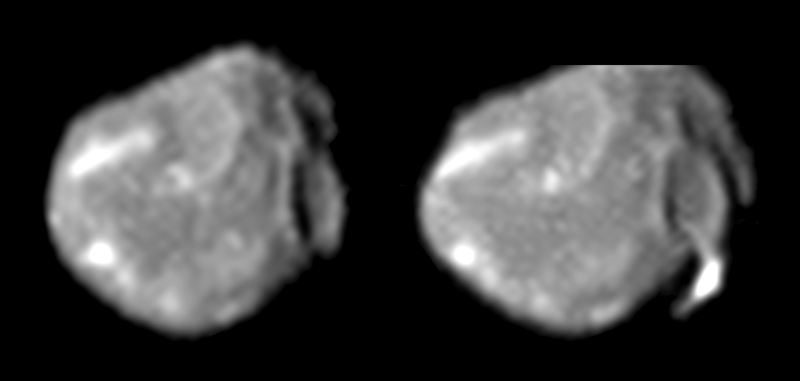
File:Amalthea_PIA02532.png · Wikimedia Commons · See Wikimedia Commons
Amalthea is one of Jupiter's moons, a small rocky body that orbits the giant planet. It is notable for being the third-closest moon to Jupiter and for its distinctive reddish color, which scientists believe comes from sulfur compounds deposited on its surface.
AI-generated from the Wikipedia summary — may contain errors.
Wikidata facts
- Instance of
- regular moon
- Named after
- Amalthea
- Parent body
- Jupiter
- Radius
- 83.45
- Mass
- 2.1
- Orbital period
- 0.49817943
- Image
- Amalthea PIA02532.png
Show 13 more facts
- Commons category
- Amalthea
- discoverer or inventor
- Edward Emerson Barnard
- site of astronomical discovery
- Lick Observatory
- time of discovery or invention
- 1892-09-09
- topic's main category
- Category:Amalthea (moon)
- periapsis
- 181150
- apoapsis
- 182840
- orbital eccentricity
- 0.00319
- semi-major axis of an orbit
- 181400
- apparent magnitude
- 14.1
- albedo
- 0.09
- orbital inclination
- 0.374
- volume as quantity
- 2430000
Sources (8)
via Wikidata · CC0
~15 min read
Encyclopedic overview
Apparent magnitude 14.1 Absolute magnitude (H) 7.2
Amalthea (/æməlˈθiːə/) is a moon of Jupiter. It has the third-closest orbit around Jupiter among known moons and was the fifth moon of Jupiter to be discovered, so it is also known as Jupiter V. It is also the fifth-largest moon of Jupiter, after the four Galilean moons. Edward Emerson Barnard discovered the moon on 9 September 1892 and named it after Amalthea of Greek mythology. It was the last natural satellite to be discovered by direct visual observation; all later moons were discovered by photographic or digital imaging.
Excerpted from Wikipedia’s “Amalthea” article, available under the CC BY-SA 4.0 licence.
Gallery (10)
Available in 75 languages
- Español
- Français
- Deutsch
- 中文
- 日本語
- Русский
- Português
- Italiano
- العربية
- हिन्दी
- Afrikaans
- Albanian
- Aragonese
- Armenian
- azb
- Bahasa Indonesia
- Bangla
- Basque
Show 56 more
- Belarusian
- Bosnian
- Breton
- Bulgarian
- Burmese
- Catalan
- cdo
- Corsican
- Croatian
- Czech
- Danish
- Esperanto
- Estonian
- Filipino
- Finnish
- Galician
- Georgian
- Greek
- Hebrew
- Hungarian
- Irish
- Komi
- Kyrgyz
- Latin
- Latvian
- Lithuanian
- Low German
- Luxembourgish
- Macedonian
- Malayalam
- Manx
- Marathi
- Mirandese
- Nederlands
- Norwegian
- Norwegian Nynorsk
- Polski
- Romanian
- Serbian
- Serbian (Latin)
- simple
- Slovak
- Slovenian
- Svenska
- Tiếng Việt
- Türkçe
- Ukrainian
- Uzbek
- Waray
- Western Panjabi
- Wu Chinese
- zh_min_nan
- zh_yue
- فارسی
- ไทย
- 한국어
via Wikidata sitelinks · CC0