File:Angle.svg · Wikimedia Commons · See Wikimedia Commons
angle
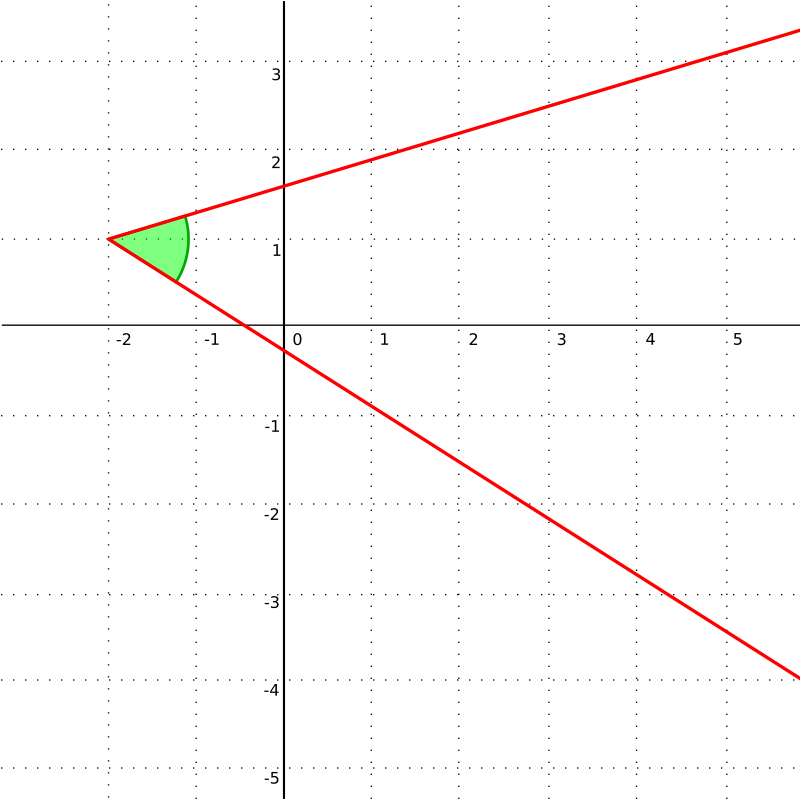
Sign in to saveclass=skin-invert-image|alt=two line bent at a point|thumb|upright=1.25|A green angle formed by two red Ray (geometry)|rays on the [[Cartesian coordinate system]]
An angle is the figure formed when two lines or rays meet at a point, and it measures how much one line is turned relative to the other. Angles are fundamental to geometry, mathematics, and practical fields like construction and navigation, where they help us describe and work with shapes, directions, and spatial relationships.
AI-generated from the Wikipedia summary — may contain errors.
Wikidata facts
- Has part
- angular measure
- Image
- Coord Angle.svg
Show 11 more facts
- described by source
- Explanatory Dictionary of the Living Great Russian Language
- Commons category
- Angles (geometry)
- topic's main category
- Category:Angle
- Stack Exchange tag
- stackoverflow.com/tags/angle
- Unicode character
- ∠
- on focus list of Wikimedia project
- Wikipedia:Vital articles/Level/4
- different from
- solid angle
- has characteristic
- angular measure
- maintained by WikiProject
- WikiProject Mathematics
- invariant under
- conformal map
- topic has template
- Template:Angles
Sources (6)
via Wikidata · CC0
~32 min read
Encyclopedic overview
32 sectionsContents
- Fundamentals
- Notation and measurement
- Units of measurement
- Addition and subtraction
- Common angles
- Combining angle pairs
- Polygon-related angles
- Plane-related angles
- Measuring angles <span class="anchor" id="Measurement"></span>
- Reference angle
- Circular measurement
- Units
- Dimensional analysis
- Signed angles
- Equivalent angles
- Related quantities
- Angles between curves
- Bisecting and trisecting angles
- Dot product and generalisations <span class="anchor" id="Dot product"></span>
- Inner product
- Angles between subspaces
- Angles in Riemannian geometry
- Hyperbolic angle
- History and etymology
- Vertical angle theorem
- Angles in geography and astronomy
- See also
- Notes
- References
- Bibliography
- Further reading
- External links
class=skin-invert-image|alt=two line bent at a point|thumb|upright=1.25|A green angle formed by two red Ray (geometry)|rays on the [[Cartesian coordinate system]]
In geometry, an angle is formed by two lines that meet at a point. Each line is called a side of the angle, and the point they share is called the vertex of the angle. The term angle is used to denote both geometric figures and their size or magnitude as associated quantity. Angular measure or measure of angle are sometimes used to distinguish between the measure of the quantity and figure itself. The measurement of angles is intrinsically linked with circles and rotation, and this is often visualized or defined using the arc of a circle centered at the vertex and lying between the sides.
Excerpted from Wikipedia’s “angle” article, available under the CC BY-SA 4.0 licence.
Gallery (322)
Available in 146 languages
- Español
- Français
- Deutsch
- 中文
- 日本語
- Русский
- Português
- Italiano
- العربية
- हिन्दी
- abstract
- Afrikaans
- Albanian
- Albanian
- Aragonese
- Aramaic
- Armenian
- Assamese
Show 127 more
- Asturian
- Aymara
- azb
- Azerbaijani
- Bahasa Indonesia
- Bangla
- Bashkir
- Basque
- bat_smg
- be_x_old
- Belarusian
- Bikol
- Bosnian
- Breton
- Bulgarian
- Buriat
- Burmese
- Catalan
- Central Kurdish
- Cherokee
- Church Slavic
- Chuvash
- Cornish
- Crimean Tatar
- Croatian
- Czech
- Danish
- Egyptian Arabic
- Erzya
- Esperanto
- Estonian
- Fiji Hindi
- Fijian
- Filipino
- Finnish
- Galician
- Gan Chinese
- gcr
- Georgian
- Greek
- Guarani
- Haitian Creole
- Hebrew
- Hungarian
- hyw
- Icelandic
- Ido
- Iloko
- Interlingua
- Irish
- Jamaican Creole English
- Javanese
- Kabardian
- Kannada
- Kazakh
- Khmer
- Kurdish
- Kyrgyz
- Latin
- Latvian
- Limburgish
- Lingala
- Lithuanian
- Lombard
- Low German
- Macedonian
- Malagasy
- Malay
- Malayalam
- Marathi
- Mari
- Mazanderani
- Mingrelian
- Moksha
- Mongolian
- Moroccan Arabic
- N’Ko
- Nederlands
- Nepali
- Newari
- Northern Frisian
- Norwegian
- Norwegian Nynorsk
- Occitan
- Pashto
- Piedmontese
- Polski
- Punjabi
- Quechua
- Romanian
- Scottish Gaelic
- Serbian
- Serbian (Latin)
- Shona
- Sicilian
- simple
- Sindhi
- Sinhala
- Slovak
- Slovenian
- Somali
- Sundanese
- Svenska
- Swahili
- Tajik
- Tamil
- Tatar
- Telugu
- Tiếng Việt
- Toki Pona
- Türkçe
- Ukrainian
- Urdu
- Uzbek
- Waray
- Welsh
- Western Panjabi
- Wu Chinese
- Yakut
- Yiddish
- zh_classical
- zh_min_nan
- zh_yue
- Zulu
- فارسی
- ไทย
- 한국어
via Wikidata sitelinks · CC0