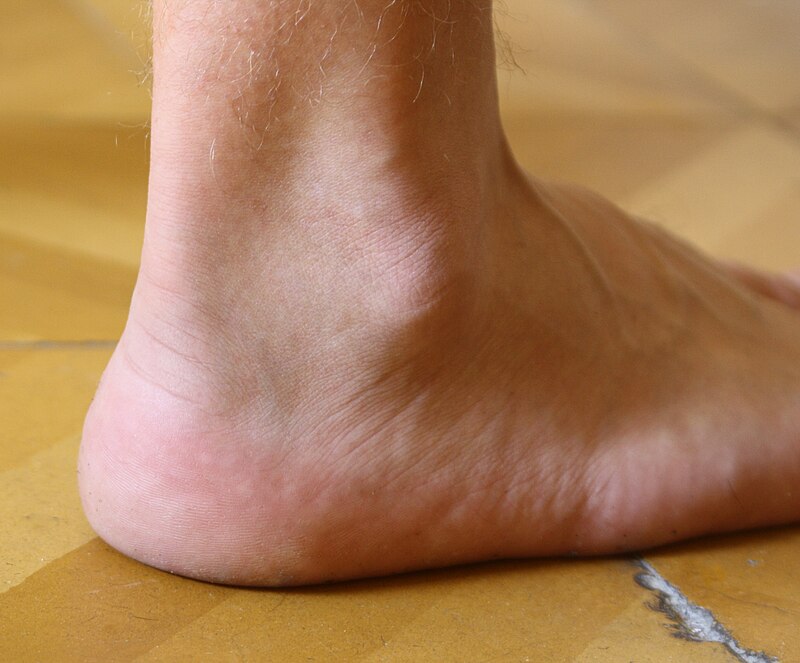
File:Ankle.jpg · Wikimedia Commons · See Wikimedia Commons
ankle
Sign in to saveAlso known as ankle joints, talocrural region
The ankle, the talocrural region or the jumping bone (informal) is the area where the foot and the leg meet. The ankle includes three joints: the ankle joint proper or talocrural joint, the subtalar joint, and the inferior tibiofibular joint. The movements produced at this joint are dorsiflexion and plantarflexion of the foot. In common usage, the term ankle refers exclusively to the ankle region. In medical terminology, "ankle" (without qualifiers) can refer broadly to the region or specifically to the talocrural joint.
The ankle is the area where your foot and leg meet, made up of three joints that work together to allow your foot to move up and down. It's an important part of your body that enables basic movements like walking and jumping.
AI-generated from the Wikipedia summary — may contain errors.
Key facts
- Anatomy.Name
- Ankle
- Anatomy.Latin
- tarsus
- Anatomy.Image
- File:Ankle.jpg
- Anatomy.Caption
- Human ankle
- Anatomy.Image2
- Ankle en.svg
- Anatomy.Caption2
- Lateral view of the human ankle
via Wikipedia infobox
Research
108,788 papers- Is Kinesio Taping Effective for Sport Performance and Ankle Function of Athletes with Chronic Ankle Instability (CAI)? A Systematic Review and Meta-Analysis.Medicina (Kaunas, Lithuania) · 2022Biz C, Nicoletti P, Tomasin M et al.DOI: 10.3390/medicina58050620
- Anatomy of the Ankle and Subtalar Joint Ligaments: What We Do Not Know About It?ReviewFoot and ankle clinics · 2023Gomes TM, Oliva XM, Viridiana Sanchez E et al.DOI: 10.1016/j.fcl.2022.12.003
- Posterior Ankle Impingement.ReviewClinics in podiatric medicine and surgery · 2023Theodoulou MH, Ravine MDOI: 10.1016/j.cpm.2022.12.002
- Open Ankle Arthrodesis for Deformity Correction.ReviewFoot and ankle clinics · 2022Vier D, Irwin TADOI: 10.1016/j.fcl.2021.11.009
- Ankle Joint Microinstability: You Might Have Never Seen It but It Has Definitely Seen You.ReviewFoot and ankle clinics · 2023Vega J, Dalmau-Pastor MDOI: 10.1016/j.fcl.2023.01.008
- Arthroscopic ankle surgery in people with haemophilia.ReviewHaemophilia : the official journal of the World Federation of Hemophilia · 2024Rodriguez-Merchan EC, De la Corte-Rodriguez H, Gomez-Cardero P et al.DOI: 10.1111/hae.14967
- [Lateral ankle ligament bracing].ReviewOperative Orthopadie und Traumatologie · 2019Lohrer HDOI: 10.1007/s00064-019-0603-y
- Complications in Total Ankle Replacement.ReviewFoot and ankle clinics · 2024Hermus JPSDOI: 10.1016/j.fcl.2023.08.007
via PubMed
Wikidata facts
- Image
- Ankle.jpg
Show 2 more facts
- described by source
- Encyclopædia Britannica 11th edition
- Commons category
- Ankles
via Wikidata · CC0
~12 min read
Encyclopedic overview
20 sectionsContents
- Structure
- Region
- Ankle joint
- Ligaments
- Retinacula, tendons and their synovial sheaths, vessels, and nerves
- Mechanoreceptors
- Function
- Clinical significance
- Traumatic injury
- Fractures
- Imaging
- Abnormalities
- History
- Other animals
- Evolution
- See also
- Footnotes
- References
- Additional images
- External links
The ankle, the talocrural region or the jumping bone (informal) is the area where the foot and the leg meet. The ankle includes three joints: the ankle joint proper or talocrural joint, the subtalar joint, and the inferior tibiofibular joint. The movements produced at this joint are dorsiflexion and plantarflexion of the foot. In common usage, the term ankle refers exclusively to the ankle region. In medical terminology, "ankle" (without qualifiers) can refer broadly to the region or specifically to the talocrural joint.
The main bones of the ankle region are the talus (in the foot), the tibia, and fibula (both in the leg). The talocrural joint is a synovial hinge joint that connects the distal ends of the tibia and fibula in the lower limb with the proximal end of the talus. The articulation between the tibia and the talus bears more weight than that between the smaller fibula and the talus.
Excerpted from Wikipedia’s “ankle” article, available under the CC BY-SA 4.0 licence.
Gallery (17)
Available in 86 languages
- Español
- Français
- Deutsch
- 中文
- 日本語
- Русский
- Português
- Italiano
- العربية
- हिन्दी
- Albanian
- Amharic
- Aragonese
- Aramaic
- Atikamekw
- Avaric
- Aymara
- Bahasa Indonesia
Show 67 more
- Banjar
- Basque
- bat_smg
- Betawi
- Bikol
- Bosnian
- Breton
- Bulgarian
- Catalan
- Central Kurdish
- Chuvash
- Croatian
- Czech
- Danish
- Divehi
- Esperanto
- Filipino
- Finnish
- fiu_vro
- Galician
- Greek
- Guarani
- Hakka Chinese
- Hebrew
- Icelandic
- Ido
- Irish
- Javanese
- Kannada
- Latvian
- lbe
- Lombard
- Luxembourgish
- Malagasy
- Malay
- Nederlands
- Nepali
- Norwegian
- Occitan
- Odia
- Polski
- Punjabi
- Quechua
- Romanian
- Sanskrit
- Scottish Gaelic
- Serbian
- Sicilian
- simple
- Sundanese
- Svenska
- Tiếng Việt
- Türkçe
- Ukrainian
- Urdu
- Uyghur
- Waray
- Welsh
- Western Frisian
- Western Panjabi
- Wu Chinese
- Xhosa
- zh_min_nan
- zh_yue
- فارسی
- ไทย
- 한국어
via Wikidata sitelinks · CC0