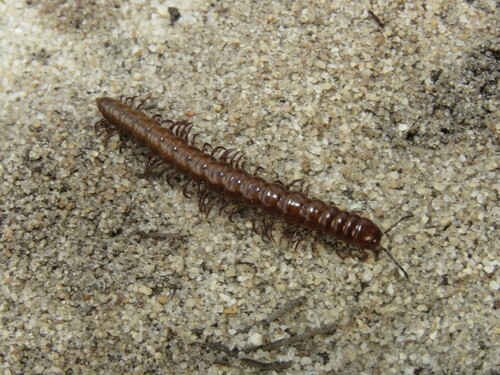
(c) Charlie Porter, some rights reserved (CC BY-NC), uploaded by Charlie Porter · cc-by-nc
Antichiropus
Sign in to saveAntichiropus is a genus of millipede in the family Paradoxosomatidae. The genus is very distinctive in the form of the gonopod, which is typically coiled through at least a full circle. It is probably endemic to Australia. Some species have small ranges of less than 10000 km2, classifying them as short-range endemic invertebrates.
Species
GENUS
- KingdomAnimalia
- PhylumArthropoda
- ClassDiplopoda
- OrderPolydesmida
- FamilyParadoxosomatidae
via GBIF
Museum specimens
- Specimen records
- 2,270
- Family
- Paradoxosomatidae
- Collections
- USNM, NMV, AM, WAM, QM
- Recorded in
- Myanmar, Australia
Wikidata facts
- Instance of
- taxon
- Parent taxon
- Paradoxosomatidae
Show 2 more facts
- taxon name
- Antichiropus
- taxon rank
- genus
Sources (1)
via Wikidata · CC0
~1 min read
Encyclopedic overview
2 sectionsContents
- See also
- References
Antichiropus is a genus of millipede in the family Paradoxosomatidae. The genus is very distinctive in the form of the gonopod, which is typically coiled through at least a full circle. It is probably endemic to Australia. Some species have small ranges of less than 10000 km2, classifying them as short-range endemic invertebrates.
==See also== Antichiropus fossulifrons (Attems, 1911) – Western Australia Antichiropus humphreysi (Shear, 1992) – Western Australia Antichiropus mammilifer (Jeekel, 1982) – South Australia Antichiropus minimus (Attems, 1911) – Western Australia Antichiropus monacanthus (Attems, 1911) – Western Australia Antichiropus nanus (Attems, 1911) – Western Australia Antichiropus sulcatus (Attems, 1911) – Western Australia Antichiropus variabilis (Attems, 1911) – Western Australia Antichiropus whistleri (Attems, 1911) – Western Australia
Excerpted from Wikipedia’s “Antichiropus” article, available under the CC BY-SA 4.0 licence.