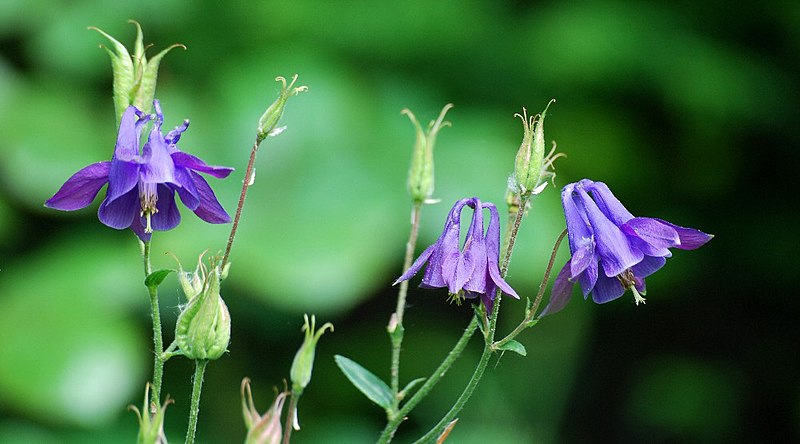
File:Wald-Akelei.JPG · Wikimedia Commons · See Wikimedia Commons
Aquilegia
Sign in to saveAlso known as columbine, Granny's Bonnet, columbines
Aquilegia, commonly known as columbines, is a genus of perennial flowering plants in the family Ranunculaceae (buttercups). The genus includes between 70 and 400 taxa (described species and subspecies) with natural ranges across the Northern Hemisphere. Natural and introduced populations of Aquilegia exist on all continents but Antarctica. Known for their high physical variability and ease of hybridization, columbines are popular garden plants and have been used to create many cultivated varieties.
OverviewAI-generated
Aquilegia, commonly known as columbine, is a genus of plants within the family Ranunculaceae. It belongs to the order Ranunculales, class Magnoliopsida, and phylum Tracheophyta in the kingdom Plantae. The genus comprises approximately 60 to 70 species of perennial plants. The entire plant is toxic and can cause dermatitis, gastroenteritis, and cardiac paralysis.
The native range of Aquilegia includes Afghanistan, Alabama, Alaska, Albania, Alberta, Algeria, Altay, Amur, Arizona, Arkansas, Austria, and the Baltic States. Records from iDigBio indicate collections in the United States and Mexico, with specimens held by institutions such as the University of Alberta Museums and INECOL. The genus has been described in sources including the Encyclopædia Britannica 11th edition and the New International Encyclopedia.
Synthesized by Vinony from 34 facts across 8 sources: Wikidata, GBIF, PubMed, Gbif Occ, Encyclopedia of Life, Plants of the World, iDigBio, Vinony graph. Generated from structured data (not the Wikipedia text) and checked against those facts — may still contain errors.
Species
Aquilegia
GENUS
- KingdomPlantae
- PhylumTracheophyta
- ClassMagnoliopsida
- OrderRanunculales
- FamilyRanunculaceae
耧斗菜属是毛茛科的其中一個屬,大約包含有60到70種多年生植物。 全草有毒,可引起皮膚炎(水疱)、胃腸炎、心臟麻痺等。
via GBIF · Kew POWO
Museum specimens
- Specimen records
- 1,251
- With media
- 905
- Family
- Ranunculaceae
- Collections
- UNIVERSITY OF ALBERTA MUSEUMS, INECOL, FCF-UANL, RMBL, SD, ASC
- Recorded in
- United States, Mexico
Research
253 papers- Aquilegia as a model system for the evolution and ecology of petals.ReviewPhilosophical transactions of the Royal Society of London. Series B, Biological sciences · 2010Kramer EM, Hodges SADOI: 10.1098/rstb.2009.0230
- Characterizing complete mitochondrial genome of Aquilegia amurensis and its evolutionary implications.BMC plant biology · 2024Xu L, Wang J, Zhang T et al.DOI: 10.1186/s12870-024-04844-9
- Columbines.ReviewCurrent biology : CB · 2007Hodges SA, Kramer EMDOI: 10.1016/j.cub.2007.09.034
- My favourite flowering image: an Aquilegia flower.Journal of experimental botany · 2020Kramer EMDOI: 10.1093/jxb/erz035
- Genomics of hybrid parallel origin in Aquilegia ecalcarata.BMC ecology and evolution · 2024Geng FD, Liu MQ, Zhang XD et al.DOI: 10.1186/s12862-024-02266-7
- The Aquilegia genome reveals a hybrid origin of core eudicots.Genome biology · 2019Aköz G, Nordborg MDOI: 10.1186/s13059-019-1888-8
- Comparative chloroplast genomes and phylogenetic analysis of Aquilegia.Applications in plant sciences · 2021Zhang W, Wang H, Dong J et al.DOI: 10.1002/aps3.11412
- Loss of staminodes in Aquilegia jonesii reveals a fading stamen-staminode boundary.EvoDevo · 2024Johns JW, Min Y, Ballerini ES et al.DOI: 10.1186/s13227-024-00225-3
via PubMed
Wikidata facts
- Instance of
- taxon
- Parent taxon
- Ranunculaceae
- Depicts
- Virgin of the Rocks
- Image
- Aquilegia columbine magpie cultivar 2.jpg
Show 7 more facts
- taxon rank
- genus
- taxon name
- Aquilegia
- Commons category
- Aquilegia
- topic's main category
- Category:Aquilegia
- Commons gallery
- Aquilegia
- taxon common name
- orlica
via Wikidata · CC0
~43 min read
Encyclopedic overview
19 sectionsContents
- Etymology
- Description
- Phytochemistry
- Ecology
- Pollination
- Taxonomy
- Evolution
- Current species
- Natural hybridization
- Distribution
- Conservation
- Cultivation
- Cultivars and cultivated hybrids
- Human uses
- Medicinal and herbal
- Other uses
- In culture
- References
- External links
Aquilegia, commonly known as columbines, is a genus of perennial flowering plants in the family Ranunculaceae (buttercups). The genus includes between 70 and 400 taxa (described species and subspecies) with natural ranges across the Northern Hemisphere. Natural and introduced populations of Aquilegia exist on all continents but Antarctica. Known for their high physical variability and ease of hybridization, columbines are popular garden plants and have been used to create many cultivated varieties.
Aquilegia plants typically possess stiff stems and leaves that divide into multiple leaflets. Columbines often have colorful flowers with five sepals and five petals. The petals generally feature nectar spurs which differ in lengths between species. In North America, morphological variations in spurs evolved to suit different pollinators. Some species and varieties of columbines are naturally spurless. In cultivation, varieties bearing significantly altered physical traits such as double flowering are prevalent.
Excerpted from Wikipedia’s “Aquilegia” article, available under the CC BY-SA 4.0 licence.
Gallery (35)
Available in 59 languages
- Español
- Français
- Deutsch
- 中文
- 日本語
- Русский
- Português
- Italiano
- العربية
- Armenian
- Azerbaijani
- Basque
- Bavarian
- Belarusian
- Bosnian
- Bulgarian
- Catalan
- Cebuano
Show 40 more
- Cornish
- Croatian
- Czech
- Danish
- Egyptian Arabic
- Esperanto
- Estonian
- Finnish
- Georgian
- Hungarian
- Icelandic
- Ido
- Irish
- Kabardian
- Kabyle
- Kazakh
- Latvian
- Limburgish
- Lithuanian
- Lombard
- Lower Sorbian
- Mongolian
- nds_nl
- Nederlands
- Northern Frisian
- Norwegian Nynorsk
- Ossetic
- Polski
- Serbian
- simple
- Svenska
- Tatar
- Türkçe
- Ukrainian
- Upper Sorbian
- Uzbek
- Veps
- Welsh
- فارسی
- 한국어
via Wikidata sitelinks · CC0