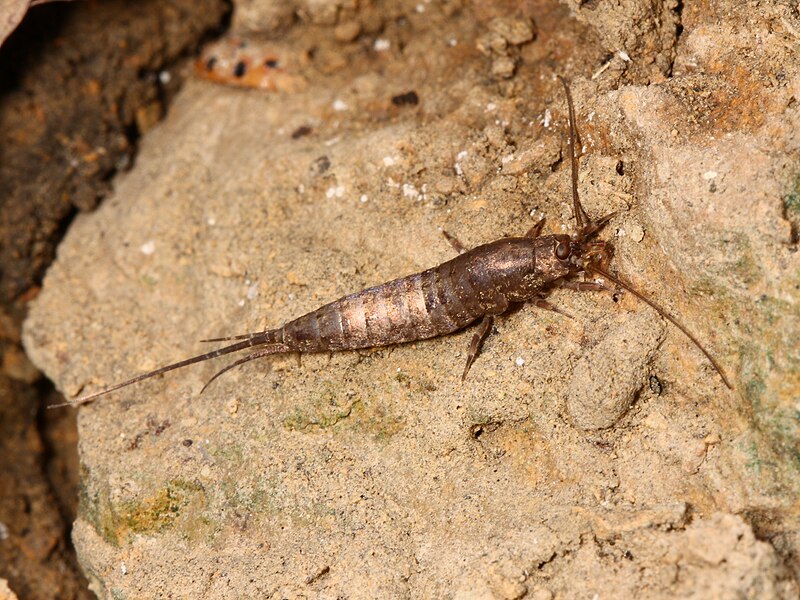
File:Rock_bristletail.JPG · Wikimedia Commons · See Wikimedia Commons
Archaeognatha
Sign in to saveThe Archaeognatha are an order of apterygotes, commonly known as bristletails. Among extant insect taxa they are some of the most evolutionarily primitive; they appeared in the Middle Devonian period at about the same time as the arachnids. Specimens that closely resemble extant species have been found as both body and trace fossils (the latter including body imprints and trackways) in strata from the remainder of the Paleozoic Era and more recent periods. For historical reasons an alternative name for the order is Microcoryphia.
OverviewAI-generated
Archaeognatha is an order of insects within the class Insecta, phylum Arthropoda, and kingdom Animalia. The group is commonly known as bristletails, as well as Rotsspringers and hoppebørstehaler. According to the World Register of Marine Species, the taxon is accepted and has a marine habitat.
Records for this order are held by several institutions, including SDNHM, UAM, YPM, UNM, and LACM. These records originate from the United States and Mexico. The Global Biodiversity Information Facility lists 22,076 occurrences for the taxon, while iDigBio contains 89 records and 12 media files.
Synthesized by Vinony from 26 facts across 6 sources: Wikidata, GBIF, Gbif Occ, WoRMS, iDigBio, Vinony graph. Generated from structured data (not the Wikipedia text) and checked against those facts — may still contain errors.
Species
bristletails
ORDER
- KingdomAnimalia
- PhylumArthropoda
- ClassInsecta
- OrderArchaeognatha
イシノミ目(古顎目、Archaeognatha、Microcoryphia)は、翅を持たない昆虫、いわゆる無翅昆虫のうちの一群で、大部分の昆虫を含む有翅昆虫に対して祖先的な特徴を大きく保持している。全世界の湿った土壌に生息する15mm以下の小さな昆虫で、外見的にはシミ類にやや似る。腹部を地面に叩きつけてジャンプを行うことからこの名がある。
via GBIF
Museum specimens
- Specimen records
- 89
- With media
- 12
- Collections
- SDNHM, UAM, YPM, UNM, LACM, EMEC
- Recorded in
- United States, Mexico
Wikidata facts
- Instance of
- taxon
- Image
- Petrobius maritimus 2010-06-02.jpg
Show 6 more facts
- Commons category
- Archaeognatha
- taxon rank
- order
- topic's main category
- Category:Archaeognatha
- taxon name
- Archaeognatha
- taxon common name
- hoppebørstehaler
- different from
- derailleur
via Wikidata · CC0
~8 min read
Encyclopedic overview
8 sectionsContents
- Etymology
- Description
- Taxonomy
- Suborder †[[Monura]] (8 species)
- Suborder [[Machilida]] (approximately 600 species)
- Biology
- References
- External links
The Archaeognatha are an order of apterygotes, commonly known as bristletails. Among extant insect taxa they are some of the most evolutionarily primitive; they appeared in the Middle Devonian period at about the same time as the arachnids. Specimens that closely resemble extant species have been found as both body and trace fossils (the latter including body imprints and trackways) in strata from the remainder of the Paleozoic Era and more recent periods. For historical reasons an alternative name for the order is Microcoryphia.
Until the late 20th century the suborders Zygentoma and Archaeognatha comprised the order Thysanura; both orders possess three-pronged tails comprising two lateral cerci and a medial epiproct or appendix dorsalis. Of the three organs, the appendix dorsalis is considerably longer than the two cerci; in this the Archaeognatha differ from the Zygentoma, in which the three organs are subequal in length. In the late 20th century, it was recognized that the order Thysanura was paraphyletic, thus the two suborders were each raised to the status of an independent monophyletic order, with Archaeognatha sister taxon to the Dicondylia, including the Zygentoma.
Excerpted from Wikipedia’s “Archaeognatha” article, available under the CC BY-SA 4.0 licence.