
File:Self-portrait_as_the_Allegory_of_Painting_(La_Pittura)_-_Artemisia_Gentileschi.jpg · Wikimedia Commons · See Wikimedia Commons
Artemisia Gentileschi
Sign in to saveAlso known as Artemissa del Gentileschy, Artemisia Lomi, Artemitia, Gentilesca, Artemizia Gentilesca, Artimisi, Artemisia, Artemisia Gentilesca
Italian Baroque painter (1593-1651)
Artemisia Gentileschi was an Italian painter of the Baroque period who lived from 1593 to 1651 and became one of the most accomplished artists of her time. She matters because she overcame significant personal hardships to achieve major recognition as a painter in an era when few women were able to pursue art professionally.
AI-generated from the Wikipedia summary — may contain errors.
Described at
Artemisia's Moment
After being eclipsed for centuries by her father, Orazio, Artemisia Gentileschi, the boldest female painter of her time, gets her due
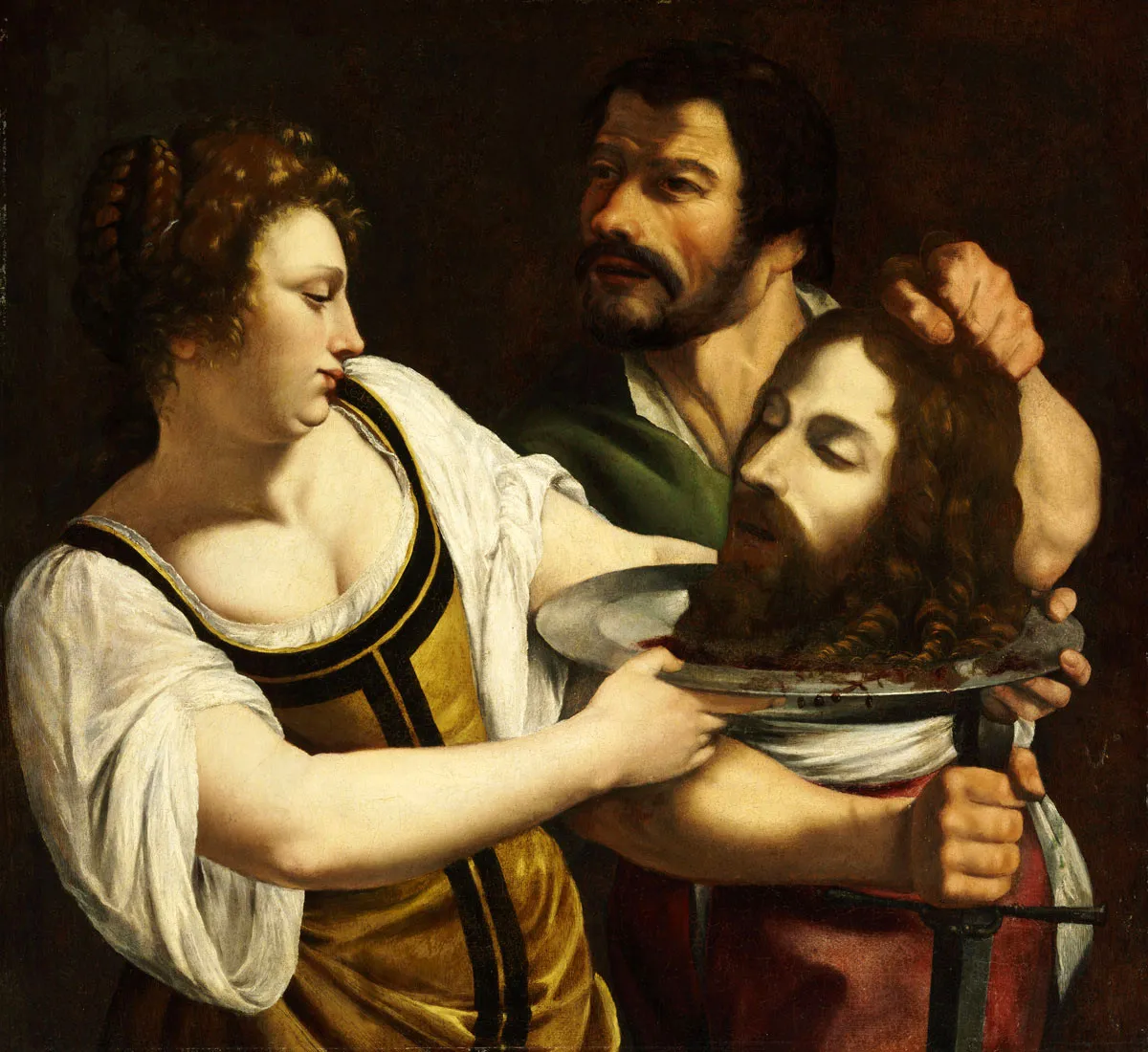
smithsonianmag.com →Salome with the Head of Saint John the Baptist, c. 1610-1615, Budapest Wikimedia Commons Holofernes’ head is upside down. his face writhes in agony. Judith drives her knee into his rib cage as he fights wildly, pushing his fist against her maidservant’s breastbone. As Judith slices Holofernes’ neck, blood spurts from his throat and runs onto the white linen bedsheets. Nearly 400 years later, even jaded citizens of the modern world are startled by this image—a painting of the key moment in the story of Judith, the Jewish widow who saves the city of Bethulia from attacking Assyrians by murdering their commander. To Italian art patrons of the early 17th century, with their taste for dramatic, even violent, imagery, the artist’s gender and notoriety only heightened the painting’s effect. Tarnished by scandal and hindered by a society that expected women to be either nuns or wives, Artemisia Gentileschi nevertheless became the most accomplished female painter of her time. She was, according to the inscription on artist Jerome David’s engraving of her, “A miracle in painting, more easily envied than imitated.” These days, after centuries of neglect, Artemisia is everywhere. The New York Times called her “this season’s ‘it’ girl.” A popular new novel, The Passion of Artemisia by Susan Vreeland, was published in January, and the following month, Lapis Blue Blood Red , a play about her, opened off-Broadway. (Several scholarly books, a catalogue raisonne and two other novels have also been writ ten about her, and one of her works even figured in the plot of the Masterpiece Theatre series Painted Lady starring Helen Mirren. In 1997, she was the subject of a French film, Artemisia .) Most important, an exhibition of her works—and those of her once more-celebrated father, Orazio—at New York’s Metropolitan Museum of Art has gone a long way toward solidifying her reputation as a dynamic and original artist, one of the very few female painters of her time bold enough to tackle historical and allegorical themes. “Orazio and Artemisia Gentileschi: Father and Daughter Painters in Baroque Italy” features 51 paintings by Orazio and 35 by Artemisia. On view through May 12 at the Met before moving to the Saint LouisArt Museum (June 14 through September 15), this first retrospective of the father’s and daughter’s works highlights their divergent responses to Baroque influences. Though in Artemisia’s case the recognition is long overdue, the strong-willed self-promoter enjoyed considerable success in her own lifetime. Painter to dukes, princes, cardinals and kings, she was the first woman admitted to the prestigious Accademia del Disegno. “I have seen myself honored by all the kings and rulers of Europe to whom I have sent my works, not only with great gifts but also with most favored letters, which I keep with me,” she wrote to her friend the astronomer Galileo in 1635. But her artistic achievements have had to compete with a real-life event. At the age of 17, she was raped by a colleague of her father’s. The subsequent trial, and the 300-page transcript of it that survived, have shaped history’s assessment of the artist. Orazio Gentileschi was one of the first painters to respond to a new aesthetic bursting forth in Rome in 1600, Artemisia’s 7th summer. The unveiling of a single commission—Caravaggio’s two works on the life of Saint Matthew—introduced key elements of a new canon, eventually called Baroque. Until that summer, Orazio had supported himself, his wife and four children by executing rather bland commissions for various altarpieces and chapels in Rome. But thunderstruck by Caravaggio’s vision, 37-yearold Orazio enthusiastically embraced the younger artist’s dramatic narratives, dynamic plays of light and shadow, energetic compositions, and close-ups of reality, such as a horse’s rump or a rotting corpse. Caravaggio scandalized the art world by painting directly, in an unidealized fashion, from live models, some of whom, rumor had it,
Excerpt from a page describing this subject · 18,990 chars · not written by Vinony
Wikidata facts
- Instance of
- human
- Gender
- female
- Citizenship
- Papal States
- Place of birth
- Rome
- Place of death
- Naples
- Father
- Orazio Gentileschi
- Occupation
- artist
- Position held
- court painter
- Languages spoken
- Italian
- Religion
- Catholicism
- Notable work
- Susanna and the Elders
- Student of
- Orazio Gentileschi
- Field of work
- painting
- Movement
- Caravaggisti
- Image
- Artemisia Gentileschi Selfportrait Martyr.jpg
- Work location
- Naples
Show 11 more facts
- has works in the collection
- Nivaagaard Museum
- Commons category
- Artemisia Gentileschi
- date of birth
- 1593-07-08
- date of death
- 1653-01-01
- member of
- Accademia delle Arti del Disegno
- Commons Creator page
- Artemisia Gentileschi
- topic's main category
- Category:Artemisia Gentileschi
- Commons gallery
- Artemisia Gentileschi
- ethnic group
- Italians
- name in native language
- Artemisia Gentileschi
Sources (5)
via Wikidata · CC0
Works in European collections
2 objects attributed to Artemisia Gentileschi, held across European museums, libraries & archives · via Europeana

~40 min read
Encyclopedic overview
Artemisia Lomi Gentileschi ( US: /ˌdʒɛntɪˈlɛski, -tiːˈ-/ JEN-til-ESK-ee, -teel-; Italian: [arteˈmiːzja ˈlɔːmi dʒentiˈleski]; 8 July 1593 – after January 1654) was an Italian Baroque painter. Gentileschi is considered among the most accomplished 17th-century artists, initially working in the style of Caravaggio. She was producing professional work by the age of 15. In an era when women had few opportunities to pursue artistic training or work as professional artists, Gentileschi was the first woman to become a member of the Accademia di Arte del Disegno in Florence and she had an international clientele. Gentileschi worked as an expatriate painter in the court of Charles I of England from 1638 to 1642, but she is thought to have fled the country in the early phases of the English Civil War. Her whereabouts over the following years are unknown, but she resurfaced in Naples during 1649. Her last known letter to one of her mentors was dated to 1650 and it indicates that she was still working as an artist. Her time of death is disputed, but her last known commission was in January 1654.
Many of Gentileschi's paintings feature women from myths, allegories, and the Bible, including victims, suicides, and warriors. Some of her best-known subjects are Susanna and the Elders (particularly 1610 version in Schloss Weißenstein, Pommersfelden), Judith Slaying Holofernes (her 1614–1620 version is in the Uffizi gallery), and Judith and Her Maidservant (her 1625 work is in the Detroit Institute of Arts).
Excerpted from Wikipedia’s “Artemisia Gentileschi” article, available under the CC BY-SA 4.0 licence.
Gallery (12)
Available in 70 languages
- Español
- Français
- Deutsch
- 中文
- 日本語
- Русский
- Português
- Italiano
- العربية
- हिन्दी
- Armenian
- Asturian
- Azerbaijani
- Bahasa Indonesia
- Basque
- Belarusian
- Bikol
- Breton
Show 51 more
- Bulgarian
- Catalan
- Chuvash
- Cornish
- Croatian
- Czech
- Danish
- Esperanto
- Estonian
- Filipino
- Finnish
- Galician
- Georgian
- Greek
- Hebrew
- Hungarian
- Icelandic
- Ido
- Irish
- Kotava
- Latin
- Ligurian
- Lithuanian
- Macedonian
- Malayalam
- Maltese
- Nederlands
- Newari
- Norwegian
- Norwegian Nynorsk
- Piedmontese
- Polski
- Romanian
- Serbian
- Serbian (Latin)
- Sicilian
- simple
- Slovak
- Slovenian
- Svenska
- Swahili
- Tiếng Việt
- Türkçe
- Ukrainian
- Waray
- Welsh
- Wu Chinese
- zh_min_nan
- فارسی
- ไทย
- 한국어
via Wikidata sitelinks · CC0