
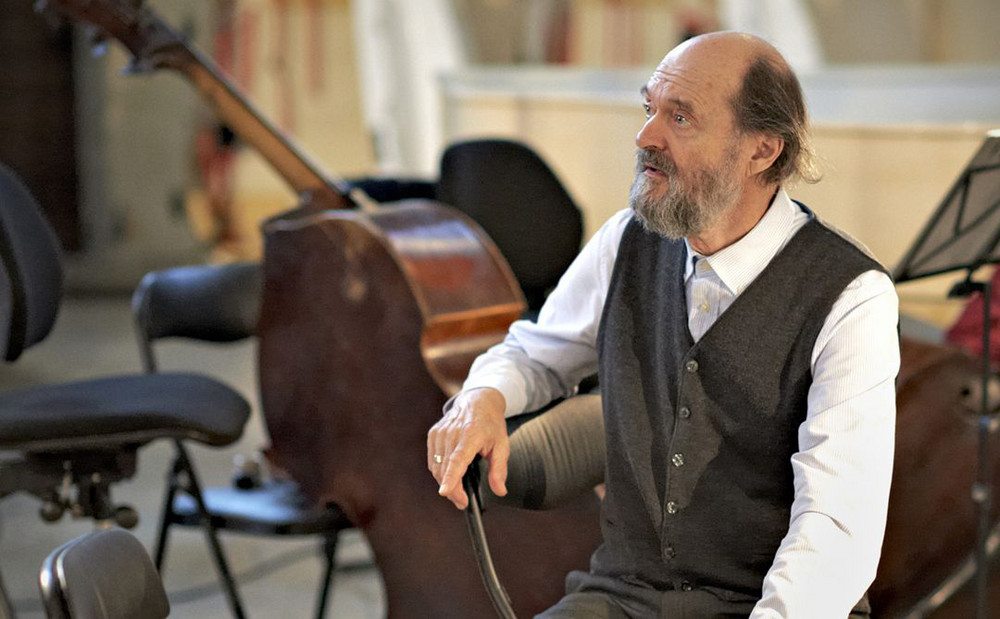
File:Arvo_Pärt.jpg · Wikimedia Commons · See Wikimedia Commons
Arvo Pärt
Sign in to saveEstonian composer (born 1935)
OverviewAI-generated
Arvo Pärt is an Estonian composer and musician born on September 11, 1935, in Paide. He holds citizenship in Estonia, Austria, and the Soviet Union. Pärt studied at the Estonian Academy of Music and Theatre and has worked in Berlin. His musical output includes symphonies, contemporary classical, minimalist, and religious music. Notable works include *Adam's Lament*, *Spiegel im Spiegel*, *Für Alina*, and *Fratres*.
He has received the Knight of the Legion of Honour, the Herder Prize, the Praemium Imperiale, and the Léonie Sonning Music Prize. Pärt is a member of the Serbian Academy of Sciences and Arts, the American Academy of Arts and Letters, the Royal Swedish Academy of Music, and the Estonian Academy of Sciences. He speaks Estonian, Russian, and German. His recordings have been released on ECM Records.
Synthesized by Vinony from 39 facts across 8 sources: Wikidata, Crossref, MusicBrainz, Last.fm, TMDb, Wikiquote, Open Library, Vinony graph. Generated from structured data (not the Wikipedia text) and checked against those facts — may still contain errors.
Film & TV
Paide, Järva County, Estonia
Arvo Pärt (Estonian pronunciation: [ˈɑrʋo ˈpært]; born September 11, 1935) is an Estonian composer of classical and religious music. Since the late 1970s, Pärt has worked in a minimalist style that employs tintinnabuli, a compositional technique he invented. His most performed works include Fratres (1977), Spiegel im Spiegel (1978), and Für Alina (1976). From 2011 to 2018, Pärt was the most…
Known for
- Rebel with a Bow Tie — Self (uncredited)2025
- 7 Lakes, 7 Lives2021
- That Pärt Feeling — Himself2019
- The Lost Paradise — Himself2015
- Arvo Pärt: Even if I lose everything — Himself2015
- Maestro2015
- Sounds and Silence - Travels with Manfred Eicher — Himself2009
- Arvo Pärt: 24 Preludes for a Fugue — Himself2002
- Grisha1996
- Arvo Pärt: And Then Came the Evening and the Morning — Himself1990
via TMDB
Music · MusicBrainz
- Type
- Person
- Gender
- Male
- Origin
- Estonia
- Active from
- 1935
Discography
- Pärt: Polüfooniline sümfoonia / Perpetuum mobile / Rääts: Sümfoonia nr. 41966
- Sinfonia n. 1 / Perpetuum mobile / Collage sur B-A-C-H / Musica sillabica / Pro et contra1969
- Tabula Rasa1984
- Arbos1987
- Passio1988
- Cello Concerto "Pro et contra" / Perpetuum Mobile / Symphony no. 1 "Polyphonic" / Symphony no. 2 / Symphony no. 31989
- Miserere1991
- Magnificat Antiphonen1992
- Trivium1992
- Collage1993
via MusicBrainz · CC0
Listeners · Last.fm
- Listeners
- 633,188
- Total plays
- 9,973,944
Tags
Arvo Pärt (11 September 1935) is an Estonian composer of classical and sacred music. Since the late 1970s, Pärt has worked in a minimalist style that employs his self-invented compositional technique, tintinnabuli. His music is in part inspired by Gregorian chant. Pärt has been the most performed living composer in the world for 5 consecutive years. Arvo Pärt was born in Paide, Järva County, Estonia. His musical studies began in 1954 at the Tallinn Music Secondary School <a href="https://www.la
Wikidata facts
- Instance of
- human
- Given name
- Arvo
- Gender
- male
- Citizenship
- Austria
- Place of birth
- Paide
- Occupation
- composer
- Educated at
- Estonian Academy of Music and Theatre
- Languages spoken
- German
- Notable work
- Spiegel im Spiegel
- Field of work
- music
- Genre
- religious music
- Record label
- ECM Records
- Official website
- www.arvopart.ee
- Image
- Arvo Pärt.jpg
- Work location
- Berlin
Show 5 more facts
- Commons category
- Arvo Pärt
- date of birth
- 1935-09-11
- topic's main category
- Category:Arvo Pärt
- related category
- Category:Compositions by Arvo Pärt
- P12674
- Jean-Yves Rey
Sources (3)
via Wikidata · CC0
~18 min read
Encyclopedic overview
Arvo Pärt ( Estonian pronunciation: [ˈɑrvo ˈpært]; born 11 September 1935) is an Estonian composer. Since the late 1970s, Pärt has worked in a minimalist style that employs tintinnabuli, a compositional technique he invented. Pärt's music is in part inspired by Gregorian chant. His most performed works include Fratres (1977), Spiegel im Spiegel (1978), and Für Alina (1976). From 2011 to 2018, and again in 2022 and 2025, Pärt was the most performed living composer in the world. The Arvo Pärt Centre, in Laulasmaa, was opened to the public in 2018.
Early life, family and education
Excerpted from Wikipedia’s “Arvo Pärt” article, available under the CC BY-SA 4.0 licence.