File:Astrocyte5.jpg · Wikimedia Commons · See Wikimedia Commons
astrocyte
Sign in to saveAlso known as astroglia, astrocytes
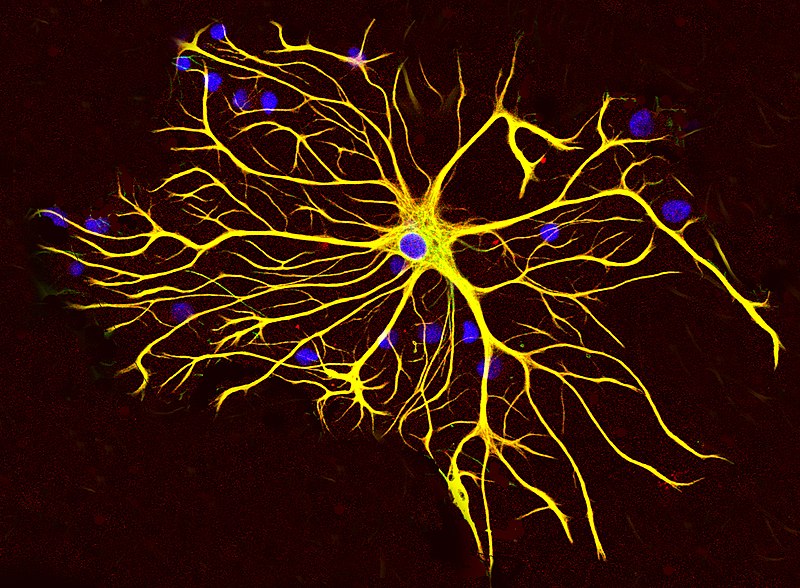
Astrocytes (from Ancient Greek , , "star" and , , "cavity", "cell"), also known collectively as astroglia, are characteristic star-shaped glial cells in the brain and spinal cord. They perform many functions, including biochemical control of endothelial cells that form the blood–brain barrier, provision of nutrients to the nervous tissue, maintenance of extracellular ion balance, regulation of cerebral blood flow, and a role in the repair and scarring process of the brain and spinal cord following infection and traumatic injuries. The proportion of astrocytes in the brain is not well defined;
Key facts
- Cell.Caption
- An astrocyte from a rat brain grown in tissue culture and stained with antibodies to GFAP (red) and vimentin (green). Both proteins are present in large amounts in the intermediate filaments of this cell, so the cell appears yellow. The blue material shows DNA visualized with DAPI stain, and reveals the nucleus of the astrocyte and of other cells. Image courtesy of EnCor Biotechnology Inc.
- Cell.Location
- Brain and spinal cord
- Cell.Precursor
- Glioblast
- Cell.Name
- Astrocyte
- Cell.Latin
- astrocytus
- Cell.Image
- Astrocyte5.jpg
via Wikipedia infobox
Research
87,559 papers- Astrocyte Biomarkers in Alzheimer's Disease.Trends in molecular medicine · 2019
- Electroacupuncture prevents astrocyte atrophy to alleviate depression.Cell death & disease · 2023
- Astrocytic neuroligins control astrocyte morphogenesis and synaptogenesis.Nature · 2017
- Astrocyte scar formation aids central nervous system axon regeneration.Nature · 2016
- Dysfunctional serotonergic neuron-astrocyte signaling in depressive-like states.Molecular psychiatry · 2023
via PubMed
Wikidata facts
- Instance of
- cell type
- Image
- Astrocyte.jpg
Show 3 more facts
- NCI Thesaurus ID
- C12477
- Commons category
- Astrocytes
- native label
- astroglia
via Wikidata · CC0
~37 min read
Encyclopedic overview
27 sectionsContents
- Structure
- Types
- Fibrous glia
- Protoplasmic glia
- Radial glia
- Energy use
- Development
- Function
- Tripartite synapse
- Glutamatergic gliotransmission
- Clinical significance
- Astrocytomas
- Neurodevelopmental disorders
- Chronic pain
- Two states of persistent pain
- Other pathologies
- Gomori-positive astrocytes and brain dysfunction
- Possible roles in pathophysiology
- Research
- Classification
- Lineage and antigenic phenotype
- Anatomical classification
- Transporter/receptor classification
- See also
- References
- Further reading
- External links
Astrocytes (from Ancient Greek , , "star" and , , "cavity", "cell"), also known collectively as astroglia, are characteristic star-shaped glial cells in the brain and spinal cord. They perform many functions, including biochemical control of endothelial cells that form the blood–brain barrier, provision of nutrients to the nervous tissue, maintenance of extracellular ion balance, regulation of cerebral blood flow, and a role in the repair and scarring process of the brain and spinal cord following infection and traumatic injuries. The proportion of astrocytes in the brain is not well defined; depending on the counting technique used, studies have found that the astrocyte proportion varies by region and ranges from 20% to around 40% of all glia. Another study reports that astrocytes are the most numerous cell type in the brain. Astrocytes are the major source of cholesterol in the central nervous system. Apolipoprotein E transports cholesterol from astrocytes to neurons and other glial cells, regulating cell signaling in the brain. Astrocytes in humans are more than twenty times larger than in rodent brains, and make contact with more than ten times the number of synapses.
Research since the mid-1990s has shown that astrocytes propagate intercellular Ca2+ waves over long distances in response to stimulation, and, similar to neurons, release transmitters (called gliotransmitters) in a Ca2+-dependent manner. Data suggest that astrocytes also signal to neurons through Ca2+-dependent release of glutamate. Such discoveries have made astrocytes an important area of research within the field of neuroscience.
Excerpted from Wikipedia’s “astrocyte” article, available under the CC BY-SA 4.0 licence.