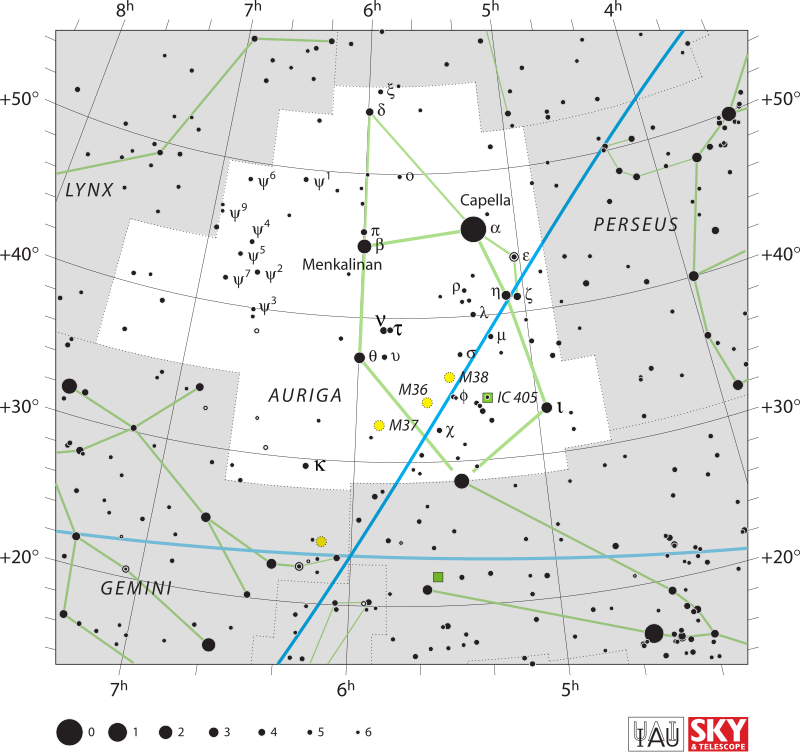
File:Auriga_IAU.svg · Wikimedia Commons · See Wikimedia Commons
Auriga
Sign in to saveAlso known as Aur, Aurigae
Auriga is a constellation in the northern celestial hemisphere. It is one of the 88 modern constellations; it was among the 48 constellations listed by the 2nd-century astronomer Ptolemy. Its name is Latin for '(the) charioteer', associating it with various mythological beings, including Erichthonius and Myrtilus. Auriga is most prominent during winter evenings in the northern Hemisphere, as are five other constellations that have stars in the Winter Hexagon asterism. Because of its northern declination, Auriga is only visible in its entirety as far south as −34°; for observers farther south i
Auriga is a constellation in the northern sky that has been recognized since ancient times, with its name meaning "the charioteer" in Latin. It is most easily seen during winter evenings in the northern hemisphere and is notable for containing some of the bright stars that form the Winter Hexagon pattern.
AI-generated from the Wikipedia summary — may contain errors.
Key facts
- Constellation.name
- Auriga
- Constellation.abbreviation
- Aur
- Constellation.genitive
- Aurigae
- Constellation.symbolism
- the Charioteer
- Constellation.RA
- –
- Constellation.dec
- –
- Constellation.family
- Perseus
- Constellation.areatotal
- 657
- Constellation.arearank
- 21st
- Constellation.numbermainstars
- 5, 8
- Constellation.numberbfstars
- 65
- Constellation.numberbrightstars
- 4
- Constellation.numbernearbystars
- 2
- Constellation.brighteststarname
- Capella (α Aur)
- Constellation.starmagnitude
- 0.08
- Constellation.neareststarname
- QY Aur
- Constellation.stardistancely
- 19.74
- Constellation.stardistancepc
- 6.05
via Wikipedia infobox
Wikidata facts
- Instance of
- constellation
- Named after
- auriga
- Official name
- Auriga
- Area
- 657
- Shares border with
- Lynx
- Child body
- Delta Aurigids
- Image
- AurigaCC.jpg
Show 8 more facts
- topic has template
- Template:Auriga (constellation)
- Commons category
- Auriga (constellation)
- topic's main category
- Category:Auriga
- Commons gallery
- Auriga
- described by source
- New International Encyclopedia
- short name
- Aur
- on focus list of Wikimedia project
- Wikipedia:Vital articles/Level/4
- maintained by WikiProject
- WikiProject Astronomy
via Wikidata · CC0
~46 min read
Encyclopedic overview
18 sectionsContents
- History and mythology
- In non-Western astronomy
- Features
- Stars
- Bright stars
- Other bright stars
- Eclipsing binary stars
- Other variable stars
- Binary and double stars
- Stars with planetary systems
- Deep-sky objects
- Meteor showers
- See also
- References
- Citations
- References
- Online sources
- External links
Auriga is a constellation in the northern celestial hemisphere. It is one of the 88 modern constellations; it was among the 48 constellations listed by the 2nd-century astronomer Ptolemy. Its name is Latin for '(the) charioteer', associating it with various mythological beings, including Erichthonius and Myrtilus. Auriga is most prominent during winter evenings in the northern Hemisphere, as are five other constellations that have stars in the Winter Hexagon asterism. Because of its northern declination, Auriga is only visible in its entirety as far south as −34°; for observers farther south it lies partially or fully below the horizon. A large constellation, with an area of 657 square degrees, it is half the size of the largest, Hydra.
Its brightest star, Capella, is an unusual multiple star system and amongst the brightest stars in the night sky. Beta Aurigae is an interesting variable star in the constellation; Epsilon Aurigae, a nearby eclipsing binary with an unusually long period, has been studied intensively. Because of its position near the winter Milky Way, Auriga has many bright open clusters in its borders, including M36, M37, and M38, popular targets for amateur astronomers. In addition, it has one prominent nebula, the Flaming Star Nebula, associated with the variable star AE Aurigae.
Excerpted from Wikipedia’s “Auriga” article, available under the CC BY-SA 4.0 licence.
Gallery (32)
Available in 92 languages
- Español
- Français
- Deutsch
- 中文
- 日本語
- Русский
- Português
- Italiano
- العربية
- हिन्दी
- Afrikaans
- Armenian
- Asturian
- Azerbaijani
- Bahasa Indonesia
- Bangla
- Bashkir
- Basque
Show 73 more
- be_x_old
- Belarusian
- Bosnian
- Breton
- Bulgarian
- Burmese
- Catalan
- cdo
- Chuvash
- Cornish
- Corsican
- Croatian
- Czech
- Danish
- Egyptian Arabic
- Esperanto
- Estonian
- Finnish
- Galician
- Georgian
- Greek
- Hakka Chinese
- Hebrew
- Hungarian
- hyw
- Icelandic
- Irish
- Javanese
- Kannada
- Latin
- Latvian
- Lithuanian
- Low German
- Luxembourgish
- Macedonian
- Malay
- Malayalam
- Manx
- Marathi
- Moksha
- Mongolian
- Nederlands
- Northern Frisian
- Norwegian
- Norwegian Nynorsk
- Ossetic
- Polski
- Romanian
- Serbian
- Serbian (Latin)
- simple
- Slovak
- Slovenian
- Svenska
- Swahili
- Tajik
- Tamil
- Tibetan
- Tiếng Việt
- Türkçe
- Ukrainian
- Urdu
- Waray
- Welsh
- Western Panjabi
- Wu Chinese
- Yakut
- Zaza
- zh_min_nan
- zh_yue
- فارسی
- ไทย
- 한국어
via Wikidata sitelinks · CC0