
Australia
Sign in to saveAlso known as Commonwealth of Australia, Straya, Aussieland, Oz, Stralia, New Holland, New Hollandia, Nova Hollandia
OverviewAI-generated
Australia, officially the Commonwealth of Australia, is a country in the Oceania region. It is located in or next to the Indian Ocean, South Pacific Ocean, Great Australian Bight, and Bass Strait. Its capital is Canberra, and it has also had Melbourne as a capital. The country covers an area of 7,692,024 square kilometers. Its population is approximately 27.5 million people.
The head of government holds the office of Prime Minister of Australia. Australia participated in the Second Boer War, World War I, the Russian Civil War, and World War II. It maintains diplomatic relations with the United States, Italy, Brazil, and France. The native label for the country is Australia. Its license plate code is AUS. The emergency phone number is 112.
Public holidays include Australia Day, Anzac Day, Good Friday, and Easter Monday. The retirement age is 67, and the marriageable age is 18. The Gini coefficient is 34.3. Life expectancy is 83.05 years. The unemployment rate is 4.09 percent. Urban population is 87.6 percent. Internet users comprise 96.1 percent of the population. The top-level domain is .au.
Synthesized by Vinony from 70 facts across 10 sources: Wikidata, Open Meteo, Openweathermap, REST Countries, World Bank, OpenStreetMap, Firecrawl, PubMed, Vinony graph, Geo. Generated from structured data (not the Wikipedia text) and checked against those facts — may still contain errors.
Weather now
cached 140h ago7-day forecast
via Open-Meteo
Country

- Capital
- Canberra
- Population
- 27,536,874
- Region
- Oceania · Australia and New Zealand
- Demonym
- Australian
- Currencies
- AUD ($)
- Languages
- English
- Calling code
- +61
- Drives on
- Left
- Gini
- 34.4 (2014)
- FIFA code
- AUS
- TLD
- .au
- Timezones
- UTC+05:00 · +7 more
via REST Countries
Indicators · World Bank
- GDP
- $1.8T(2024)
- Population
- 27,196,812(2024)
- Life expectancy
- 83.1 yrs(2024)
- Unemployment
- 4.1 %(2025)
- Urban population
- 87.6 %(2024)
- Internet users
- 96.1 %(2024)
- Forest area
- 17.4 %(2023)
- Renewable energy
- 12.3 %(2021)
via World Bank Open Data · CC BY 4.0
Wikipedia views (30d)
461,514 totalvia Wikimedia Pageviews API
Key facts
- Country.Gini
- 32.4
- Country.conventional_long_name
- Commonwealth of Australia
- Country.common_name
- Australia
- Country.image_flag
- Flag of Australia (converted).svg
- Country.alt_flag
- A blue field with the Union Flag in the upper hoist quarter, a large white seven-pointed star in the lower hoist quarter, and constellation of five white stars in the fly – one small five-pointed star and four, larger, seven-pointed stars
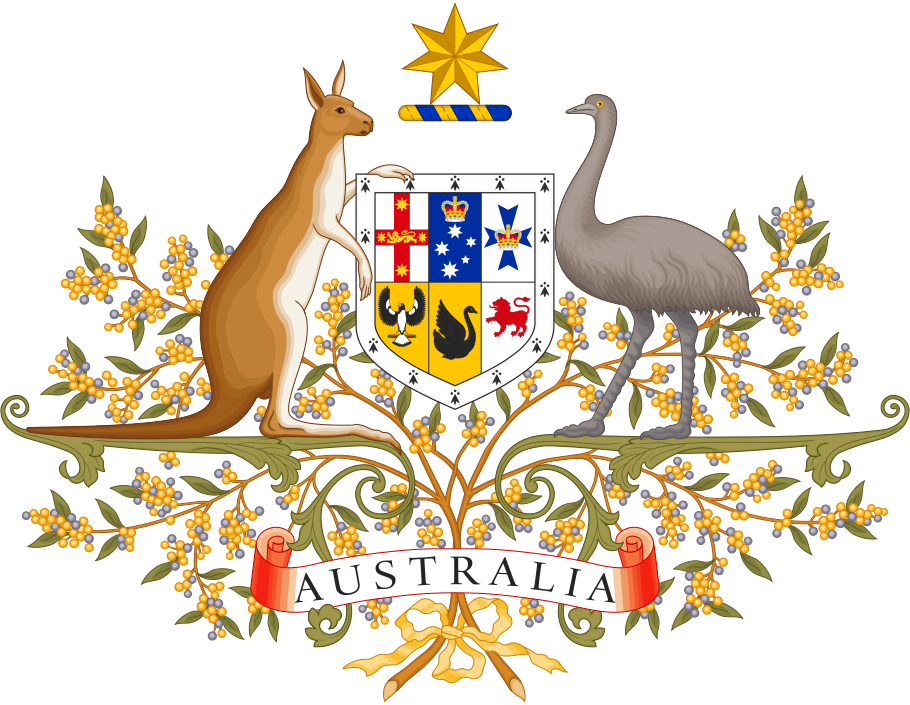
- Country.image_coat
- Coat of arms of the Commonwealth of Australia.svg
- Country.national_anthem
- "Advance Australia Fair"
- Country.alt_map
- A map of the eastern hemisphere centred on Australia, using an orthographic projection
- Country.capital
- Canberra
- Country.largest_city
- Sydney (metropolitan)Melbourne (urban)
- Country.languages_type
- National language
- Country.languages
- English
- Country.religion_year
- 2021
- Country.government_type
- Federal parliamentary constitutional monarchy
- Country.leader_title1
- Monarch
- Country.leader_name1
- Charles III
- Country.leader_name2
- Sam Mostyn
- Country.leader_title3
- Prime Minister
via Wikipedia infobox
Research
1,222,298 papers- Australia's mysterious rock paintings.ReviewThe Journal of comparative neurology · 2020Weiler RDOI: 10.1002/cne.24912
- Australia's fertility rate and the future.The Australian & New Zealand journal of obstetrics & gynaecology · 2024Boothroyd C, Bassett K, Robson SDOI: 10.1111/ajo.13847
- Australia's 'No Jab No Play' policies: history, design and rationales.ReviewAustralian and New Zealand journal of public health · 2022Attwell K, Drislane SDOI: 10.1111/1753-6405.13289
- Australia's contribution to global immunisation.ReviewAustralian and New Zealand journal of public health · 2012Ruff TA, Taylor K, Nolan TDOI: 10.1111/j.1753-6405.2012.00956.x
- Australia's Response to COVID-19.Health economics, policy, and law · 2022Stobart A, Duckett SDOI: 10.1017/S1744133121000244
- Silicosis-lessons from Australia's Dust Diseases Taskforce (2019-21).Occupational medicine (Oxford, England) · 2022Edwards GMDOI: 10.1093/occmed/kqab184
- Management approaches to conserve Australia's marine ecosystem under climate change.ReviewScience (New York, N.Y.) · 2023Bay LK, Gilmour J, Muir B et al.DOI: 10.1126/science.adi3023
- No More Extinctions: Recovering Australia's Biodiversity.ReviewAnnual review of animal biosciences · 2025Woinarski JCZ, Garnett ST, Legge SMDOI: 10.1146/annurev-animal-111523-102004
via PubMed
Official website
Find government payments and services | myGov
australia.gov.au →Link to the official site · 2,175 chars · not written by Vinony
Described at

About Australia | Australian Government Department of Foreign Affairs and Trade
Australia is one of the most multicultural countries in the world, and home to the world's oldest continuing culture. We have a highly skilled workforce and a proud history of democracy and stable government. Australia's Indigenous peoples have lived on and managed the land for more than 60,000 years however, the early treatment of Australia's Indigenous population was marked by conflict and mistreatment.
dfat.gov.au →Australia is one of the most multicultural countries in the world, and home to the world's oldest continuing culture. We have a highly skilled workforce and a proud history of democracy and stable government. Australia's Indigenous peoples have lived on and managed the land for more than 60,000 years however, the early treatment of Australia's Indigenous population was marked by conflict and mistreatment. Since the 1960s successive Australian Governments have joined with Aboriginal and Torres Strait Islander peoples to work towards reconciliation. In 2008, the Australian Parliament passed a motion of Apology to Indigenous Australians for past mistreatment and injustices, especially the Stolen Generations, who were Indigenous children forcibly removed from their families. National Sorry Day is held every year on 26 May to remember and acknowledge this mistreatment. In July each year, NAIDOC Week celebrations mark the history, culture and achievements of Aboriginal and Torres Strait Islander peoples. In the 1850s gold was discovered and the gold rush that followed brought people to Australia from all over the world. In 1901, Australia became a nation, forming the Commonwealth of Australia. One year later, Australia became one of the first countries in the world to give women the right to vote. We take our international responsibilities seriously and work closely with other countries to promote peace and security. Since 1947, over 65,000 Australians have served in more than 50 peace and security operations around the world. Before the COVID-19 pandemic in 2020, Australia recorded 28 straight years of annual economic growth and was the world's 14th largest economy. Following the COVID-19 pandemic, we continue to assist countries in the Indo-Pacific to access safe and effective COVID-19 vaccines. For example, our regional vaccine program ensures that Pacific countries achieve full COVID-19 vaccine coverage. Today we are home to 25 million people from almost 200 countries. All Australians have access to quality and affordable health care – for both physical and mental health. Over 30 per cent of the Australian resident population were born overseas. While English is the national language, more than 300 languages are spoken in Australian homes. The top five (excluding English) are Mandarin, Arabic, Cantonese, Vietnamese, and Italian. Australia in Brief provides an authoritative overview of Australia's history, the land, its people and their way of life. It also looks at Australia's economic, scientific and cultural achievements and its foreign, trade and defence policies. freedom of election and being elected freedom of assembly and political participation freedom of speech, expression and religious belief rule of law other basic human rights. All Australian citizens over the age of 18 must vote in elections. The Australian Constitution of 1901 established a federal system of government, based on the British (Westminster) tradition of government. Powers are distributed between a national government (the Commonwealth) and the six states (New South Wales, Queensland, South Australia, Tasmania, Victoria and Western Australia). The Australian Capital Territory and the Northern Territory have self-government arrangements. Australia's elected national government is answerable to the Parliament for its actions. The Prime Minister leads a Cabinet of ministers, who are responsible for decisions made by their department. Australians enjoy some of the highest living standards in the world despite being home to only 0.3 per cent of the global population. Since 1992, our economy has grown faster than any other major developed country. We have plentiful natural resources and a sophisticated services sector backed by a highly educated workforce. These agreements open up export markets for our companies, reduce the cost of doing business overseas, and give Australians greater choice and more affordable products. In 2020, FTAs wit
Excerpt from a page describing this subject · 21,230 chars · not written by Vinony
Travel guide
Understand
The sixth largest country in the world by area, Australia has a relatively small (but growing) population of 25 million. A G20 member, it has high quality of life and is constantly ranked among the world's most livable countries. It is a significant player in the economic and political spheres of the Indo-Pacific region.
Get around
Australia is huge but sparsely populated over much of its area and is larger than the contiguous U.S. You can sometimes travel many hours before finding the next trace of civilization, especially once you leave the south-eastern coastal fringe.
Do
thumb|Australia is known for having some of the most beautiful beaches in the world (Bondi Beach pictured) thumb|Surfers Paradise, located in the Gold Coast, is one of the most popular tourist destinations in the country, boasting some of the world's greatest beaches and located near an array of theme parks
Buy
thumb|Pitt Street Mall in Sydney is one of Australia's busiest shopping districts
Australia is largely a cashless society, as virtually all businesses accept credit cards and debit cards. For a short trip, there is no need to exchange Australian currency. Cash is still widely accepted, but cashless businesses are increasingly common.
1-2% surcharges for card payments at cafes, pubs and restaurants are common (and perfectly legal), but you will likely lose more than that on the exchange if you pay cash.
Eat
thumb|A "smashed avo" toast, a staple of Australian brunches
Australian cuisine is hard to pin down: in this nation of immigrants, restaurants claiming to offer it are few and far between, and the word tends to either evoke meat-and-three-veg British stodge or tourist-trap restaurants hawking kangaroo burgers and crocodile kebabs. Yet with amazing local produce, influences from cuisines from all over the world, and an exciting Modern Australian food scene awaiting those not afraid to experiment, there are plenty of incredible eats and drinks to be found.
Generally speaking, table manners in Australia conform to European norms.
Sleep
thumb|Camping by the Yarrangobilly River, NSW Accommodation is readily available in most Australian cities and tourist destinations. As with everything else in Australia, it tends to be on the expensive side by international standards.
Respect
Travellers are generally unlikely to insult or cause offence to an Australian through any kind of cultural ignorance.
Australian modes of address tend towards the familiar. It is acceptable and normal to use first names in all situations, even to people many years your senior. Many Australians are fond of using and giving nicknames — even to recent acquaintances. It is likely being called such a name is an indication that you are considered a friend and as such it would be rare they are being condescending.
It is generally acceptable to wear revealing clothing in Australia. Bikinis and swimming attire are okay on the beach, and usually at the kiosk across the road from the beach. It is normal to wear at least a shirt and footwear before venturing any further. Most beaches are effectively top optional (topless) while sunbathing. Just about all women wear a top while walking around or in the water. There are some clothing optional (nude) beaches, usually a little further removed from residential areas. Thong bikinis (more commonly called g-string bikinis in Australia as thongs refer to flip-flop footwear) are fine on all beaches and some outdoor pools for women and men, although they are not as common as conventional beachwear. Some outdoor pools have a "top required" policy for women.
Cover up a little more when visiting places of worship such as churches. In warm conditions casual "t-shirt and shorts" style clothing predominates except in formal situations. Business attir…
Travel guide from Wikivoyage (CC BY-SA 4.0)
~40 min read
Encyclopedic overview
38 sectionsContents
- Etymology
- History
- Indigenous prehistory
- European exploration and colonisation
- Colonial expansion
- Federation to the World Wars
- Post-war and contemporary eras
- Geography
- General characteristics
- Geology
- Climate
- Biodiversity
- Government and politics
- States and territories
- Foreign relations
- Military
- Human rights
- Economy
- Energy
- Science and technology
- Demographics
- Cities
- Ancestry and immigration
- Language
- Religion
- Health
- Education
- Culture
- Arts
- Media
- Cuisine
- Sport and recreation
- See also
- Notes
- References
- Bibliography
- Further reading
- External links
Australia, officially the Commonwealth of Australia, is a country comprising the mainland of the Australian continent, the island of Tasmania and numerous smaller islands. It has a land area of 7,688,287 km (2,968,464 sq mi), making it the sixth-largest country in the world. Australia is the world's flattest and driest inhabited continent. It is a megadiverse country, and its size gives it a wide variety of landscapes and climates including deserts in the interior and tropical rainforests along the coast.
The ancestors of Aboriginal Australians began arriving from Southeast Asia 50,000 to 65,000 years ago, during the Last Glacial Period. By the time of British settlement, Aboriginal Australians spoke more than 250 distinct languages and had one of the oldest living cultures in the world. Australia's written history commenced with Dutch exploration of most of the coastline in the 17th century. British colonisation began in 1788 with the establishment of the penal colony of New South Wales. By the mid-19th century, most of the continent had been explored by European settlers and five additional self-governing British colonies were established, each gaining responsible government by 1890. The colonies federated in 1901, forming the Commonwealth of Australia. This continued a process of increasing autonomy from the United Kingdom, highlighted by the Statute of Westminster Adoption Act 1942, and culminating in the Australia Act 1986.
Excerpted from Wikipedia’s “Australia” article, available under the CC BY-SA 4.0 licence.
Gallery (40)
On the map
4 mapped locations
Available in 319 languages
- Español
- Français
- Deutsch
- 中文
- 日本語
- Русский
- Português
- Italiano
- العربية
- हिन्दी
- Abkhazian
- abstract
- Acehnese
- Adyghe
- Afrikaans
- Akan
- Akan
- Albanian
Show 300 more
- Albanian
- Amharic
- ami
- Angika
- Aragonese
- Aramaic
- Armenian
- Arpitan
- Assamese
- Asturian
- Avaric
- Awadhi
- Aymara
- azb
- Azerbaijani
- Bahasa Indonesia
- Balinese
- Bambara
- Bangla
- Banjar
- Bashkir
- Basque
- bat_smg
- Batak Toba
- Bavarian
- be_x_old
- Belarusian
- Betawi
- Bhojpuri
- Bikol
- Bishnupriya
- Bislama
- blk
- Bosnian
- Breton
- btm
- Buginese
- Bulgarian
- Buriat
- Burmese
- Catalan
- cbk_zam
- cdo
- Cebuano
- Central Dusun
- Central Kurdish
- Chamorro
- Chechen
- Cherokee
- Cheyenne
- Church Slavic
- Chuvash
- Colognian
- Cornish
- Corsican
- Crimean Tatar
- Croatian
- Czech
- dag
- Danish
- Dinka
- Divehi
- dty
- Dzongkha
- Egyptian Arabic
- eml
- Erzya
- Esperanto
- Estonian
- Ewe
- Extremaduran
- Faroese
- Fiji Hindi
- Fijian
- Filipino
- Finnish
- fiu_vro
- Friulian
- Fula
- Gagauz
- Galician
- Gan Chinese
- gcr
- Georgian
- Gilaki
- Gorontalo
- Gothic
- gpe
- Greek
- Guarani
- Gujarati
- Haitian Creole
- Hakka Chinese
- Hausa
- Hawaiian
- Hebrew
- Hungarian
- hyw
- Iban
- Icelandic
- Ido
- Igbo
- igl
- Iloko
- Inari Sami
- Ingush
- Interlingua
- Interlingue
- Inuktitut
- Inupiaq
- Irish
- Jamaican Creole English
- Javanese
- Kabardian
- Kabyle
- kai
- Kannada
- Kanuri
- Kara-Kalpak
- Karachay-Balkar
- Kashmiri
- Kashubian
- Kazakh
- kbp
- kge
- Khmer
- Kikuyu
- Kinyarwanda
- Komi
- Komi-Permyak
- Kongo
- Konkani
- Kotava
- Kurdish
- Kyrgyz
- Ladino
- Lao
- Latgalian
- Latin
- Latvian
- lbe
- Lezghian
- Ligurian
- Limburgish
- Lingala
- Lingua Franca Nova
- Lithuanian
- lld
- Lojban
- Lombard
- Low German
- Lower Sorbian
- Luxembourgish
- Macedonian
- Madurese
- Maithili
- Malagasy
- Malay
- Malayalam
- Maltese
- Manipuri
- Manx
- Māori
- map_bms
- Marathi
- Mari
- Mazanderani
- Minangkabau
- Mingrelian
- Mirandese
- Moksha
- Mongolian
- Moroccan Arabic
- N’Ko
- Navajo
- nds_nl
- Neapolitan
- Nederlands
- Nepali
- Newari
- Nias
- Nigerian Pidgin
- Northern Frisian
- Northern Sami
- Northern Sotho
- Norwegian
- Norwegian Nynorsk
- Novial
- nrm
- Nyanja
- Occitan
- Odia
- Old English
- olo
- Oromo
- Ossetic
- Pampanga
- Pangasinan
- Papiamento
- Pashto
- Pennsylvania German
- Picard
- Piedmontese
- Polski
- Pontic
- Punjabi
- Quechua
- roa_rup
- roa_tara
- Romanian
- Romansh
- Rundi
- Rusyn
- Samoan
- Sango
- Sanskrit
- Santali
- Sardinian
- Saterland Frisian
- Scots
- Scottish Gaelic
- Serbian
- Serbian (Latin)
- Shan
- Shona
- Sicilian
- Silesian
- simple
- Sindhi
- Sinhala
- skr
- Slovak
- Slovenian
- Somali
- Southern Altai
- Southern Sotho
- Sranan Tongo
- Standard Moroccan Tamazight
- Sundanese
- Svenska
- Swahili
- Swati
- syl
- szy
- Tachelhit
- Tahitian
- Tajik
- Talysh
- Tamil
- Taroko
- Tatar
- tay
- Telugu
- Tetum
- Tibetan
- Tiếng Việt
- Tigrinya
- Tok Pisin
- Toki Pona
- Tongan
- Tsonga
- Tswana
- Tulu
- Tumbuka
- Türkçe
- Turkmen
- Tuvinian
- Tyap
- Udmurt
- Ukrainian
- Upper Sorbian
- Urdu
- Uyghur
- Uzbek
- Venetian
- Veps
- Volapük
- Walloon
- Waray
- Welsh
- West Flemish
- Western Frisian
- Western Mari
- Western Panjabi
- Wolof
- Wu Chinese
- Xhosa
- Yakut
- Yiddish
- Yoruba
- Zaza
- Zeelandic
- zh_classical
- zh_min_nan
- zh_yue
- Zhuang
- Zulu
- فارسی
- ไทย
- 한국어
via Wikidata sitelinks · CC0