
Babrius
Sign in to saveAlso known as Valerius Babrius, Gabrius, Gabrias, Babrias
thumb|The fables of Babrius Babrius (, Bábrios; ), also known as Babrias () or Gabrias (), was the author of a collection of Greek fables, many of which are known today as Aesop's Fables.
OverviewAI-generated
Babrius was a male poet and writer who flourished around the year 300. He wrote in Ancient Greek and also spoke or wrote Latin. His work has been described by sources including the Nordisk familjebok, Pauly–Wissowa, Brockhaus and Efron Encyclopedic Dictionary, and The Nuttall Encyclopædia.
Open Library lists 41 works by Babrius. Notable titles include *Le favole d'Aviano tradotte in versi volgari*, *Babriou Mythiamboi*, *Fabulae*, *Fabvlarvm Babrianarvm paraphrasis bodleiana*, and *Les fables ésopiques de Babrius*. Europeana Sparql records 36 works associated with him.
Synthesized by Vinony from 11 facts across 3 sources: Wikidata, Open Library, Europeana Sparql. Generated from structured data (not the Wikipedia text) and checked against those facts — may still contain errors.
Person · Open Library
- Works
- 41
Top works
- Le favole d'Aviano tradotte in versi volgari
- Babriou Mythiamboi
- Fabulae
- Fabvlarvm Babrianarvm paraphrasis bodleiana
- Les fables ésopiques de Babrius
via Open Library + Wikidata
Wikidata facts
Show 4 more facts
- floruit
- 0200-00-00
- date of birth
- 0100-00-00
- date of death
- 0300-00-00
- writing language
- Ancient Greek
Sources (2)
via Wikidata · CC0
Works in European collections
36 objects attributed to Babrius, held across European museums, libraries & archives · via Europeana
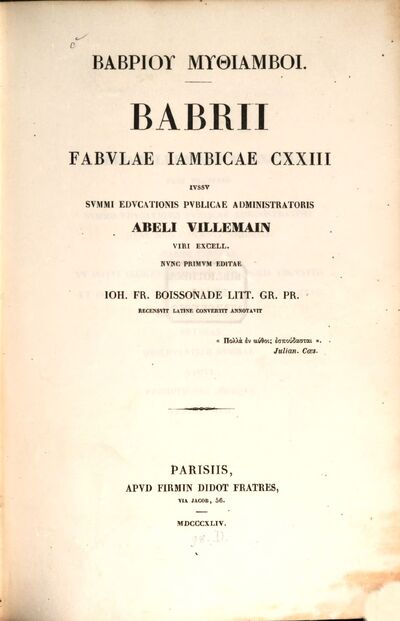
Fabulae jambicae 123 jussu... : Abeli Villemaïn ... nunc pr. editae. Joh. Fr. Boissonade recensuit, Latine convertit, annotavit

Babrii Fabulae ex rec. Alfredi Eberhard

Fabellae jambicae CXXIII
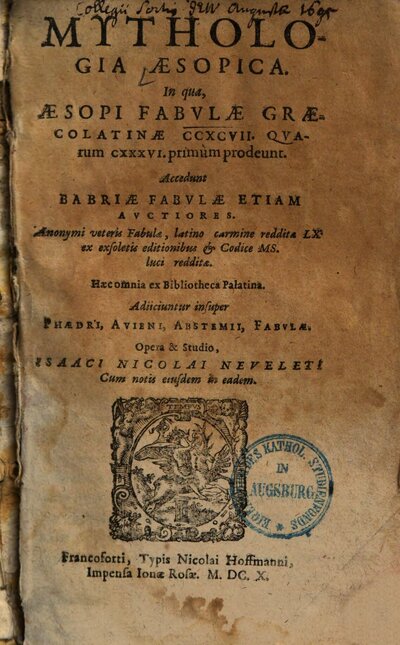
Mythologia Aesopica : in qua Aesopi fabulae Graeco-latinae 197 quarum 136 primum prodeunt

Babrios und die älteren Jambendichter :Griechisch mit metrischer Übersetzung und prüfenden und erklärenden Anmerkungen von J. A. Hartung

Fabeln, übersetzt in deutschen Choliamben : Nebst einer Abhandlung über den Begriff der Fabel u. ihre histor. Entwickelung bey der Griechen von W. Hertzberg

Babrius, des Fabeldichters, wieder gefundene Fabeln : in drei Büchern
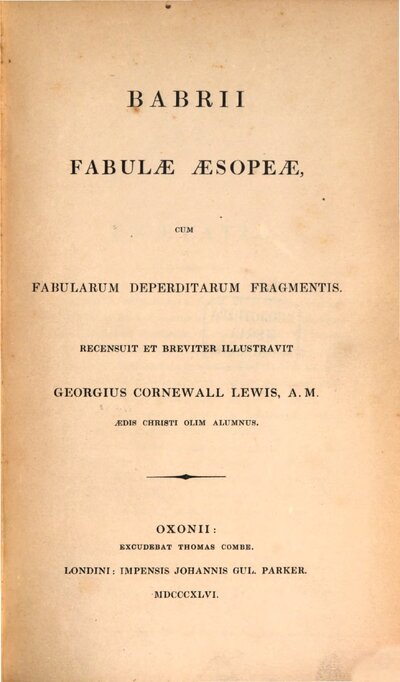
Babrii fabulae Aesopeae cum fabularum deperditarum fragmentis
Fabulae Aesopeae. Edidit F. G. Schneidewin
Babrius, des Fabeldichters, wieder gefundene Fabeln. in drei Büchern
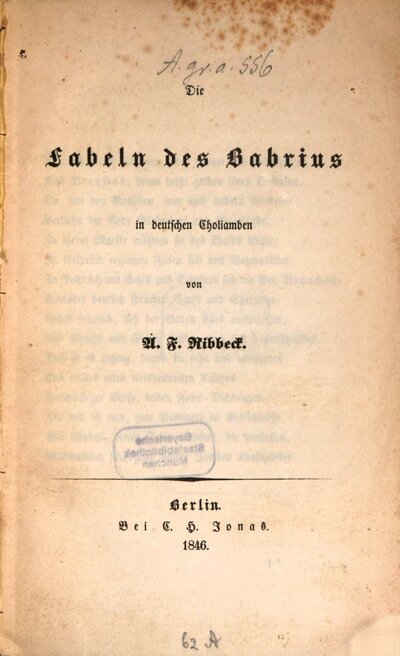
Die Fabeln des Babrius
Babrios und die älteren Jambendichter. Griechisch mit metrischer. Uebersetzung und Anmerkungen von J. A. Hartung
Fabulae Aesopeae. E Codice Manuscripto Partem Secundam Nunc Primum Edidit Georgius Cornewall Lewis

Fabularum Babrianarum paraphrasis Bodleiana

Babrius edited with introductory dissertations, critical notes, commentary and lexicon by W. Gunion Rutherford
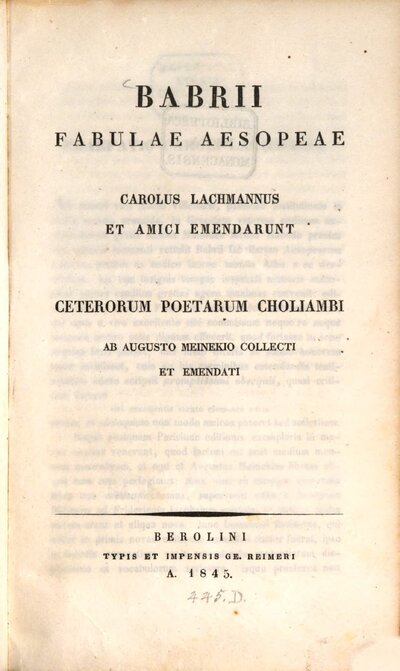
Babrii Fabulae Aesopeae

Babrius, des Fabeldichters, wieder gefundene Fabeln : in drei Büchern

Babriu Mythōn chōliambikōn biblia tria : = Babrii Fabularum choliambicarum libri tres
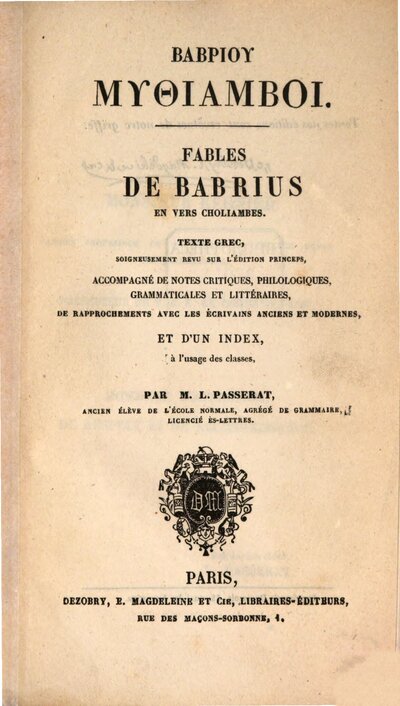
Fables de Babrius en vers choliambes : <...>Texte grec, soigneusement revu sur l'édition princeps, accompagné de notes critiques, philologiques, grammaticales et littéraires de rapprochements avec les écrivains anciens et modernes et d'un index, à l'usage des classes. Par M. L. Passerat

Babriu Mythōn chōliambikōn biblia tria : = Babrii Fabularum choliambicarum libri tres
![Aesopi Phrygis fabulae : elegantissimis eiconibus veras animaliu[m] species ad viuu[m] adumbrantes](https://api.europeana.eu/thumbnail/v2/url.json?uri=https%3A%2F%2Fapi.digitale-sammlungen.de%2Fiiif%2Fimage%2Fv2%2Fbsb11263303_00005%2Ffull%2Ffull%2F0%2Fdefault.jpg&type=IMAGE)
Aesopi Phrygis fabulae : elegantissimis eiconibus veras animaliu[m] species ad viuu[m] adumbrantes

Apologi sev Fabellae Aesopicae Graeco Ac Latino Carmine prosaque redditae ab Aphthonio Sophista, Babria seu Gabria, Phaedro Avg. Liberto & Aviano
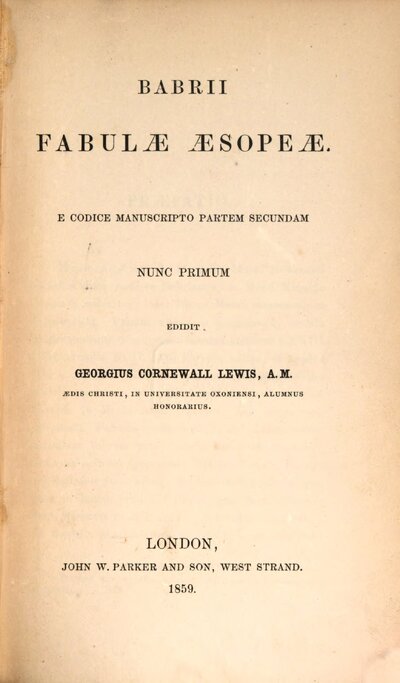
Fabulae Aesopeae : E codice manuscripto partem secundam nunc primum edidit Georgius Cornewall Lewis

Untitled

Untitled
Untitled

Untitled

Untitled

Untitled

Untitled

Untitled

Untitled

Untitled

Untitled

Untitled
Untitled
~5 min read
Encyclopedic overview
7 sectionsContents
- Life
- Work of Richard Bentley
- 1842 find
- Editions
- Notes
- References
- External links
thumb|The fables of Babrius Babrius (, Bábrios; ), also known as Babrias () or Gabrias (), was the author of a collection of Greek fables, many of which are known today as Aesop's Fables.
==Life== Practically nothing is known of him. He is supposed to have been a Hellenized Roman, whose original name may have been Valerius. He lived in the East, probably in Syria, where the fables seem first to have gained popularity. The address to "a son of King Alexander" has caused much speculation, with the result that dates varying between the 3rd century BC and the 3rd century AD have been assigned to Babrius. The Alexander referred to may have been Alexander Severus (AD 222–235), who was fond of having literary men of all kinds about his court. "The son of Alexander" has further been identified with a certain Branchus mentioned in the fables, and it is suggested that Babrius may have been his tutor; probably, however, Branchus is a purely fictitious name. There is no mention of Babrius in ancient writers before the beginning of the 3rd century AD. As appears from surviving papyrus fragments, his work is to be dated before c. 200 AD (and probably not much earlier, for his language and style seem to show that he belonged to that period).
Excerpted from Wikipedia’s “Babrius” article, available under the CC BY-SA 4.0 licence.