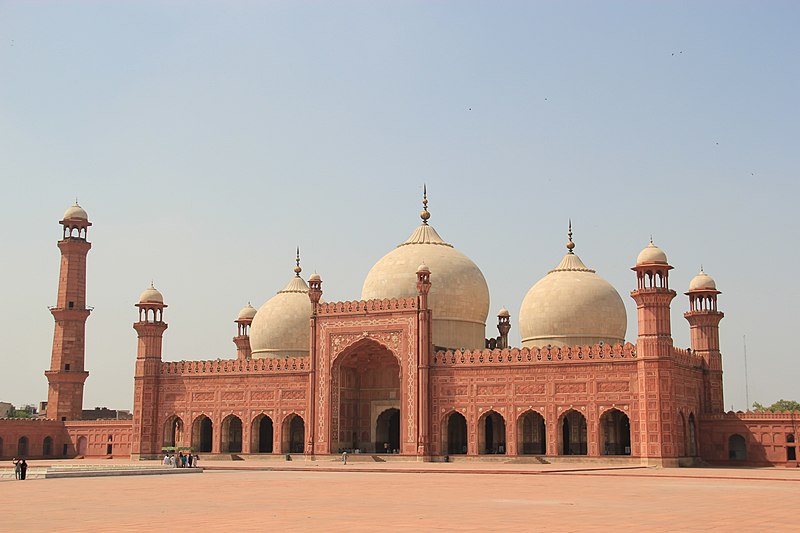
File:Badshahi_Mosque_front_picture.jpg · Wikimedia Commons · See Wikimedia Commons
Badshahi Mosque
Sign in to savemosque in Lahore, Pakistan
The Badshahi Mosque is a large mosque located in Lahore, Pakistan, notable for its impressive architecture and historical significance. It is one of South Asia's largest mosques and stands as an important religious and cultural landmark in the region.
AI-generated from the Wikipedia summary — may contain errors.
Wikidata facts
- Instance of
- mosque
- Religion
- Islam
- Country
- Pakistan
- Located in
- Lahore
- Founded by
- Aurangzeb
- Material used
- sandstone
- Image
- Badshahi Mosque July 1 2005 pic32 by Ali Imran (1).jpg
- Has parts of class
- minaret
Show 7 more facts
- commissioned by
- Aurangzeb
- heritage designation
- Tentative World Heritage Site
- Commons category
- Badshahi Mosque
- architectural style
- Mughal architecture
- inception
- 1671-00-00
- maximum capacity
- 100000
- on focus list of Wikimedia project
- Wikipedia:Vital articles/Level/4
via Wikidata · CC0
~13 min read
Encyclopedic overview
The Badshahi Mosque is a Mughal-era imperial mosque located in Lahore, Punjab, Pakistan. It was constructed between 1671 and 1673 by the Mughal emperor Aurangzeb, opposite to the Lahore Fort in the northern outskirts of the historic Walled City. It is widely considered to be an iconic landmark of the country.
The mosque is an important example of the Mughal architecture, with an exterior that is decorated with carved red sandstone with marble inlay. It was the largest mosque built during the Mughal era, and is currently the third largest mosque in Pakistan.
Excerpted from Wikipedia’s “Badshahi Mosque” article, available under the CC BY-SA 4.0 licence.
Gallery (12)
On the map
Available in 66 languages
- Español
- Français
- Deutsch
- 中文
- 日本語
- Русский
- Italiano
- العربية
- हिन्दी
- Armenian
- Asturian
- Azerbaijani
- Bahasa Indonesia
- Bangla
- Bashkir
- Basque
- Belarusian
- Bosnian
Show 47 more
- Bulgarian
- Catalan
- Croatian
- Czech
- Egyptian Arabic
- Esperanto
- Finnish
- Greek
- Hausa
- Hebrew
- Kinyarwanda
- Lithuanian
- Macedonian
- Madurese
- Maithili
- Malay
- Malayalam
- Marathi
- Nederlands
- Norwegian
- Norwegian Nynorsk
- Occitan
- Pashto
- Polski
- Punjabi
- Romanian
- Scots
- Serbian
- simple
- Sindhi
- Slovenian
- Svenska
- Tamil
- Telugu
- Tiếng Việt
- Türkçe
- Ukrainian
- Urdu
- Uzbek
- Waray
- Western Mari
- Western Panjabi
- Wu Chinese
- zh_yue
- فارسی
- ไทย
- 한국어
via Wikidata sitelinks · CC0