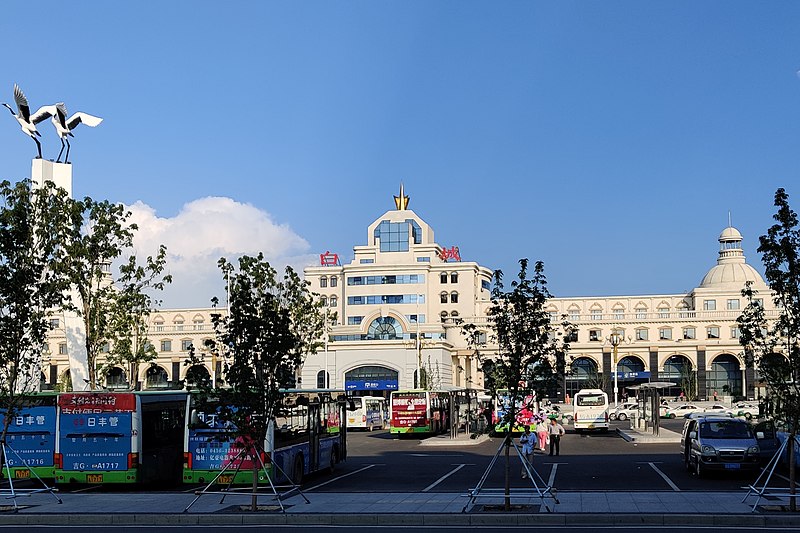
File:白城站171653.jpg · Wikimedia Commons · See Wikimedia Commons
Baicheng
Sign in to saveBaicheng () is a prefecture-level city in the northwestern part of Jilin province, China, bordering Inner Mongolia to the north and west and Heilongjiang to the east and northeast. At the 2010 census, 2,033,058 people lived within its administrative area of .
Key facts
- Settlement.name
- Baicheng
- Settlement.native_name
- 白城市
- Settlement.native_name_lang
- zh
- Settlement.settlement_type
- Prefecture-level city
- Settlement.image_skyline
- 白城站171653.jpg
- Settlement.image_caption
- Baicheng Railway Station
- Settlement.image_map
- Location of Baicheng Prefecture within Jilin (China).png
- Settlement.map_caption
- Location of Baicheng City (yellow) in Jilin (light grey)
- Settlement.subdivision_type
- Country
- Settlement.subdivision_name
- People's Republic of China
- Settlement.subdivision_type1
- Province
- Settlement.subdivision_name1
- Jilin
- Settlement.parts_type
- County-level divisions
- Settlement.parts_style
- para
- Settlement.p1
- 5
- Settlement.seat_type
- City seat
- Settlement.seat
- Taobei District
- Settlement.government_type
- Prefecture-level city
via Wikipedia infobox
Wikidata facts
- Instance of
- prefecture-level city
- Official name
- 白城市
- Country
- China
- Located in
- Jilin
- Contains
- Da'an
- Population
- 1551378
- Area
- 25758.73
- Elevation
- 154
- Time zone
- UTC+08:00
- Official website
- www.bc.jl.gov.cn
- Image
- 海明路步行街170157.jpg
- Dialing code
- 0436
- Licence plate code
- 吉G
Show 4 more facts
- topic's main category
- Category:Baicheng
- postal code
- 137000
- Commons category
- Baicheng
- category of associated people
- Category:People from Baicheng
Sources (2)
via Wikidata · CC0
~11 min read
Encyclopedic overview
16 sectionsContents
- Toponymy
- History
- Geography
- Climate
- Administrative divisions
- Demographics
- Economy
- Transportation
- Railway
- Road
- Air
- Culture
- Healthcare
- Sister cities
- References
- External links
Baicheng () is a prefecture-level city in the northwestern part of Jilin province, China, bordering Inner Mongolia to the north and west and Heilongjiang to the east and northeast. At the 2010 census, 2,033,058 people lived within its administrative area of .
== Toponymy == By 1938 the area was renamed to Baicheng, which in Chinese means white town. The name's origin is the Mongolian name of the city Chaghanhot, which also means "white town".
Excerpted from Wikipedia’s “Baicheng” article, available under the CC BY-SA 4.0 licence.
Gallery (12)
On the map
3 mapped locations