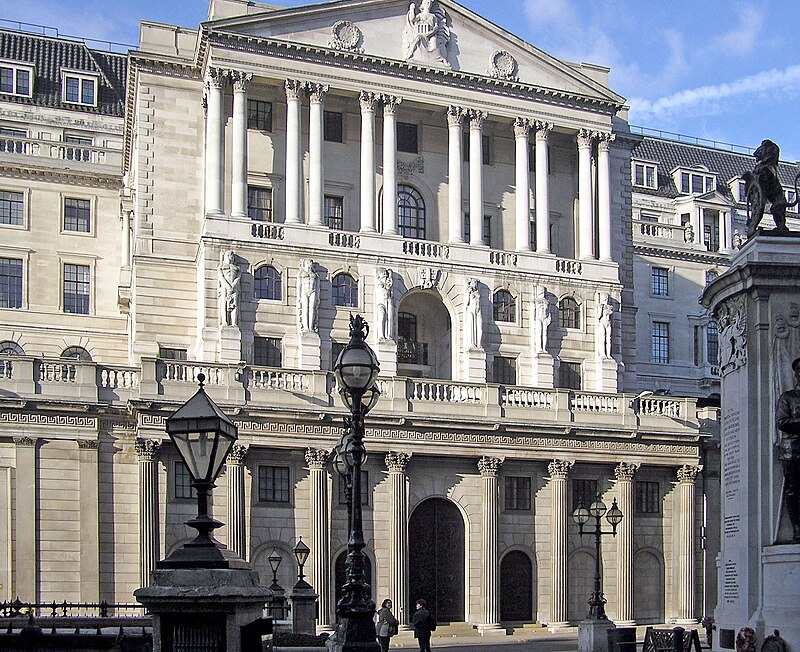
File:London.bankofengland.arp.jpg · Wikimedia Commons · See Wikimedia Commons
bank
Sign in to saveAlso known as financial institution
A bank is a financial institution that accepts deposits from the public and creates a demand deposit while making loans. Lending activities can be directly performed by the bank or indirectly through capital markets.
A bank is a financial institution where people and businesses can deposit their money and where the bank uses that money to make loans to borrowers. Banks matter because they connect people who have money to save with those who need to borrow, either by lending directly themselves or by working through investment markets.
AI-generated from the Wikipedia summary — may contain errors.
Wikidata facts
- Subclass of
- financial institution
- Named after
- bench
- Industry
- bank operations
- Image
- National Bank of Liechtenstein.JPG
- Has use
- financial services
Show 12 more facts
- OpenStreetMap tag
- amenity=bank
- Unicode character
- 🏦
- topic's main category
- Category:Banks
- Commons category
- Banks
- Stack Exchange tag
- stackoverflow.com/tags/banking
- Commons gallery
- Bank
- topic has template
- Template:Infobox bank
- on focus list of Wikimedia project
- Wikipedia:Vital articles/Level/4
- uses
- bank branch
- related category
- Category:Banks by name
- P8168
- Elaeis guineensis
- equivalent class
- dbpedia.org/ontology/Bank
via Wikidata · CC0
~46 min read
Encyclopedic overview
38 sectionsContents
- Activities
- Standard business
- Range of activities
- Channels
- Business models
- Products
- Retail
- Business (or commercial/investment) banking
- History
- Medieval
- Early modern
- Modern
- Etymology
- Definition
- Capital and risk
- Banks in the economy
- Economic functions
- Bank crisis
- Size of global banking industry
- Mergers and acquisitions
- Regulation
- Different types of banking
- Types of banks
- Types of investment banks
- Combination banks
- Other types of banks
- Challenges within the banking industry
- United States
- Loan activities of banks
- Investment for the fossil fuel industry
- Types of accounts
- Brokered deposits
- Custodial accounts
- Globalization
- See also
- References
- Further reading
- External links
A bank is a financial institution that accepts deposits from the public and creates a demand deposit while making loans. Lending activities can be directly performed by the bank or indirectly through capital markets.
Banks play an important role in financial stability and the economy of a country, so most countries exercise a high degree of regulation over banks. Most countries have institutionalized a system known as fractional-reserve banking, under which banks hold liquid assets equal to only a portion of their current liabilities. In addition to other regulations intended to ensure liquidity, banks are generally subject to minimum capital requirements based on an international set of capital standards, the Basel Accords.
Excerpted from Wikipedia’s “bank” article, available under the CC BY-SA 4.0 licence.
Gallery (32)
Available in 144 languages
- Español
- Français
- Deutsch
- 中文
- 日本語
- Русский
- Português
- Italiano
- العربية
- हिन्दी
- Afrikaans
- Akan
- Akan
- Albanian
- Amharic
- Aramaic
- Armenian
- Assamese
Show 125 more
- Asturian
- azb
- Azerbaijani
- Bahasa Indonesia
- Bangla
- Bashkir
- Basque
- bat_smg
- be_x_old
- Belarusian
- Betawi
- Bosnian
- Bulgarian
- Buriat
- Burmese
- Catalan
- cdo
- Central Kurdish
- Chuvash
- Croatian
- Czech
- Danish
- Egyptian Arabic
- Esperanto
- Estonian
- Fijian
- Filipino
- Finnish
- Galician
- Georgian
- Goan Konkani
- Gorontalo
- Greek
- Guarani
- Gujarati
- Haitian Creole
- Hakka Chinese
- Hausa
- Hawaiian
- Hebrew
- Hungarian
- Iban
- Icelandic
- Ido
- Igbo
- Interlingua
- Irish
- Javanese
- Kannada
- Kara-Kalpak
- Kashmiri
- Kazakh
- kbp
- Kurdish
- Kyrgyz
- Latin
- Latvian
- Lithuanian
- Lombard
- Luxembourgish
- Macedonian
- Maithili
- Malagasy
- Malay
- Malayalam
- Marathi
- Minangkabau
- Mongolian
- Nederlands
- Nepali
- Newari
- Norwegian
- Norwegian Nynorsk
- nrm
- Occitan
- Odia
- Oromo
- Palatine German
- Pashto
- Polski
- Punjabi
- Quechua
- Romanian
- Romansh
- Scots
- Scottish Gaelic
- Serbian
- Serbian (Latin)
- Sicilian
- simple
- Sindhi
- Sinhala
- Slovak
- Slovenian
- Somali
- Sundanese
- Svenska
- Swahili
- szy
- Tajik
- Tamil
- Tatar
- Telugu
- Tiếng Việt
- Tongan
- Türkçe
- Tyap
- Ukrainian
- Urdu
- Uzbek
- Walloon
- Waray
- Welsh
- Western Frisian
- Western Panjabi
- Wu Chinese
- Yakut
- Yiddish
- Zaza
- zh_min_nan
- zh_yue
- Zhuang
- فارسی
- ไทย
- 한국어
via Wikidata sitelinks · CC0