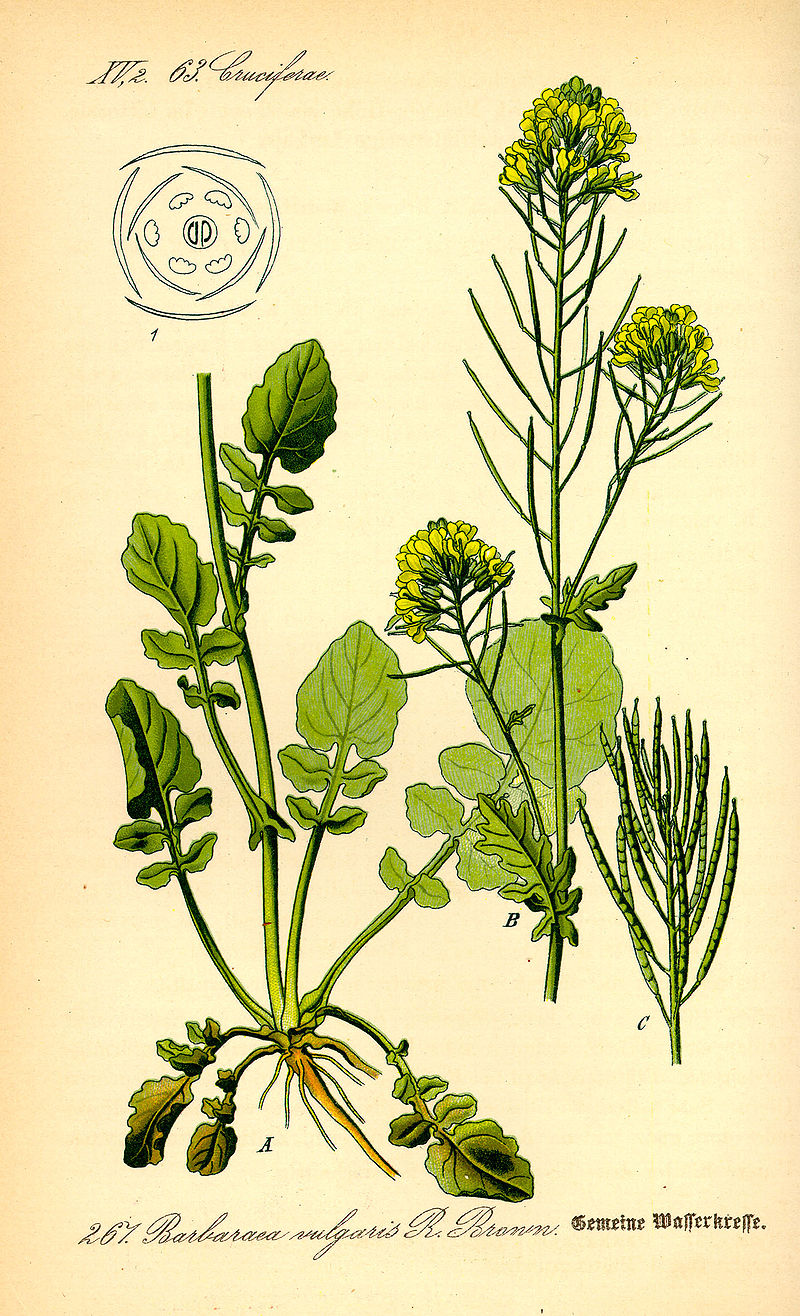
File:Illustration_Barbaraea_vulgaris0.jpg · Wikimedia Commons · See Wikimedia Commons
OverviewAI-generated
Barbarea is a genus of plants in the family Brassicaceae. It is classified within the order Brassicales, the class Magnoliopsida, and the phylum Tracheophyta. The genus was described by W.T. Aiton and is currently accepted in taxonomic records.
Occurrences of this genus have been documented in the United States, China, Georgia, and India. These records are held by institutions including NY, DAV, A, and GH. The taxon has an occurrence count of 388,050 and is associated with 117 PubMed entries.
Synthesized by Vinony from 29 facts across 8 sources: Wikidata, GBIF, PubMed, Gbif Occ, Plants of the World, WoRMS, iDigBio, Vinony graph. Generated from structured data (not the Wikipedia text) and checked against those facts — may still contain errors.
In the Vinony graph
Within Vinony's link graph, ترتیزک جویباری is referenced by 32 other articles, and connects out to Europe, Asia and plant.
Vinony files it under Barbarea, Brassicaceae genera and Leaf vegetables.
Its subject is documented across 37 Wikipedia language editions.
Species
GENUS
- KingdomPlantae
- PhylumTracheophyta
- ClassMagnoliopsida
- OrderBrassicales
- FamilyBrassicaceae
Die Pflanzengattung Barbarakräuter (Barbarea), auch Winterkressen genannt, gehört zur Familie der Kreuzblütengewächse (Brassicaceae). Inhaltsverzeichnis 1 Beschreibung 1.1 Vegetative Merkmale 1.2 Generative Merkmale 2 Systematik und Verbreitung 3 Illustrationen 4 Quellen 4.1 Einzelnachweise 4.2 Weblinks Beschreibung Vegetative Merkmale Die Barbarea-Arten wachsen selten als einjährige, meist als zweijährige oder ausdauernde, krautige Pflanzen. Die ausdauernden Arten bilden oft Rhizome als Überdauerungsorgane. Die Pflanzenteile sind nicht oder spärlich flaumig mit einfachen Trichomen (Pflanzenhaaren) bedeckt. Die aufrechten bis manchmal liegenden Stängel sind oft kantig und verzweigt. Die sowohl in grundständigen Rosetten als auch am Stängel verteilt angeordneten (Phyllotaxis) Laubblätter sind gestielt oder sitzend mit glatten, gekerbten, gelappten, selten gezähnten oder gewellten Blatträndern. Die grundständigen Blätter sind meist leierförmig bis fiederteilig, selten einfach. Die Stängelblätter sind gestielt oder sitzend, manchmal mit Öhrchen oder stängelumfassend, leierförmig bis fiederteilig oder einfach mit gezähnten, gelappten oder glatten Blatträndern. Blütenstand des Echten Ba
via GBIF · Kew POWO
Museum specimens
- Specimen records
- 507
- With media
- 450
- Family
- Brassicaceae
- Collections
- NY, DAV, A, GH
- Recorded in
- United States, China, Georgia, India
Research
117 papers- Hybridization and complex evolution of Barbarea vulgaris and related species (Brassicaceae).Molecular phylogenetics and evolution · 2022
- Phytoalexins of the crucifer Barbarea vulgaris: Structural profile and correlation with glucosinolate turnover.Phytochemistry · 2023
- Reciprocal mutations of two multifunctional β-amyrin synthases from Barbarea vulgaris shift α/β-amyrin ratios.Plant physiology · 2022
- Barbarea verna as a source of 2-phenylethyl glucosinolate, precursor of cancer chemopreventive phenylethyl isothiocyanate.Fitoterapia · 2001
- Evaluation of biological activities of Barbarea integrifolia and isolation of a new glucosinolate derivated compound.Zeitschrift fur Naturforschung. C, Journal of biosciences · 2021
via PubMed
Wikidata facts
- Instance of
- taxon
- Parent taxon
- Cardamineae
- Named after
- Saint Barbara
- Image
- Illustration Barbaraea vulgaris0.jpg
Show 7 more facts
- taxon common name
- barbica
- Commons category
- Barbarea
- taxon rank
- genus
- taxon name
- Barbarea
- topic's main category
- Category:Barbarea
- taxonomic type
- Barbarea vulgaris
Sources (2)
via Wikidata · CC0
Gallery (4)
Available in 37 languages
- Español
- Français
- Deutsch
- 中文
- Русский
- Português
- Italiano
- العربية
- Azerbaijani
- Bahasa Indonesia
- Belarusian
- Catalan
- Cebuano
- Chuvash
- Croatian
- Czech
- Danish
- Egyptian Arabic
Show 18 more
via Wikidata sitelinks · CC0