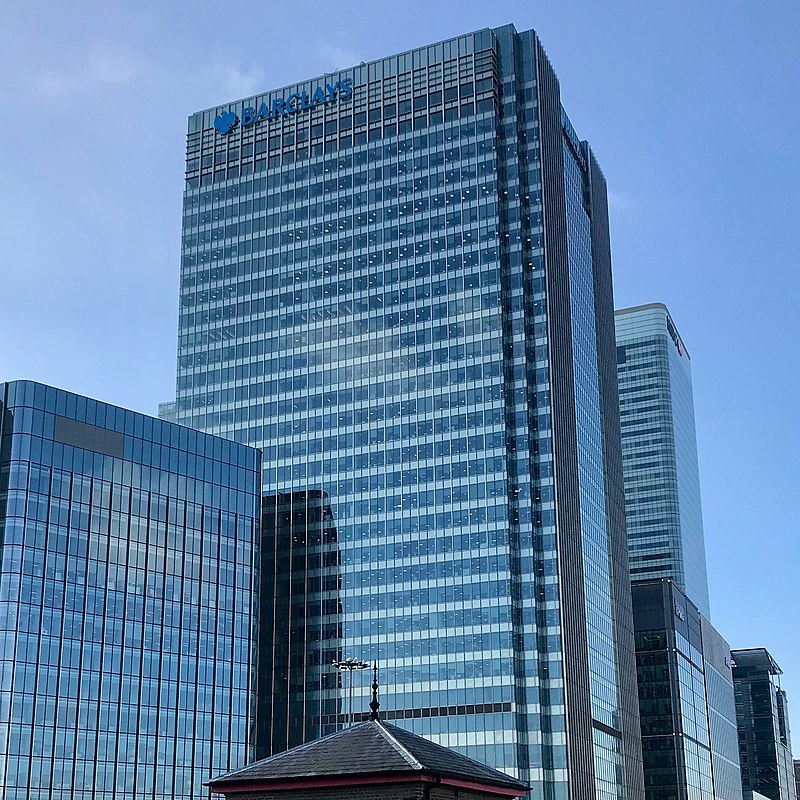
File:Barclays_Tower.jpg · Wikimedia Commons · See Wikimedia Commons
Barclays
Sign in to saveAlso known as Barclays PLC, Barclays (United Kingdom), Barclays Bank
Barclays PLC (, occasionally ) is a British multinational universal bank, headquartered in London, England. Barclays operates as five divisions: the UK Consumer Bank, UK Corporate Bank, Private Bank and Wealth Management (PBWM), Investment Bank, and the US Consumer Bank.
OverviewAI-generated
Barclays is a company and funder based in London, United Kingdom. The organization was established in 1690 and currently maintains an active status. It employs 79,900 people and has 304,440 social media followers.
The entity is associated with the IPv4 routing prefixes 141.228.0.0/16, 157.83.0.0/16, and 167.203.0.0/16. Its official websites are home.barclays and barclays.co.uk, while service status information is available at status.uk.barclays. Barclays is referenced by 2,745 other encyclopedia articles.
Synthesized by Vinony from 21 facts across 4 sources: Wikidata, Firecrawl, ROR, Vinony graph. Generated from structured data (not the Wikipedia text) and checked against those facts — may still contain errors.
Key facts
- Company.logo_size
- 250px
- Company.name
- Barclays PLC
- Company.logo
- Barclays logo.svg
- Company.logo_caption
- Barclays' current logo, used since 2004
- Company.image
- Barclays Tower.jpg
- Company.image_size
- x250px
- Company.image_caption
- Headquarters at One Churchill Place in Canary Wharf, London
- Company.former_name
- Barclays Bank PLC (18961985)
- Company.type
- Public
- Company.industry
- Financial services
- Company.foundation
- in the City of London, Kingdom of England
- Company.location
- One Churchill Place, Canary Wharf
- Company.location_city
- London
- Company.location_country
- England
- Company.area_served
- Worldwide
- Company.revenue
- £29.140 billion (2025)
- Company.operating_income
- £9.139 billion (2025)
- Company.net_income
- £7.213 billion (2025)
via Wikipedia infobox
Research organization · ROR
- Type
- Company, Funder
- Founded
- 1690
- Location
- London, United Kingdom
- Status
- Active
GRID grid.432391.e
Described at

History of Barclays plc – FundingUniverse
Explore the history, profile and timeline of Barclays plc.
fundinguniverse.com →We aspire to be one of the most admired financial services organisations in the world, recognised as an innovative, customer-focused company that delivers superb products and services, ensures excellent careers for our people and contributes positively to the communities in which we live and work. With a rich history dating back almost 300 years, Barclays plc has grown into one of the largest financial services groups in the United Kingdom. The company is involved in banking, investment banking, and investment management and operates 2,000 domestic branches and nearly 850 international branches in over 60 countries across the globe. Barclays is organized into seven business units: Barclays Africa; Barclaycard; Barclays Capital; Barclays Global Investors; Barclays Private Clients; and UK Banking. The company has over 4.5 million registered online bankers and over 10.6 million Barclaycard customers in the United Kingdom. In 2003, Barclays was the world's ninth-largest bank based on market capitalization. Barclays takes it symbol, the spread eagle, from the Quaker goldsmithing and banking firm founded by John Freame in 1728. In 1736, James Barclay, Freame's brother-in-law, became a partner in the Black Spread Eagle. When two more of Barclay's relatives joined the firm--Silvanus Bevan in 1767 and John Henton Tritton in 1782--the banking firm took the name by which it would be known for more than a century: Barclays, Bevan & Tritton. While fledgling joint-stock banks outside London struggled to establish themselves in the late 18th and early 19th centuries, Barclays, Bevan & Tritton was still occupied with the well-established and highly lucrative commercial life of London. A series of legislative changes enacted in the late 19th century created a new banking climate that threatened the existence of private banks such as Barclays. First, the Bank Charter Act of 1826 allowed banks with more than six partners to be formed only outside London. In 1833, the geographical restriction was removed. Stockholders of new joint-stock companies were granted limited liability for the first time in 1854. Finally, in 1879, existing joint-stock associations were allowed to convert to a limited-liability structure. As a result of these legislative changes, provincial limited-liability joint-stock companies started picking off private banks. After lengthy negotiations, three of the largest Quaker-run banking firms--Barclays (which had become Barclays, Tritton, Ransom, Bouverie & Company after a merger in 1888), Jonathan Backhouse & Company, and Gurneys, Birkbeck, Barclay & Buxton, along with 17 smaller Quaker-run banks, agreed to merge and form a bank large enough to resist takeover attempts. Barclays took its modern form in 1896 when the 20 private banks merged to form Barclay and Company, Ltd., a joint-stock association with deposits totaling an impressive £26 million. This marked the beginning of Barclays' tradition of service to farmers and fishermen. Francis Augustus Bevan, grandson of Silvanus Bevan, served as the new bank's first chairman for 20 years. The company's structure and course, however, were directed for its initial 40 years by Frederick Crauford Goodenough, as first secretary, until 1917, and then as chairman after Bevan's retirement until his own death in 1934. Goodenough was the only chairman recruited from outside the original founding families until 1987. Recruited from the Union Bank of London, Goodenough remained aloof from family controversies and quickly proved his merit. Goodenough's first task was to meld the constituent banks into a single enterprise. He took a decentralized approach that was to be Barclays' hallmark for most of the 20th century. Each member bank was independently operated under the control of its own board of directors. Senior partners of the constituent banks were given a seat on the Barclays board. In this way, longstanding relationships between each member bank and its customers were maintained,
Excerpt from a page describing this subject · 27,698 chars · not written by Vinony
Wikidata facts
- Instance of
- public company
- Country
- United Kingdom
- Headquarters
- London
- Employees
- 79900
- Stock exchange
- Tokyo Stock Exchange
- Official website
- www.barclays.co.uk
- Image
- Barclays HQ.jpg
Show 12 more facts
- Commons category
- Barclays
- topic's main category
- Category:Barclays
- location of formation
- Lombard Street
- IPv4 routing prefix
- 167.203.0.0/16
- owner of
- Barclays Investment Bank
- product or material produced
- commercial bank
- described at URL
- www.fundinguniverse.com/company-histories/barclays-plc-history
- social media followers
- 304440
- inception
- 1690-00-00
- native label
- Barclays
- P12749
- Scabiosa columbaria
- service status information URL
- status.uk.barclays
Sources (15)
via Wikidata · CC0
~45 min read
Encyclopedic overview
27 sectionsContents
- Name
- History
- 1690 to 1900
- 1900 to 1945
- 1946 to 1980
- 1980 to 2000
- 2000 to 2010
- "Double Dip" tax scams
- Lehman Brothers acquisition
- Qatar capital raising
- Rate-fixing scandal
- 2010 to 2020
- 2020 to present
- Environmental criticism
- Operations
- Principal divisions and subsidiaries
- Branches and ATMs
- Senior management
- List of former group chairmen
- List of former group chief executives
- Sponsorships
- Coat of Arms
- See also
- Notes
- References
- Further reading
- External links
Barclays PLC (, occasionally ) is a British multinational universal bank, headquartered in London, England. Barclays operates as five divisions: the UK Consumer Bank, UK Corporate Bank, Private Bank and Wealth Management (PBWM), Investment Bank, and the US Consumer Bank.
Barclays traces its origins to the goldsmith banking business established in the City of London in 1690 by Quakers John Freame and Thomas Gould. James Barclay became a partner in the business in 1736. In 1896, twelve banks in London and the English provinces, including Goslings Bank, Backhouse's Bank and Gurney, Peckover and Company, united as a joint-stock bank under the name Barclays and Co. Over the following decades, Barclays expanded to become a nationwide bank. In 1967, Barclays deployed the world's first cash dispenser. Barclays has made numerous corporate acquisitions, including of London, Provincial and South Western Bank in 1918, British Linen Bank in 1919, Mercantile Credit in 1975, the Woolwich in 2000 and the North American operations of Lehman Brothers in 2008.
Excerpted from Wikipedia’s “Barclays” article, available under the CC BY-SA 4.0 licence.