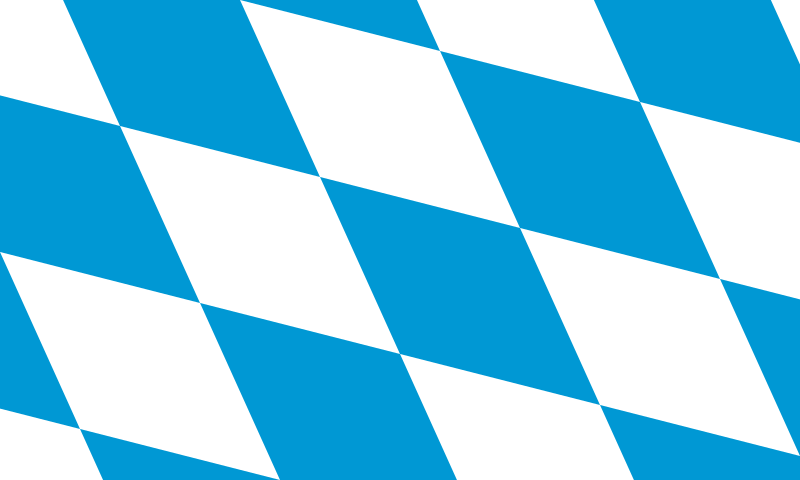
File:Flag_of_Bavaria_(lozengy).svg · Wikimedia Commons · See Wikimedia Commons
Bavaria
Sign in to saveAlso known as Free State of Bavaria, Bayern, Freistaat Bayern, Freistoot Bayern, State of Bavaria
Bavaria, officially the Free State of Bavaria, is a landlocked state of Germany, bordering the states of Baden-Württemberg, Hesse, Thuringia and Saxony, as well as the countries of Austria and the Czech Republic. Its capital and largest city is Munich and other major cities include Nuremberg and Augsburg. With an area of 70,550 square kilometres (27,249 sq mi), it is the largest German state, and with 13.08 million inhabitants, it is the second most populous.
Bavaria is the largest state in Germany by area and the second most populous, located in the southeastern part of the country with its capital in Munich. It borders several German states as well as Austria and the Czech Republic, making it an important region in central Europe.
AI-generated from the Wikipedia summary — may contain errors.
Key facts
- Settlement.official_name
- Free State of Bavaria
- Settlement.settlement_type
- State
- Settlement.imagesize
- 270px
- Settlement.image_map
- File:Locator map Bavaria in Germany.svg
- Settlement.map_caption
- Location of Bavaria in Germany
- Settlement.image_flag
- 120px|border|Flag of Free State of Bavaria120px|border|Flag of Free State of Bavaria
- Settlement.flag_size
- 120px
- Settlement.image_shield
- Coat of arms of Bavaria.svg
- Settlement.shield_size
- 110
- Settlement.anthem
- File:Für Bayern (Bayernhymne).ogg
- Settlement.mapframe
- yes
- Settlement.mapframe zoom
- 5
- Settlement.mapframe point
- none
- Settlement.mapsize
- 155px
- Settlement.subdivision_type
- Country
- Settlement.subdivision_name
- Germany
- Settlement.seat_type
- Capital(and largest city)
- Settlement.seat
- Munich
via Wikipedia infobox
Wikidata facts
- Official name
- Freistoot Boarn
- Demonym
- بَوَارِيَّةٌ
- Population
- 13038724
- Area
- 70551
- Elevation
- 503
- Official website
- bayernportal.de
- Unemployment rate
- 3.0
Show 22 more facts
- Commons category
- Bavaria
- inception
- 1919-01-12
- IPA transcription
- ˈbaɪ̯ɐn
- Commons gallery
- Bayern
- water as percent of area
- 2.0
- native label
- Freistaat Bayern
- short name
- Beieren
- compulsory education (minimum age)
- 6
- compulsory education (maximum age)
- 18
- P6482
- Bavaria
- P8168
- Zaharija of Serbia
- P11012
- Primorsky Krai
- social media followers
- 26300
- privacy policy URL
- www.bayern.de/datenschutz
- impressum URL
- www.bayern.de/impressum
- contact page URL
- www.bayern.de/buergerservice/kontakt
- email address
- mailto:[email protected]
- phone number
- +49-89-21650
- terms of service URL
- www.bayern.de/impressum
- web feed URL
- www.bayern.de/rss/pm_alle.php
- budget
- 71424666800
- official jobs URL
- sei-dabay.de
Sources (12)
via Wikidata · CC0
~53 min read
Article
50 sectionsContents
- History
- Antiquity
- Middle Ages
- Electorate of Bavaria
- Kingdom of Bavaria
- Part of the German Empire
- Free State of Bavaria
- Bavarian identity
- Flags and coat of arms
- Flags
- Coat of arms
- Geography
- Climate
- Administrative divisions
- Administrative regions
- Bezirke
- Population and area
- Districts
- Municipalities
- Major cities and towns
- Politics
- Current Landtag <!-- Update "current" -->
- Government
- Minister-presidents of Bavaria since 1945
- Designation as a "free state"
- Arbitrary arrest and human rights
- Economy
- Demographics
- Total population
- Vital statistics
- Culture
- Religion
- Traditions
- Food and drink
- Language and dialects
- Ethnography
- Museums
- Transport
- Air
- Sports
- Football
- Basketball
- Ice hockey
- Notable people
- See also
- Notes
- References
- Citations
- General and cited sources
- External links
Bavaria, officially the Free State of Bavaria, is a landlocked state of Germany, bordering the states of Baden-Württemberg, Hesse, Thuringia and Saxony, as well as the countries of Austria and the Czech Republic. Its capital and largest city is Munich and other major cities include Nuremberg and Augsburg. With an area of 70,550 square kilometres (27,249 sq mi), it is the largest German state, and with 13.08 million inhabitants, it is the second most populous.
The history of Bavaria includes its earliest settlement by Iron Age Celtic tribes, followed by the conquests by the Roman Empire in the 1st century BC, when the territory was incorporated into the provinces of Raetia and Noricum. It became the Duchy of Bavaria (a stem duchy) in the 6th century AD following the collapse of the Western Roman Empire. It was later incorporated into the Holy Roman Empire, became the independent Kingdom of Bavaria after 1806, joined the Prussian-led German Empire in 1871 while retaining its title of kingdom, and finally became a state of the Federal Republic of Germany in 1949.
Gallery (632)
On the map
31 mapped locations
Available in 175 languages
- Español
- Français
- Deutsch
- 中文
- 日本語
- Русский
- Português
- Italiano
- العربية
- हिन्दी
- Afrikaans
- Albanian
- Albanian
- Amharic
- Aragonese
- Armenian
- Arpitan
- Asturian
Show 156 more
- Aymara
- azb
- Azerbaijani
- Bahasa Indonesia
- Balinese
- Bangla
- Bashkir
- Basque
- bat_smg
- Bavarian
- be_x_old
- Belarusian
- Bosnian
- Breton
- Bulgarian
- Buriat
- Burmese
- Catalan
- cbk_zam
- cdo
- Cebuano
- Central Kurdish
- Chechen
- Chuvash
- Colognian
- Cornish
- Crimean Tatar
- Croatian
- Czech
- dag
- Danish
- Egyptian Arabic
- eml
- Esperanto
- Estonian
- Extremaduran
- Filipino
- Finnish
- Friulian
- Galician
- Georgian
- Greek
- Guarani
- Hakka Chinese
- Hebrew
- Hungarian
- Icelandic
- Ido
- Iloko
- Ingush
- Interlingua
- Interlingue
- Irish
- Javanese
- Kara-Kalpak
- Kashubian
- Kazakh
- kge
- Kongo
- Kurdish
- Kyrgyz
- Latgalian
- Latin
- Latvian
- Ligurian
- Limburgish
- Lingua Franca Nova
- Lithuanian
- lld
- Lombard
- Low German
- Lower Sorbian
- Luxembourgish
- Macedonian
- Malagasy
- Malay
- Malayalam
- Maltese
- Manx
- Marathi
- Mazanderani
- Mingrelian
- Mongolian
- Moroccan Arabic
- nds_nl
- Nederlands
- Nepali
- Newari
- Northern Frisian
- Northern Sami
- Norwegian
- Norwegian Nynorsk
- Novial
- Occitan
- Old English
- Ossetic
- Palatine German
- Pampanga
- Papiamento
- Pashto
- Pennsylvania German
- Picard
- Piedmontese
- Polski
- Punjabi
- Quechua
- Romanian
- Romansh
- Rusyn
- Sardinian
- Saterland Frisian
- Scots
- Scottish Gaelic
- Serbian
- Serbian (Latin)
- Sicilian
- Silesian
- simple
- Sindhi
- Slovak
- Slovenian
- Sundanese
- Svenska
- Swahili
- Tajik
- Talysh
- Tamil
- Tatar
- Tetum
- Tiếng Việt
- Toki Pona
- Türkçe
- Turkmen
- Ukrainian
- Upper Sorbian
- Urdu
- Uzbek
- Venetian
- Volapük
- Waray
- Welsh
- West Flemish
- Western Frisian
- Western Panjabi
- Wu Chinese
- Yakut
- Yiddish
- Yoruba
- Zaza
- Zeelandic
- zh_classical
- zh_min_nan
- zh_yue
- فارسی
- ไทย
- 한국어
via Wikidata sitelinks · CC0