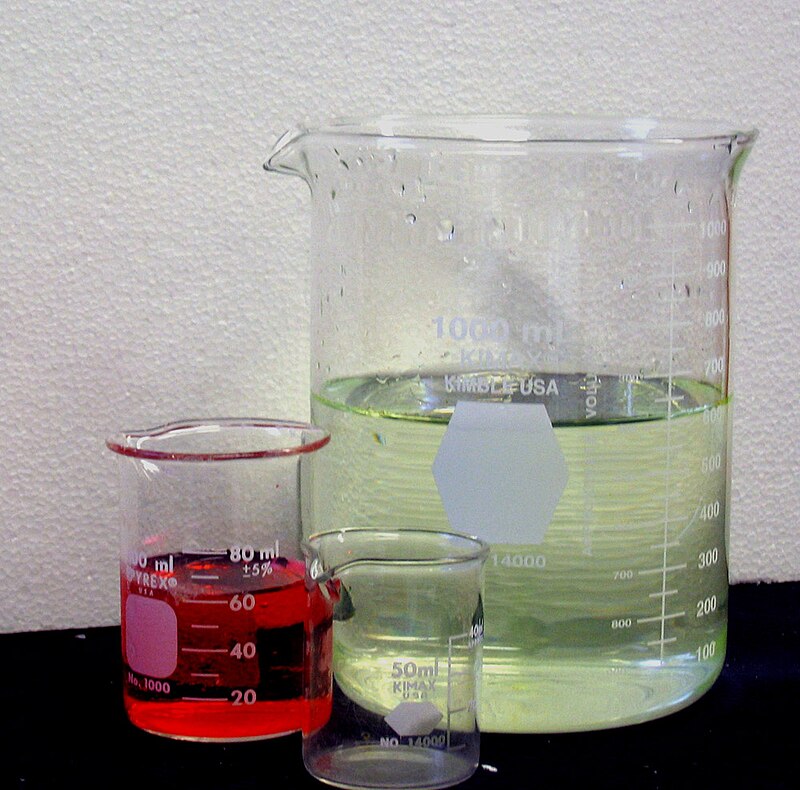
File:Beakers.jpg · Wikimedia Commons · See Wikimedia Commons
beaker
Sign in to saveAlso known as laboratory beaker, lab beaker, chemistry beaker
cylindrical, open-topped laboratory container
Key facts
- Uses
- Liquid volume containment, and measurement
- Related items
- Laboratory flask
via Wikipedia infobox
Wikidata facts
- Subclass of
- laboratory glassware
- Has part
- scale marking
- Material used
- borosilicate glass
- Image
- Beakers.jpg
Show 4 more facts
- Commons gallery
- Beaker
- exact match
- wordnet-rdf.princeton.edu/wn30/02815834-n
- Commons category
- Beakers (laboratory equipment)
- shape
- cylinder
via Wikidata · CC0
~3 min read
Encyclopedic overview
In laboratory equipment, a beaker is generally a cylindrical container with a flat bottom. Most also have a small spout (or "beak") to aid pouring, as shown in the picture. Beakers are available in a wide range of sizes, from one milliliter up to several liters. A beaker is distinguished from a flask by having straight rather than sloping sides. The exception to this definition is a slightly conical-sided beaker called a Philips beaker. The beaker shape in general drinkware is similar.
Beakers are commonly made of glass (today usually borosilicate glass), but can also be in metal (such as stainless steel or aluminum) or certain plastics (notably polythene, polypropylene, PTFE). A common use for polypropylene beakers is gamma spectral analysis of liquid and solid samples.
Excerpted from Wikipedia’s “beaker” article, available under the CC BY-SA 4.0 licence.