(c) explorationtechnology_deepsea, all rights reserved, uploaded by explorationtechnology_deepsea
Benthocodon
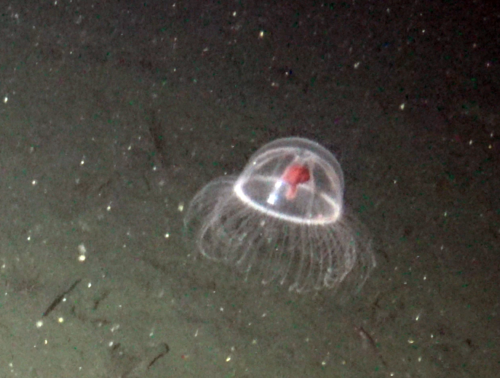
Sign in to saveBenthocodon is a genus of hydrozoans of the family Rhopalonematidae. The genus contains two known species: Benthocodon hyalinus and Benthocodon pedunculatus, however due to the small size and red pigmentation, they can easily be confused with related genera. Unlike many hydromedusae, these jellyfish do not have a sessile stage. Rather, they spend their entire lives in the water column as plankton. The genus Benthocodon can be found near the sea floor in the Pacific Ocean from Antarctica to California to the Arctic Ocean.
Species
GENUS
- KingdomAnimalia
- PhylumCnidaria
- ClassHydrozoa
- OrderTrachymedusae
- FamilyRhopalonematidae
via GBIF
Museum specimens
- Specimen records
- 9
- With media
- 18
- Family
- Rhopalonematidae
- Collections
- USNM, SIO
- Recorded in
- United States, Azores
Wikidata facts
- Instance of
- taxon
- Parent taxon
- Rhopalonematidae
- Image
- Benthocodon.jpg
Show 3 more facts
- taxon name
- Benthocodon
- taxon rank
- genus
- Commons category
- Benthocodon
Sources (1)
via Wikidata · CC0
~1 min read
Encyclopedic overview
1 sectionsContents
- References
Benthocodon is a genus of hydrozoans of the family Rhopalonematidae. The genus contains two known species: Benthocodon hyalinus and Benthocodon pedunculatus, however due to the small size and red pigmentation, they can easily be confused with related genera. Unlike many hydromedusae, these jellyfish do not have a sessile stage. Rather, they spend their entire lives in the water column as plankton. The genus Benthocodon can be found near the sea floor in the Pacific Ocean from Antarctica to California to the Arctic Ocean.
The benthocodon's predators are mainly larger fish. They primarily feeds off of crustaceous and foraminiferan forms. They live in the Pacific Ocean from California to Antarctica to the Arctic Ocean near the sea floor. They eat by paralyzing their prey using their red tentacles then they pull it in to consume. They also have a red inner membrane which helps when hunting due to it masking the bioluminescence of their prey so they can eat without attracting predators.
Excerpted from Wikipedia’s “Benthocodon” article, available under the CC BY-SA 4.0 licence.