(c) Ellura Sanctuary, some rights reserved (CC BY-NC), uploaded by Ellura Sanctuary · cc-by-nc
Bertya
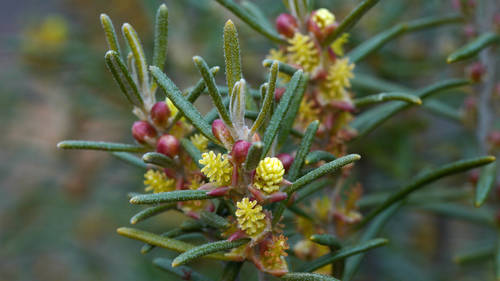
Sign in to saveBertya is a genus of flowering plants in the family Euphorbiaceae endemic to Australia. Plants in the genus Bertya are shrubs, usually monoecious, with simple leaves, flowers arranged singly in leaf axils, male flowers with many stamens, female flowers usually smaller and narrower than male flowers, and the fruit a capsule containing a single seed.
Species
fine haired bertya
GENUS
- KingdomPlantae
- PhylumTracheophyta
- ClassMagnoliopsida
- OrderMalpighiales
- FamilyEuphorbiaceae
via GBIF · Kew POWO
Museum specimens
- Specimen records
- 23
- With media
- 14
- Family
- Euphorbiaceae
- Collections
- MEL, INSTITUTO NACIONAL DE PESQUISAS DA AMAZÔNIA (INPA), NY, MO, VT, BG
- Recorded in
- Australia, Brasil
Wikidata facts
- Instance of
- taxon
- Image
- Bertya gummifera 8002290357 608ff1640f o.jpg
Show 5 more facts
- taxon name
- Bertya
- taxon rank
- genus
- topic's main category
- Category:Bertya
- Commons category
- Bertya
Sources (1)
via Wikidata · CC0
~2 min read
Encyclopedic overview
4 sectionsContents
- Description
- Taxonomy
- Species list
- References
Bertya is a genus of flowering plants in the family Euphorbiaceae endemic to Australia. Plants in the genus Bertya are shrubs, usually monoecious, with simple leaves, flowers arranged singly in leaf axils, male flowers with many stamens, female flowers usually smaller and narrower than male flowers, and the fruit a capsule containing a single seed.
==Description== Plants in the genus Bertya are usually monoecious, often sticky shrubs, either glabrous or covered with woolly, star-shaped hairs. The leaves are usually arranged alternately, simple, sessile or on a short petiole, flat or with the ends curved downwards, and lack stipules. The flowers are sessile or on a short pedicel, usually singly, or in umbel-like clusters on a peduncle in leaf axils. Male flowers usually have no petals, but many stamens with their bases fused, and no styles. Female flowers are small and narrower, have no petals, the ovary usually with three locules and three styles fused at the base. The fruit is a capsule, usually containing a single oval, elliptic or oblong seed with a creamy-white to yellowish caruncle.
Excerpted from Wikipedia’s “Bertya” article, available under the CC BY-SA 4.0 licence.