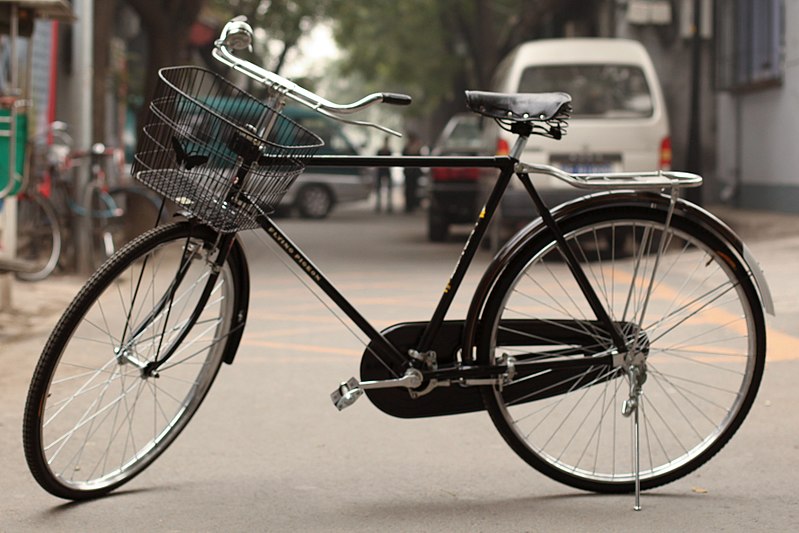
File:Left_side_of_Flying_Pigeon.jpg · Wikimedia Commons · See Wikimedia Commons
bicycle
Sign in to saveAlso known as bike, pushbike, pedal bike, pedal cycle, cycle, 🚲, Bicycles
thumb|Classic bell of a bicycle A bicycle, also called a pedal cycle, bike, push-bike or cycle, is a human-powered or motor-assisted, pedal-driven, single-track vehicle, with two wheels attached to a frame, one behind the other. A is called a cyclist, or bicyclist.
A bicycle is a vehicle with two wheels arranged one behind the other on a frame, powered by pedaling and sometimes assisted by a motor. Bicycles are valued as practical transportation and recreation tools that can be powered by human effort alone.
AI-generated from the Wikipedia summary — may contain errors.
Key facts
- Machine.free_text
- Utility bicycle, mountain bicycle, racing bicycle, touring bicycle, hybrid bicycle, cruiser bicycle, BMX bike, tandem, low rider, tall bike, fixed gear, folding bicycle, amphibious cycle, cargo bike, recumbent, electric bicycle
- Machine.name
- Bicycle
- Machine.image
- Left side of Flying Pigeon.jpg
- Machine.caption
- The most popular bicycle model—and most popular vehicle of any kind in the world—is the Chinese Flying Pigeon, with about 500 million produced.
- Machine.classification
- Vehicle
- Machine.application
- Transportation
- Machine.fuel_source
- Human or motor-power
- Machine.wheels
- 2
- Machine.components
- Frame, wheels, tires, saddle, handlebar, pedals, drivetrain
- Machine.invented
- 19th century
- Machine.inventor
- Karl von Drais, Kirkpatrick MacMillan
- Machine.free_label
- Types
via Wikipedia infobox
Wikidata facts
- Subclass of
- sports equipment
- Has part
- bicycle suspension
- Material used
- fiberglass
- Image
- .00 3321 Petersen-Fahrrad.jpg
- Has use
- freestyle BMX
Show 19 more facts
- Unicode character
- 🚲
- topic's main category
- Category:Bicycles
- Commons gallery
- Bicycle
- MCN code
- 8712.00.10
- Commons category
- Bicycles
- designed to carry
- cyclist
- hashtag
- koło
- on focus list of Wikimedia project
- Wikipedia:Vital articles/Level/4
- time of discovery or invention
- 1885-00-00
- Stack Exchange site URL
- bicycles.stackexchange.com
- history of topic
- history of the bicycle
- used by
- bicycle infantry
- related category
- Category:Songs about bicycles
- different from
- pedelec
- discoverer or inventor
- Kirkpatrick Macmillan
- physically interacts with
- road
- has effect
- travel
- carbon footprint
- 21
Sources (11)
via Wikidata · CC0
~50 min read
Encyclopedic overview
37 sectionsContents
- Etymology
- History
- Uses
- Technical aspects
- Types
- Dynamics
- Performance
- Parts
- Frame
- Drivetrain and gearing
- Steering
- Seating
- Brakes
- Suspension
- Wheels and tires
- Accessories
- Standards
- Maintenance and repair
- Maintenance
- Repair
- Tools
- Social and historical aspects
- In daily life
- Poverty alleviation
- Female emancipation
- Economic implications
- Environmental impact
- Manufacturing
- Legal requirements
- Theft
- See also
- Notes
- References
- Citations
- Sources
- Further reading
- External links
thumb|Classic bell of a bicycle A bicycle, also called a pedal cycle, bike, push-bike or cycle, is a human-powered or motor-assisted, pedal-driven, single-track vehicle, with two wheels attached to a frame, one behind the other. A is called a cyclist, or bicyclist.
The bicycle was introduced in the 19th century in Europe. By the early 21st century, there were more than 1 billion bicycles. Bicycles are the principal means of transport in many regions. They also provide a popular form of recreation, and have been adapted for use as children's toys. Bicycles are used for fitness, military and police applications, courier services, bicycle racing, and artistic cycling.
Excerpted from Wikipedia’s “bicycle” article, available under the CC BY-SA 4.0 licence.
Gallery (632)
Available in 185 languages
- Español
- Français
- Deutsch
- 中文
- 日本語
- Русский
- Português
- Italiano
- العربية
- हिन्दी
- Adyghe
- Afrikaans
- Albanian
- Albanian
- Amharic
- Angika
- Aragonese
- Armenian
Show 166 more
- Assamese
- Asturian
- azb
- Azerbaijani
- Bahasa Indonesia
- Bangla
- Banjar
- Bashkir
- Basque
- bat_smg
- Bavarian
- be_x_old
- Belarusian
- Betawi
- Bhojpuri
- Bikol
- Bosnian
- Breton
- Buginese
- Bulgarian
- Buriat
- Burmese
- Catalan
- Central Kurdish
- Chechen
- Cheyenne
- Chuvash
- Cornish
- Croatian
- Czech
- dag
- Danish
- Egyptian Arabic
- Esperanto
- Estonian
- Fiji Hindi
- Fijian
- Filipino
- Finnish
- fiu_vro
- Fon
- Galician
- gcr
- Georgian
- Gorontalo
- Greek
- Guarani
- Hausa
- Hebrew
- Hungarian
- hyw
- Iban
- Icelandic
- Ido
- Iloko
- Interlingua
- Interlingue
- Irish
- Jamaican Creole English
- Javanese
- Kannada
- Kara-Kalpak
- Kashmiri
- Kashubian
- Kazakh
- kbp
- kge
- Kikuyu
- Kinyarwanda
- Kongo
- Kurdish
- Kyrgyz
- Ladino
- Latin
- Latvian
- Ligurian
- Limburgish
- Lingala
- Lingua Franca Nova
- Lithuanian
- lld
- Lojban
- Lombard
- Low German
- Luxembourgish
- Macedonian
- Malagasy
- Malay
- Malayalam
- Maltese
- Marathi
- Minangkabau
- Mirandese
- Mongolian
- nds_nl
- Nederlands
- Nepali
- Newari
- Nias
- Northern Frisian
- Norwegian
- Norwegian Nynorsk
- nrm
- Occitan
- Odia
- olo
- Oromo
- Pangasinan
- Papiamento
- Pennsylvania German
- Piedmontese
- Polski
- Punjabi
- Quechua
- Romanian
- Romansh
- rsk
- Rusyn
- Sanskrit
- Santali
- Scots
- Scottish Gaelic
- Serbian
- Serbian (Latin)
- Shona
- Sicilian
- Silesian
- simple
- Sindhi
- Sinhala
- Slovak
- Slovenian
- Somali
- Sundanese
- Svenska
- Swahili
- szy
- Tamil
- Tatar
- Telugu
- Tiếng Việt
- Toki Pona
- Türkçe
- Turkmen
- Tyap
- Ukrainian
- Upper Sorbian
- Urdu
- Uyghur
- Uzbek
- Venetian
- Veps
- Walloon
- Waray
- Wayuu
- Welsh
- West Flemish
- Western Frisian
- Western Panjabi
- Yakut
- Yiddish
- zh_yue
- Zhuang
- فارسی
- ไทย
- 한국어
via Wikidata sitelinks · CC0